Apache Airflow End of Life (EOL) Dates and End of Support (EOS) Dates
Apache Airflow end of life (EOL) and end of support (EOS) dates: 9 Apache Airflow versions have reached EOL, including Apache Airflow 3.3 (EOL date: Nov 07, 2026) — no longer receiving security updates or patches. Apache Airflow 3.4.0 is the current supported release — 2 versions in active support. Also see Apache Tomcat end of life dates for related end-of-life information.
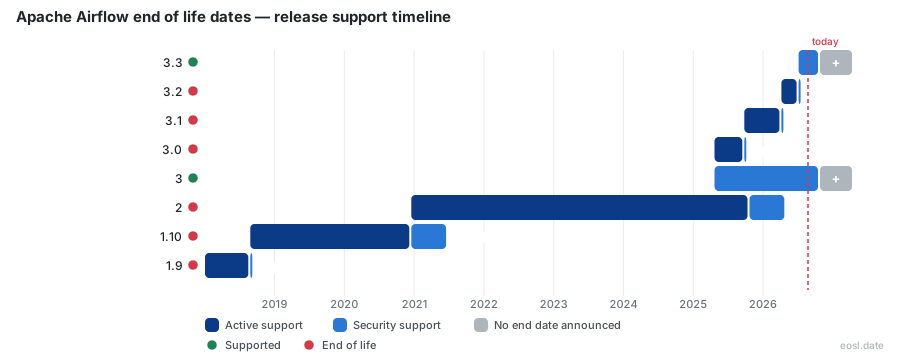
Currently Supported Apache Airflow Releases - Active EOS/EOSL Support (2)
Apache Airflow End of Life (EOL) Releases - No Longer Supported (9)
| Release | Released | Limited Support | Active Support | Latest |
|---|---|---|---|---|
| 3.3 | (4 months ago) | (2 weeks ago) | (2 weeks ago) | 3.3.2 (2 months ago) |
| 3.2 | (7 months ago) | (4 months ago) | (4 months ago) | 3.2.2 (5 months ago) |
| 3.1 | (1 year and 1 month ago) | (7 months ago) | (7 months ago) | 3.1.8 (8 months ago) |
| 3.0 | (1 year and 6 months ago) | (1 year and 1 month ago) | (1 year and 1 month ago) | 3.0.6 (1 year and 2 months ago) |
| 2 | (5 years and 11 months ago) | (6 months ago) | (1 year ago) | 2.11.2 (8 months ago) |
| 1.10 | (8 years and 2 months ago) | (5 years and 5 months ago) | (5 years and 11 months ago) | 1.10.15 (5 years and 8 months ago) |
| 1.9 | (8 years and 10 months ago) | (8 years and 2 months ago) | (8 years and 2 months ago) | 1.9.0 (8 years and 10 months ago) |
| 1.8 | (9 years and 6 months ago) | (8 years and 10 months ago) | (8 years and 10 months ago) | 1.8.2 (9 years and 2 months ago) |
| 1.7 | (10 years and 7 months ago) | (9 years and 8 months ago) | (9 years and 8 months ago) | 1.7.1.2 (9 years and 6 months ago) |
If your team still runs Airflow 2, the Apache Airflow end of life date has already passed: open-source Airflow 2 reached end of life on April 22, 2026. This guide covers the support timeline, the danger of running an unsupported version, and the route to Airflow 3, so your data engineers can plan a migration against a hard deadline.
Apache Airflow End of Life Dates and Version Life Cycle
Apache publishes a version life cycle for every release line. Each line moves from active support to limited maintenance and finally to EOL, when no fixes of any kind remain. Here is where each line stands today:
| Version | Latest release | State | Limited support began | EOL date |
|---|---|---|---|---|
| 3 | 3.3.2 | Supported | TBD | TBD |
| 2 | 2.11.2 | EOL | Oct 22, 2025 | Apr 22, 2026 |
| 1.10 | 1.10.15 | EOL | Dec 17, 2020 | Jun 17, 2021 |
Active Support and Limited Maintenance Phases
Airflow 2 spent almost five years in full support after its December 17, 2020 release. Limited support then began on October 22, 2025, with no new features and only security and critical bug fixes. Airflow follows semantic versioning, so each minor version gets its own window.
Airflow 2.11 Is the Final Airflow 2 Line
The last release, 2.11.2, shipped on March 14, 2026. It adds deprecation warnings that flag code Airflow 3 rejects, so read its release notes before you plan the move. The schedule for this line is final and an end-of-life notice means no more patches are coming.
What an Unsupported Version Means After EOL
Once an Apache line is deprecated and past EOL, the security patches stop and every new bug stays open. Staying put is a choice with a growing risk.
Compliance Exposure and Vulnerabilities
New vulnerabilities will not get security fixes, and regulated industries may face compliance issues because auditors flag unpatched software. Your audit exposure grows with each month.
Operational Fallout and Ecosystem Disruption
Nothing guarantees compatibility with operating system updates or dependent library updates. Provider packages for Snowflake and Databricks will start to require Airflow 3, the ecosystem moves on, and the technical debt and cost of staying keep climbing.
Python and Kubernetes Supported Versions Policy
Apache Airflow drops Python versions and Kubernetes versions when upstream reaches EOL, so an old install gets stranded quickly:
- Python: support is dropped in main right after the upstream EOL date.
- Kubernetes: the same rule applies, and removal lands with the next minor release.
Airflow 3 Upgrade Path After Airflow 2 End of Life
You cannot jump straight in. Move to Airflow 2.11 first, then follow this upgrade path to Airflow 3 one step at a time.
Use What Is Left of the Migration Window
The official migration window ran from October 2025 to April 2026 and is closed. Astronomer's Astro platform still supports Airflow 2 through April 2027, which buys time but does not remove the work. Each Astro customer should still schedule the move.
Clean the Metadata Database
Archive old XCom data and task history, because huge tables slow the schema migrations. Rehearse in a test environment with rollbacks ready.
Update and Test Your DAGs
Run ruff rules to find removed syntax, use the official migration tooling, then do your testing on every one of your DAGs before an upgrade to Airflow 3 reaches production.
Breaking Changes Airflow 2 EOL Teams Must Fix
SubDAGs, Import Paths and Template Variables
Convert SubDAGs to TaskGroups, change import paths from airflow.models to airflow.sdk, and replace removed variables such as execution_date.
New Components and Direct Reads
The dag-processor and api-server are now mandatory in your infrastructure. Custom operators can no longer read the metadata database directly; they call the Task Execution API. Check your executor and scheduler settings, and read the documentation for each change.
Why Moving Past EOL Pays Off: What the Newest Release Adds
These additions are the practical payoff for leaving a retired Airflow release behind.
DAG Versioning and Event-Driven Scheduling
DAG versioning records which tasks ran in each run, and event-driven scheduling starts data pipelines the moment data lands, which replaces polling sensors in many workflows.
Human-in-the-Loop and Remote Execution
Human-in-the-loop steps pause a workflow for approval, remote execution runs tasks inside secure networks, and a rebuilt React UI adds scheduler-backed backfills. For orchestration needs once split across tools, one orchestrator may now be enough, so consider the full migration and upgrade as a gain in stability, not just a chore.