Apache Spark End of Life (EOL) Dates and End of Support (EOS) Dates
Apache Spark end of life (EOL) and end of support (EOS) dates: 17 Apache Spark versions have reached EOL, including Apache Spark 3.4 (EOL date: Oct 21, 2024) — no longer receiving security updates or patches. Apache Spark 4.0 reaches its End of Support date on Nov 23, 2026 — plan your upgrade path now. Apache Spark 4.3.0 is the current supported release, with support through Apr 30, 2028 — 4 versions in active support. Also see Apache Airflow end of support dates for related end-of-life information.
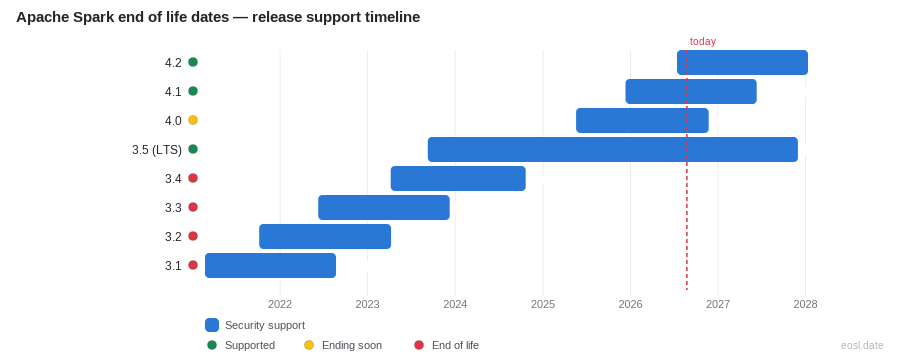
Currently Supported Apache Spark Releases - Active EOS/EOSL Support (4)
| Release | Released | Support | Latest | LTS |
|---|---|---|---|---|
| 4.3 | (3 weeks and 1 day ago) | (in 1 year and 5 months) | 4.3.0 (3 weeks and 4 days ago) | - |
| 4.2 | (4 months ago) | (in 1 year and 1 month) | 4.2.1 (1 month ago) | - |
| 4.1 | (11 months ago) | (in 6 months) | 4.1.4 (1 month ago) | - |
| 3.5 (LTS) | (3 years and 2 months ago) | (in 1 year) | 3.5.9 (4 months ago) | LTS |
Apache Spark Releases Nearing End of Life - Support Ending Soon (1)
| Release | Released | Support | Latest | LTS |
|---|---|---|---|---|
| 4.0 | (1 year and 6 months ago) | (in 2 days) | 4.0.5 (1 month ago) | - |
Apache Spark End of Life (EOL) Releases - No Longer Supported (17)
| Release | Released | Support | Latest | LTS |
|---|---|---|---|---|
| 3.4 | (3 years and 7 months ago) | (2 years and 1 month ago) | 3.4.4 (2 years and 1 month ago) | - |
| 3.3 | (4 years and 5 months ago) | (2 years and 11 months ago) | 3.3.4 (2 years and 11 months ago) | - |
| 3.2 | (5 years and 1 month ago) | (3 years and 7 months ago) | 3.2.4 (3 years and 7 months ago) | - |
| 3.1 | (5 years and 8 months ago) | (4 years and 2 months ago) | 3.1.3 (4 years and 9 months ago) | - |
| 3.0 | (6 years and 5 months ago) | (4 years and 11 months ago) | 3.0.3 (5 years and 5 months ago) | - |
| 2.4 (LTS) | (8 years ago) | (5 years and 6 months ago) | 2.4.8 (5 years and 6 months ago) | LTS |
| 2.3 | (8 years and 8 months ago) | (7 years and 2 months ago) | 2.3.4 (7 years and 2 months ago) | - |
| 2.2 | (9 years and 4 months ago) | (7 years and 9 months ago) | 2.2.3 (7 years and 10 months ago) | - |
| 2.1 | (9 years and 11 months ago) | (8 years and 4 months ago) | 2.1.3 (8 years and 4 months ago) | - |
| 2.0 | (10 years and 4 months ago) | (9 years and 11 months ago) | 2.0.2 (10 years ago) | - |
| 1.6 | (10 years and 11 months ago) | (10 years and 4 months ago) | 1.6.3 (10 years ago) | - |
| 1.5 | (11 years and 2 months ago) | (10 years and 11 months ago) | 1.5.2 (11 years ago) | - |
| 1.4 | (11 years and 5 months ago) | (11 years and 2 months ago) | 1.4.1 (11 years and 4 months ago) | - |
| 1.3 | (11 years and 8 months ago) | (11 years and 5 months ago) | 1.3.1 (11 years and 7 months ago) | - |
| 1.2 | (11 years and 11 months ago) | (11 years and 7 months ago) | 1.2.2 (11 years and 7 months ago) | - |
| 1.1 | (12 years and 2 months ago) | (11 years and 11 months ago) | 1.1.1 (12 years ago) | - |
| 1.0 | (12 years and 5 months ago) | (12 years and 2 months ago) | 1.0.2 (12 years and 3 months ago) | - |
Running an open source engine means the project decides when your version stops getting fixes, and Apache Spark end of life is the day that decision reaches your cluster. Whether Spark feeds analytics dashboards, data science notebooks or machine learning training, this guide shows which release lines are still supported, which LTS branch buys the most time, and what to do before security fixes stop.
Apache Spark EOL Dates by Version
Each Spark release line has a published end of support date, and the Spark EOL status of a branch is simply whether that date has passed. The table below reflects the project's own schedule as of late October 2026; the release date column shows when each line first shipped.
| Version | Release date | Support ends | Status in October 2026 |
|---|---|---|---|
| Spark 3.3 | June 2022 | December 2023 | EOL, no fixes |
| Spark 3.4 | April 2023 | October 2024 | EOL, no fixes |
| Spark 3.5 (LTS) | September 2023 | November 2027 | Extended LTS, security-only |
| Spark 4.0 | May 2025 | November 2026 | Ends in about one month |
| Spark 4.1 | December 2025 | June 2027 | Supported |
| Spark 4.2 | July 2026 | January 2028 | Latest, supported |
A normal line gets bug fixes for roughly 18 months after release, then it falls out of support. You can confirm which branch you are on with spark-shell --version and compare it to the row above. If you use a hosted apache spark eol date tracker, check it against the project's own page, because third-party lists sometimes lag behind announced extensions.
Spark 3.5 LTS Extended Support Window
The final minor releases in a major line are normally kept longer as an LTS (long term support) branch; Spark 2.4 was maintained for about 31 months. Spark 3.5 gets an even longer maintenance window: only security fixes are shipped until November 2027, which gives teams time to migrate. That extension covers the main Spark repository, not sub-projects with separate repositories such as the Kubernetes operator. Treat it as a bridge, not a destination, and plan the move to 4.x inside that window.
Spark Versions Past End of Life
Any of the older Spark versions in the table, 3.4 and below, is now unpatched. No new critical bug fixes or fixes for newly disclosed flaws will land there, so a job that still runs correctly is simply carrying growing exposure. Retire these branches first.
Apache Spark Lifecycle, Versioning Policy and Release Cadence
The Apache Spark lifecycle follows the project's versioning policy, which adopts semantic versioning in the form MAJOR.FEATURE.MAINTENANCE, with a few deviations because Spark is a multi-module project. The code was donated to the Apache Software Foundation in 2013, and the Apache Software Foundation hosts that policy in its public documentation, and the community under the Apache Software Foundation debates changes on the developer mailing list and GitHub before a schedule shifts. Under the current plan, major releases arrive yearly, while feature releases move to a quarterly release cadence starting with 4.3, replacing the older roughly six-month rhythm. This product lifecycle is why dates keep moving: a faster cadence means more branches to support at once.
Maintenance Releases and Feature Releases
These add capabilities and may only add public APIs; they do not change behavior or defaults. Maintenance releases carry fixes only and appear whenever a patch is urgent. Each feature release has a merge window, a code freeze, a QA period and then voting. For 4.3 the freeze and branch cut were scheduled for August 2026, so check the current release window before you pin a version in a deployment.
What End of Support Means for Spark Clusters
When a branch reaches EOL, Apache Spark end of life becomes an operational fact: the project stops issuing patches for it, and the only official remedy is to upgrade. For production pipelines the security implication matters most: a Spark cluster exposes web UIs, RPC endpoints and shuffle services, and every new report of vulnerabilities after the cutoff has no fix on your branch. That is a risk few enterprise teams can accept for long, and delayed patching feeds technical debt across the whole framework stack.
No Security Patches After Apache Spark EOL
After Apache Spark EOL, a flaw found in your branch is not fixed there; you must move forward to a supported line. This is the practical meaning of Spark end of life for operations teams. Because Spark sits on Hadoop client libraries, a disclosed issue in the storage layer can reach your production cluster with no upstream backport, and the same gap applies to a Hadoop distribution that you cannot patch independently.
Compliance Risk for Unsupported Spark: PCI DSS, SOC 2, HIPAA and GDPR
Once a Spark branch is past its support date, auditors treat it as unsupported software and record a finding. PCI DSS expects critical patches within a month, which is impossible when none exist. SOC 2 reviewers flag unsupported components as a control gap, and teams processing regulated data under HIPAA or GDPR face the same questions in vendor questionnaires. Passing compliance checks usually means a documented upgrade plan with dates.
CVE History and the Dependency Tree
Spark's own CVE record is only part of the exposure: CVE-2022-33891, a command-injection flaw in the web UI with a CVSS score of 8.8, shows how a single advisory can threaten a whole cluster, and branches past support never receive a fix for the next one, so vulnerabilities accumulate and weaken overall security. A deployment pulls in a long dependency list, and every transitive library brings its own advisory stream; these dependencies and transitive dependencies include Netty, Jackson, Parquet, Avro and Guava. Older lines also bundle legacy Log4j 1.x, and Log4j 1.2 itself has known advisories that managed platforms had to patch by hand, and storage formats such as Delta Lake add their own version constraints. Once the parent branch is unsupported, nobody coordinates fixes across that tree for you, and upgrades of these bundled libraries are not backported into your Spark branch.
Spark LTS and API Compatibility Across Releases
When you move off an unsupported line, the job is easier when you know what the project promises. Within a major line, API compatibility is a firm commitment: minor releases keep binary compatibility and source compatibility, so code compiled against 3.5 keeps running on later 3.5.x builds. Across a major boundary, breaking changes are allowed, and the maintainers weigh how widely an API is used and how it fails. A compile error is the mild outcome; silently different answers is the worst. APIs marked deprecated should name a replacement, and deprecation warnings in your logs are an early signal to refactor. Those guarantees protect performance and stability for the engine and for downstream analytics jobs when you leave an unsupported line.
Spark SQL, PySpark and MLlib Impact
Most breakage shows up in the components you touch daily. Spark SQL semantics, PySpark Python version pins, Structured Streaming state formats and MLlib models all have documented upgrade notes. Check your Scala, Python and Java versions against the target release first: Spark 4.x runs on Scala 2.13, so libraries built for Scala 2.12 must be rebuilt (a point that also covers any in-house Scala code), and each line raises its minimum Java and Python too. A PySpark job usually fails on a package pin, while a PySpark notebook that calls Structured Streaming must also check its checkpoint format, since streaming state outlives a deployment. The same applies to machine learning pipelines, streaming and batch jobs, and any machine learning feature jobs, and data science notebooks that run on big data volumes, because each can depend on a library pinned to one open source release.
Apache Spark End of Life on Azure Synapse and Fabric Runtimes
Managed platforms set their own dates on top of the project's. In Azure Synapse, a runtime bundles a Spark version with connectors and packages, and each runtime has its own announcement and effective-support dates. The 3.4 runtime is deprecated, while the 3.5 runtime enters LTS for twelve months from November 2027. Microsoft Fabric runtimes follow a separate lifecycle and already offer Spark 4.1. Runtime patching is monthly and, for an LTS runtime, security only. On self-managed stacks the same logic applies to Kubernetes images and YARN clusters: your platform's Apache Spark end-of-life date is what counts, not only the upstream one.
Upgrade Planning: A Migration Guide Before End-of-Life
Treat every upgrade as a project with an owner and a date. Inventory the Spark version for each job, rank them by exposure, and start with branches already past support. Your data pipelines and ETL schedules set the cutover windows, and your data engineering team should read the official migration guide for each hop. Spark is an analytics framework that other systems depend on, so one change ripples outward. If a full move cannot finish in time, long term support from a vendor can be a stopgap.
- List every job, its Spark version and its owner.
- Read the release notes for removed APIs and changed defaults.
- Build a test pool on the target version and rerun representative jobs.
- Cut over in stages and keep a rollback path.
Migrate and Test Your Spark Code
To move safely, update libraries first, then replace removed APIs. A migration only counts once testing proves that row counts and aggregates match the old version on real data; compare outputs, not just exit codes, since a silent semantic change is the hardest bug to find.
Extended Lifecycle Support and Rushed Upgrades
Some vendors sell extended lifecycle support that backports security fixes to old Spark lines. It is not free and it does not replace an upgrade, but it beats a panic migration that breaks production in the week before a deadline. Use it to buy time for a tested move, and keep the production plan and its security review on the calendar.