Apache Tomcat End of Life (EOL) Dates and End of Support (EOS) Dates
Apache Tomcat end of life (EOL) and end of support (EOS) dates: 6 Apache Tomcat versions have reached EOL, including Apache Tomcat 10.0 (EOL date: Oct 31, 2022) — no longer receiving security updates or patches. Apache Tomcat 9.0 reaches its End of Support date on Mar 31, 2027 — plan your upgrade path now. Apache Tomcat 11.0.29 is the current supported release — 3 versions in active support. Also see Apache Ant end of service life for related end-of-life information.
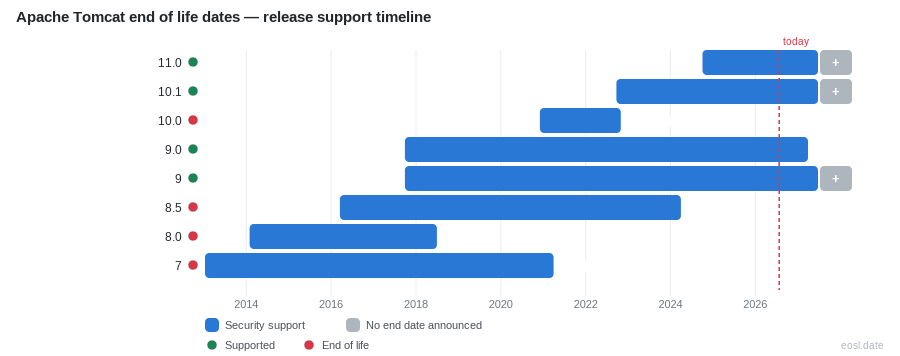
Currently Supported Apache Tomcat Releases - Active EOS/EOSL Support (3)
Apache Tomcat Releases Nearing End of Life - Support Ending Soon (1)
| Release | Min Java Version | Released | Security Support | Latest |
|---|---|---|---|---|
| 9.0 | 8 | (9 years and 1 month ago) | (in 4 months) | 9.0.124 (1 week and 5 days ago) |
Apache Tomcat End of Life (EOL) Releases - No Longer Supported (6)
| Release | Min Java Version | Released | Security Support | Latest |
|---|---|---|---|---|
| 10.0 | 8 | (5 years and 11 months ago) | (4 years ago) | 10.0.27 (4 years and 1 month ago) |
| 8.5 | 7 | (10 years and 8 months ago) | (2 years and 7 months ago) | 8.5.100 (2 years and 8 months ago) |
| 8.0 | 7 | (12 years and 9 months ago) | (8 years and 4 months ago) | 8.0.53 (8 years and 4 months ago) |
| 7 | 6 | (16 years and 5 months ago) | (5 years and 7 months ago) | 7.0.109 (5 years and 6 months ago) |
| 6 | 5 | (20 years and 1 month ago) | (9 years and 10 months ago) | 6.0.53 (9 years and 7 months ago) |
| 5 | 1.4 | (23 years and 2 months ago) | (14 years and 1 month ago) | 5.5.36 (14 years and 1 month ago) |
Running an Apache Tomcat end of life build means your open-source Java web server stops getting fixes while it keeps serving traffic. This guide shows when each servlet container line is retired, what that costs an enterprise team, and where to go next. Apache Tomcat 9.0.x carries the next big deadline, so start there.
Apache Tomcat End of Life Dates by Version
Each major line follows a rough 10 years pattern from launch to the last one. Use this quick reference to see which Tomcat versions are stable, which ended, and which still have a date ahead. Only Tomcat 9 has a cutoff in the future, while Tomcat 8.5 and 10.0 have already passed theirs.
| Version | Release date | Support ends | Status |
|---|---|---|---|
| Tomcat 11.0 | October 2024 | Not announced | Supported |
| Tomcat 10.1 | September 2022 | Not announced | Supported |
| Tomcat 10.0 | December 2020 | 31 October 2022 | Ended |
| Tomcat 9.0.x | September 2017 | 31 March 2027 | Active until then |
| Tomcat 8.5.x | March 2016 | 31 March 2024 | Ended |
| Tomcat 7 | June 2010 | 31 March 2021 | Ended |
| Tomcat 6 | October 2006 | 31 December 2016 | Ended |
The latest release of each supported line sits on the download page, and the dates above come from the project's own announcements.
Tomcat 9 End of Life and the 9.1.x Branch
The Apache Tomcat team announced in February 2026 that support for 9.0.x ends on 31 March 2027. After that date, releases from that line are highly unlikely, bugs affecting only it will not be addressed, and security reports will not be checked against it. On 30 June 2027 the download links vanish, the latest release leaves the mirror system and the documentation links come down. Every build stays in the archive. That is what end of support for Apache Tomcat 9.0.x means in practice, and the official announcement and notice say the same.
A new 9.1.x branch softens the cliff. The final 9.0.x release arrives shortly before the cutoff, then Tomcat 9.1.x continues until 31 December 2030 as a long-term support (LTS) line. It is no destination, though: Tomcat 9 is the last Java EE version built on the javax namespace, so your applications still face a Jakarta migration. The Tomcat Migration Tool for Jakarta EE speeds that move.
What Changes Between 9.0.x and 9.1.x
The differences are small. The APR/native connectors for HTTP, HTTPS and AJP are removed, and Tomcat Native 1.3.x is dropped while Tomcat Native 2.0.x continues. If you rely on the APR/native AJP connector, switch to the NIO AJP connector first. Everyone else upgrades like any normal point update.
Tomcat 8.5 End of Life and Older Versions
Tomcat 8.5.x began in March 2016 as a fork of the 9.0 milestone work so users on older runtimes could get newer features. The notice titled End of life for Apache Tomcat 8.5.x set the cutoff a year ahead, and support ended on 31 March 2024 with 8.5.100 as the final release. That line then went read-only, its Bugzilla project froze and its documentation links were removed. That end-of-life status is easy to miss, as is the end-of-support date, because 8.5 still runs inside certified middleware and vendor appliances in production, and the project may sunset such branches quietly for EOL users.
Older lines are worse off. Tomcat 10.0 ended on 31 October 2022, Tomcat 7 on 31 March 2021 and Tomcat 6 on 31 December 2016, and none should still face a network.
Tomcat Support Policy and Support Lifecycle
Apache Tomcat publishes no fixed window, and its maintenance covers only a few lines. The pattern is steady, though: about 10 years per major release line, three concurrent branches at a time and an announcement roughly a year before a branch is retired. Generally three major versions are maintained, so the oldest one ends when a new major line turns stable. Each major line tracks a specification level for servlet, JSP, EL and WebSockets, which is why new releases pass through alpha, beta and milestone builds until that specification is final.
The project began in 1998 as a Sun Microsystems reference implementation, joined the Apache Software Foundation in 1999 and became a top-level, community-supported project in 2005. As an open source project it is also the default container inside Spring Boot, which explains why an EOL build can hide inside so many stacks long after its branch is retired.
Supported Tomcat Versions: End of Support and Java Compatibility
The 11.0 line is the current stable release and 10.1 sits beside it, and both run on Jakarta EE. Apache Tomcat 12 is in early development and aims at Java 21. Your minimum runtime depends on the line you run:
| Tomcat version | Minimum Java version |
|---|---|
| 11.0 | Java 17 |
| 10.1 | Java 11 |
| 9.0 | Java 8 |
| 8.5 | Java 7 |
What Happens After Tomcat EOL
An EOL install keeps running, and nothing breaks on the cutoff date. What disappears is the safety net. Once 9.0.x support ends:
- Each newly reported vulnerability is no longer checked against your line, so every advisory becomes a silent risk.
- No patch or update arrives, known vulnerabilities stay open, and security patches in the monthly security release skip you.
- An unpatched application server can fail a compliance review and weakens your wider infrastructure.
Stale deployments facing the internet are the worst case: in October 2025 researchers counted more than 540,000 exposed Tomcat instances.
CVEs on Unsupported Branches
Apache stops updating the security page for an ended branch, yet NVD records still list its versions. CVE-2025-24813, a critical path equivalence flaw rated CVSS 9.8, affected 8.5 even though the security page shows nothing past 8.5.99. Monthly rounds fix several CVEs across supported lines, and each CVE fix stops covering you the day your line ends. A CVE that lands later simply stays open.
Options for Unsupported Tomcat Deployments
You have three realistic paths: upgrade to a supported line, bridge on 9.1.x, or buy extended support from a commercial vendor who backports fixes. Switching runtime is possible too, with TomEE, Jetty, WildFly, JBoss, Payara, GlassFish, WebSphere or WebLogic as alternatives. NGINX is a web server, so it does not replace an application server. Pick the option that matches how fast you can change your software.
Moving to Tomcat 10.1 or Tomcat 11 on Jakarta EE
Both lines use the jakarta namespace, so applications written for Java EE need migration before they start. Run the Tomcat Migration Tool on a test copy first, then upgrade in stages.