Apache ActiveMQ Artemis End of Life (EOL) Dates and End of Support (EOS) Dates
Apache ActiveMQ Artemis end of life (EOL) and end of support (EOS) dates: 54 Apache ActiveMQ Artemis versions have reached EOL, including Apache ActiveMQ Artemis 2.52 (EOL date: Mar 17, 2026) — no longer receiving security updates or patches. Apache ActiveMQ Artemis 2.53.0 is the current supported release. Also see Apache Tomcat end of support dates for related end-of-life information.
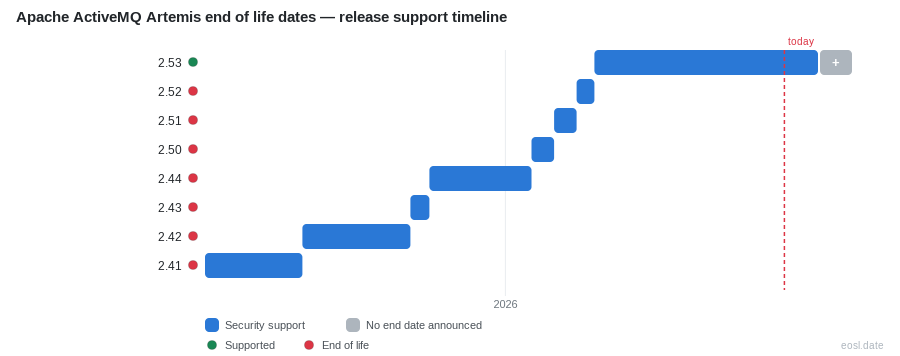
Currently Supported Apache ActiveMQ Artemis Releases - Active EOS/EOSL Support (1)
| Release | Released | Security Support | Latest |
|---|---|---|---|
| 2.53 | (8 months ago) | Active | 2.53.0 (8 months ago) |
Apache ActiveMQ Artemis End of Life (EOL) Releases - No Longer Supported (54)
| Release | Released | Security Support | Latest |
|---|---|---|---|
| 2.52 | (8 months ago) | (8 months ago) | 2.52.0 (8 months ago) |
| 2.51 | (9 months ago) | (8 months ago) | 2.51.0 (9 months ago) |
| 2.50 | (9 months ago) | (9 months ago) | 2.50.0 (10 months ago) |
| 2.44 | (1 year ago) | (9 months ago) | 2.44.0 (1 year ago) |
| 2.43 | (1 year and 1 month ago) | (1 year ago) | 2.43.0 (1 year and 1 month ago) |
| 2.42 | (1 year and 4 months ago) | (1 year and 1 month ago) | 2.42.0 (1 year and 4 months ago) |
| 2.41 | (1 year and 6 months ago) | (1 year and 4 months ago) | 2.41.0 (1 year and 6 months ago) |
| 2.40 | (1 year and 8 months ago) | (1 year and 6 months ago) | 2.40.0 (1 year and 8 months ago) |
| 2.39 | (1 year and 11 months ago) | (1 year and 8 months ago) | 2.39.0 (1 year and 11 months ago) |
| 2.38 | (2 years and 1 month ago) | (1 year and 11 months ago) | 2.38.0 (2 years and 1 month ago) |
| 2.37 | (2 years and 3 months ago) | (2 years and 1 month ago) | 2.37.0 (2 years and 3 months ago) |
| 2.36 | (2 years and 3 months ago) | (2 years and 3 months ago) | 2.36.0 (2 years and 3 months ago) |
| 2.35 | (2 years and 5 months ago) | (2 years and 3 months ago) | 2.35.0 (2 years and 5 months ago) |
| 2.34 | (2 years and 5 months ago) | (2 years and 5 months ago) | 2.34.0 (2 years and 5 months ago) |
| 2.33 | (2 years and 8 months ago) | (2 years and 5 months ago) | 2.33.0 (2 years and 8 months ago) |
| 2.32 | (2 years and 9 months ago) | (2 years and 8 months ago) | 2.32.0 (2 years and 9 months ago) |
| 2.31 | (3 years and 2 months ago) | (2 years and 9 months ago) | 2.31.2 (3 years ago) |
| 2.30 | (3 years and 4 months ago) | (3 years and 2 months ago) | 2.30.0 (3 years and 4 months ago) |
| 2.29 | (3 years and 5 months ago) | (3 years and 4 months ago) | 2.29.0 (3 years and 5 months ago) |
| 2.28 | (3 years and 9 months ago) | (3 years and 5 months ago) | 2.28.0 (3 years and 9 months ago) |
| 2.27 | (4 years ago) | (3 years and 9 months ago) | 2.27.1 (3 years and 11 months ago) |
| 2.26 | (4 years and 2 months ago) | (4 years ago) | 2.26.0 (4 years and 2 months ago) |
| 2.25 | (4 years and 2 months ago) | (4 years and 2 months ago) | 2.25.0 (4 years and 2 months ago) |
| 2.24 | (4 years and 3 months ago) | (4 years and 2 months ago) | 2.24.0 (4 years and 3 months ago) |
| 2.23 | (4 years and 5 months ago) | (4 years and 3 months ago) | 2.23.1 (4 years and 5 months ago) |
| 2.22 | (4 years and 6 months ago) | (4 years and 5 months ago) | 2.22.0 (4 years and 6 months ago) |
| 2.21 | (4 years and 8 months ago) | (4 years and 6 months ago) | 2.21.0 (4 years and 8 months ago) |
| 2.20 | (4 years and 11 months ago) | (4 years and 8 months ago) | 2.20.0 (4 years and 11 months ago) |
| 2.19 | (5 years and 1 month ago) | (4 years and 11 months ago) | 2.19.1 (4 years and 9 months ago) |
| 2.18 | (5 years and 3 months ago) | (5 years and 1 month ago) | 2.18.0 (5 years and 3 months ago) |
| 2.17 | (5 years and 9 months ago) | (5 years and 3 months ago) | 2.17.0 (5 years and 9 months ago) |
| 2.16 | (6 years ago) | (5 years and 9 months ago) | 2.16.0 (6 years ago) |
| 2.15 | (6 years and 2 months ago) | (6 years ago) | 2.15.0 (6 years and 2 months ago) |
| 2.14 | (6 years and 4 months ago) | (6 years and 2 months ago) | 2.14.0 (6 years and 4 months ago) |
| 2.13 | (6 years and 6 months ago) | (6 years and 4 months ago) | 2.13.0 (6 years and 6 months ago) |
| 2.12 | (6 years and 7 months ago) | (6 years and 6 months ago) | 2.12.0 (6 years and 7 months ago) |
| 2.11 | (6 years and 10 months ago) | (6 years and 7 months ago) | 2.11.0 (6 years and 10 months ago) |
| 2.10 | (7 years and 2 months ago) | (6 years and 10 months ago) | 2.10.1 (7 years and 1 month ago) |
| 2.9 | (7 years and 5 months ago) | (7 years and 2 months ago) | 2.9.0 (7 years and 5 months ago) |
| 2.8 | (7 years and 6 months ago) | (7 years and 5 months ago) | 2.8.1 (7 years and 6 months ago) |
| 2.7 | (7 years and 8 months ago) | (7 years and 6 months ago) | 2.7.0 (7 years and 8 months ago) |
| 2.6 | (8 years and 6 months ago) | (7 years and 8 months ago) | 2.6.4 (7 years and 10 months ago) |
| 2.5 | (8 years and 8 months ago) | (8 years and 6 months ago) | 2.5.0 (8 years and 8 months ago) |
| 2.4 | (9 years ago) | (8 years and 8 months ago) | 2.4.0 (9 years ago) |
| 2.3 | (9 years and 2 months ago) | (9 years ago) | 2.3.0 (9 years and 2 months ago) |
| 2.2 | (9 years and 3 months ago) | (9 years and 2 months ago) | 2.2.0 (9 years and 3 months ago) |
| 2.1 | (9 years and 6 months ago) | (9 years and 3 months ago) | 2.1.0 (9 years and 6 months ago) |
| 2.0 | (9 years and 8 months ago) | (9 years and 6 months ago) | 2.0.0 (9 years and 8 months ago) |
| 1.5 | (10 years ago) | (8 years and 8 months ago) | 1.5.6 (8 years and 9 months ago) |
| 1.4 | (10 years and 2 months ago) | (10 years ago) | 1.4.0 (10 years and 2 months ago) |
| 1.3 | (10 years and 5 months ago) | (10 years and 2 months ago) | 1.3.0 (10 years and 5 months ago) |
| 1.2 | (10 years and 10 months ago) | (10 years and 5 months ago) | 1.2.0 (10 years and 10 months ago) |
| 1.1 | (11 years and 2 months ago) | (10 years and 10 months ago) | 1.1.0 (11 years and 2 months ago) |
| 1.0 | (11 years and 6 months ago) | (11 years and 2 months ago) | 1.0.0 (11 years and 6 months ago) |
If you run a broker built on Apache ActiveMQ Artemis End of Life questions are probably why you are here, and the short version is reassuring: the project is alive, but only the newest release gets fixes. This guide shows which Apache releases are still supported, which Apache Artemis versions are not, and how to decide between staying put, upgrading and moving to a different broker.
Apache ActiveMQ Artemis End of Life: The Short Answer
No, the broker is not dead. The Apache Software Foundation has not announced a shutdown date for Apache Artemis, and new Apache versions keep shipping every few weeks, while Apache ActiveMQ Classic continues on its own track. The phrase "end of life" is where the confusion starts, because it gets used for three different things: the end of the project, the end of support for one specific version, and the end of active investment. Artemis is nowhere near the first, and it is already past the second for every release except the latest.
The practical reading is simple. If you are not on the newest Apache Artemis release, you are carrying the same risk as someone on an inactive Classic line. The sections below explain how to check where you stand.
Artemis Support Window and Release Policy
Apache publishes no long-term support window for Apache Artemis. The Apache download page offers one current release, 2.57.0 from 9 September 2026, which needs Java 17 or later. The independent tracker endoflife.date applies a rolling rule: a release keeps security support until the next release ships, and then that support ends. Bug fixes follow the same pattern, so a fix lands in the newest release rather than being back-ported to an older one.
Version Support Status for Recent Releases
The table shows how short that rolling window is in practice.
| Apache Artemis release | Released | Security support ended |
|---|---|---|
| 2.57 | 9 Sep 2026 | Still supported |
| 2.56 | 27 Aug 2026 | 9 Sep 2026 |
| 2.55 | 23 Jun 2026 | 27 Aug 2026 |
| 2.54 | 14 May 2026 | 23 Jun 2026 |
Before you rely on any older entry, open its page and check four things:
- the release notes for breaking changes and fixed issues, which Apache publishes for every Apache Artemis version;
- the Java compatibility line, since releases up to 2.43 list Java 17 to 22 and later ones list 17 or newer;
- the published Docker image, if your brokers run in containers;
- the matching documentation, which Apache keeps per release.
The past releases page repeats this layout for every older build, and each entry also links to the checksums so you can verify the integrity of a download. Read the release notes and Java compatibility details together before planning any rollout, and keep the Docker tag pinned to a version you have actually tested. The release notes, the Docker page and the Java compatibility line are where Apache documents each break, and the Apache documentation explains the rest. Any TLS proxy or Docker orchestration layer in front of the broker deserves the same scrutiny.
How the 2025 Split Made Apache Artemis a Top-Level Project
On 19 November 2025 the ActiveMQ PMC voted to make Artemis its own top-level project. The Apache Software Foundation now runs two brokers with separate domains, mailing lists, issue trackers and governance. Many engineers read the split as a sign that Classic is being retired. The reverse is closer to the truth: each codebase now has its own community, and Artemis is no longer framed as the designated successor to Classic.
What the split does show is where the energy sits. Apache Artemis is an open source, Java-based message broker with an asynchronous journal, replication for high availability and native support for several transport protocols, including STOMP, MQTT, AMQP and OpenWire. Apache Artemis keeps leading new architectural work, while Apache ActiveMQ Classic still relies on KahaDB and is better described as stable than fast-moving. The Apache Artemis roadmap and the Apache ActiveMQ Classic roadmap diverge, and for most enterprise teams that difference matters more than any formal announcement from the Apache Software Foundation.
Inactive and Active ActiveMQ Classic Release Series
Apache ActiveMQ Classic works differently from Apache Artemis. Apache sets no fixed dates; instead its download page marks every release series as active or inactive. An inactive series is end of life, gets no updates and is not recommended for new deployments. Because there is no calendar, that page is the only reliable check, and a series can switch status between two of your patch windows. The table reflects the page as checked on 12 October 2026.
| Release series | Status | Last release | Java | JMS API |
|---|---|---|---|---|
| 6.3.x | Active | 6.3.2 | 17, 21, 25 | Jakarta |
| 6.0.x to 6.2.x | Inactive | 6.2.10 | 17 and later | Jakarta |
| 5.19.x | Active | 5.19.11 | 11, 17, 21 | javax |
| 5.18.x and older | Inactive | 5.18.7 | 8 and later | javax |
Is the Older Classic Broker Discontinued?
No. Two series remain active, 6.3.x and 5.19.x, and both are receiving point releases. A series can still lose support while recent advisories name it: the 6.2 line received security fixes this year and is now listed as inactive.
Choosing an Upgrade Path Off an Unsupported Version
The two active Classic series are very different moves. The 5.19.x line keeps the javax.jms API and runs on Java 11, bundling Spring 5.3 and Jetty 9.4. The 6.x line needs Java 17, moves to Jakarta Messaging and bundles Spring 7 and Jetty 12 in 6.3, so application code has to change.
Does ActiveMQ 6 Need Java 17 and Jakarta?
Yes. Any service that imports javax.jms must switch to the Jakarta namespace before it can talk to a 6.x broker natively. Treat that as a second project, not a patch.
Upgrading From the 5.15 to 5.18 Releases
For these estates, 5.19.x is the smallest step that brings security fixes back. Releases 5.15 and 5.16 run on Java 8, so the step also means a Java 11 runtime. Plan the JVM change first and the broker change second.
Upgrading Brokers Pinned to Older Artemis Releases
Apache Artemis moves quickly, so read the upgrade notes in the Apache documentation for each release between yours and the latest. Recent notes cover the web console, where the tree view moved to the Artemis JMX tab, Jolokia now discards insecure origin headers by default, and Hawtio throttles repeated login attempts unless you turn that off.
What End of Support Means for Your Brokers
An Artemis release is unpatched once the next one ships, and an inactive Classic series never gets another fix, yet both keep running, which is exactly why they get forgotten. The cost shows up later, in three places.
Security Exposure and Published Advisories
Old Classic builds have a record of serious flaws, the best known being CVE-2023-46604 in the OpenWire protocol. Once a series is inactive, a new CVE will not get a patch for it, so the fix is always an upgrade. Check each CVE against your exact series before assuming you are covered.
Compliance and Audit Findings
Auditors increasingly flag software without vendor patches. An Artemis release past its security support date, or an inactive Classic series, tends to appear as a finding that someone must explain.
Operational and Talent Risk
Fewer people remember how Classic 5.18 and older brokers were tuned, and community answers for them thin out, so the risk to your team grows quietly every quarter.
Community Supported Releases and Maintenance Mode
Both brokers are open source, so there is no vendor contract behind their end-of-life status. Classic is best understood as being in maintenance mode: it still gets fixes, but major new capabilities are unlikely to land there.
What Community Supported Really Means
For Apache Artemis, community supported means fixes only land in the newest release. Volunteers and sponsored committers decide what gets fixed and when, with no service-level agreement, no guaranteed response time and no promise to back-port a fix to your version. If you need that, buy a commercial support contract.
Which Releases Get Security Patches
Only the newest Artemis release, plus the 6.3.x and 5.19.x Classic series. Everything else is on its own.
End-of-Life Planning and the Feature Parity Reality
Migration from Apache ActiveMQ Classic to Apache Artemis is not a drop-in swap. Apache Artemis supports the same major protocols and includes an OpenWire layer so many clients connect unchanged, but the storage model, clustering and configuration files differ. Test your real producers, consumers and message selectors rather than relying on a feature checklist, and treat the migration as a project with its own owner, because feature parity on paper hides differences in behavior under load. If you are already on Artemis, the end-of-life question is simply about staying current.
Migration Timing and Sequence
When an Artemis release or Classic series loses support, a migration done in a quiet window beats one forced by an advisory. Move in a deliberate order:
- Inventory every broker and its exact version.
- Upgrade the Java runtime where required.
- Rehearse the move with a copy of production traffic.
- Cut over one application at a time, keeping the old broker running until it drains, and run both community releases side by side only as long as you must.
When ActiveMQ Classic Is the Right Place to Stay
If your estate runs 5.19.x or 6.3.x, your applications are stable, and you can patch promptly, staying is a legitimate choice. Just track the download page for status changes.
Decision Framework for ActiveMQ End of Life: Stay, Patch or Move
Ask three questions in order, using the Apache support status of each broker. Are you on a supported release today? If not, patch to the nearest active series first. Do you need new capabilities such as modern high availability? If so, plan the Artemis move on its own schedule. Can your team absorb a rapid release cadence? Artemis ships often, so the answer decides whether you adopt a regular upgrade rhythm or choose Classic for its slower pace. For architects and DevOps teams running production middleware, this decision framework beats waiting for an official announcement that may never come.
Not Discontinued, but Time to Act: Your Next Steps
Nothing here is discontinued, yet the risk of drift is real. Start by listing every broker and its release, then compare each against the tables above. Subscribe to the project news, watch the download page for a status change, and schedule an upgrade window now rather than after an incident. If you cannot name the version running in production, that is your first task. If an enterprise team is weighing RabbitMQ instead, the same end-of-support questions apply to it. Whether you pick Apache ActiveMQ Classic or Apache Artemis, an owner and a patch cadence matter more than the brand on the broker.