Apache ActiveMQ Classic End of Life (EOL) Dates and End of Support (EOS) Dates
Apache ActiveMQ Classic end of life (EOL) and end of support (EOS) dates: 21 Apache ActiveMQ Classic versions have reached EOL, including Apache ActiveMQ Classic 6.1 (EOL date: Dec 02, 2025) — no longer receiving security updates or patches. Apache ActiveMQ Classic 6.4.0 is the current supported release — 4 versions in active support. Also see Apache Tomcat end of support dates for related end-of-life information.
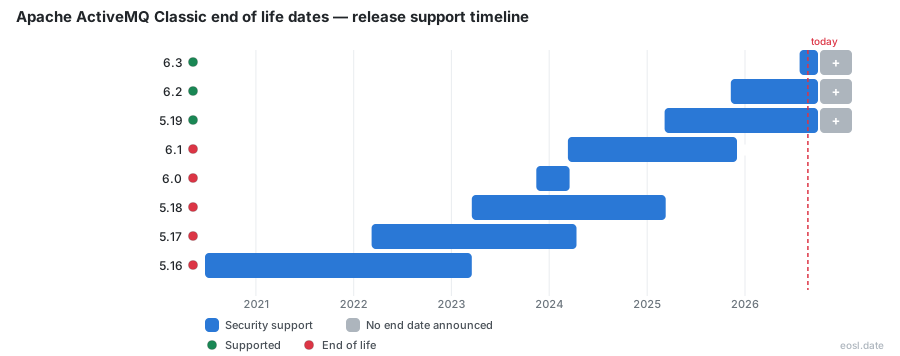
Currently Supported Apache ActiveMQ Classic Releases - Active EOS/EOSL Support (4)
Apache ActiveMQ Classic End of Life (EOL) Releases - No Longer Supported (21)
| Release | Released | Support | Latest |
|---|---|---|---|
| 6.1 | (2 years and 8 months ago) | (11 months ago) | 6.1.8 (1 year and 1 month ago) |
| 6.0 | (3 years ago) | (2 years and 8 months ago) | 6.0.1 (2 years and 11 months ago) |
| 5.18 | (3 years and 8 months ago) | (1 year and 8 months ago) | 5.18.7 (1 year and 8 months ago) |
| 5.17 | (4 years and 8 months ago) | (2 years and 7 months ago) | 5.17.7 (1 year and 8 months ago) |
| 5.16 | (6 years and 4 months ago) | (3 years and 8 months ago) | 5.16.8 (1 year and 8 months ago) |
| 5.15 | (9 years and 4 months ago) | (4 years and 8 months ago) | 5.15.16 (3 years ago) |
| 5.14 | (10 years and 3 months ago) | (9 years and 4 months ago) | 5.14.5 (9 years and 7 months ago) |
| 5.13 | (10 years and 11 months ago) | (9 years and 11 months ago) | 5.13.5 (9 years and 11 months ago) |
| 5.12 | (11 years and 3 months ago) | (10 years and 9 months ago) | 5.12.3 (10 years and 9 months ago) |
| 5.11 | (11 years and 9 months ago) | (10 years and 9 months ago) | 5.11.4 (10 years and 9 months ago) |
| 5.10 | (12 years and 5 months ago) | (11 years and 9 months ago) | 5.10.2 (11 years and 9 months ago) |
| 5.9 | (13 years and 1 month ago) | (12 years and 5 months ago) | 5.9.1 (12 years and 7 months ago) |
| 5.8 | (13 years and 9 months ago) | (13 years and 1 month ago) | 5.8.0 (13 years and 9 months ago) |
| 5.7 | (14 years and 1 month ago) | (13 years and 9 months ago) | 5.7.0 (14 years and 1 month ago) |
| 5.6 | (14 years and 6 months ago) | (14 years and 1 month ago) | 5.6.0 (14 years and 6 months ago) |
| 5.5 | (15 years and 7 months ago) | (14 years and 6 months ago) | 5.5.1 (15 years and 1 month ago) |
| 5.4 | (16 years and 3 months ago) | (15 years and 1 month ago) | 5.4.3 (15 years and 1 month ago) |
| 5.3 | (17 years ago) | (16 years and 3 months ago) | 5.3.1 (16 years and 8 months ago) |
| 5.2 | (17 years and 4 months ago) | (17 years ago) | 5.2.0 (17 years and 4 months ago) |
| 5.1 | (18 years and 6 months ago) | (17 years and 4 months ago) | 5.1.0 (18 years and 6 months ago) |
| 5.0 | (18 years and 11 months ago) | (18 years and 6 months ago) | 5.0.0 (18 years and 11 months ago) |
Searching for Apache ActiveMQ Classic end of life turns up conflicting answers, so here is the short version: this open source message broker is still shipping, but only the newest series get fixes. Every Java-based release line has its own support status, and the protocol it speaks (STOMP, MQTT or AMQP) says nothing about whether your version still gets a patch or release from the project.
Is Apache ActiveMQ Classic End of Life? The Short Answer
For the project as a whole, no. The Apache Software Foundation has not announced an ActiveMQ end of life date, and each maintenance release keeps arriving on the 6.3.x, 6.2.x and 5.19.x series, most recently in September and October 2026. The term EOL really covers three different things: the end of the project, the end of support for one version, and the end of active investment. Classic is not at the first, is well past the second for old versions, and is arguably drifting toward the third.
The project also has no formal support policy. In practice, the most recent minor releases are the supported release lines, and older middleware builds are treated as no longer actively maintained.
ActiveMQ Version Support Status by Release Line
The project's download page labels every series Active or Inactive. Inactive means the series reached end-of-life and receives no further updates. Each series also bundles its own Jetty web console, Log4j logging and Spring libraries, so the latest patch version of an active series is also where a Log4j or Jetty fix lands, in the next release. This table shows the state published in October 2026.
| Release line | Status | Latest patch version | Client API | Java | Jetty | Log4j |
|---|---|---|---|---|---|---|
| 6.3.x | Active | 6.3.2 (Sep 2026) | Jakarta JMS 2/3.1 | 17 to 25 | 12.1 | 2.26 |
| 6.2.x | Inactive | 6.2.10 (Sep 2026) | Jakarta JMS 2/3.1 | 17+ | 11.0 | 2.25 |
| 6.1.x | Inactive | 6.1.8 | Jakarta JMS 2/3.1 | 17+ | 11.0 | 2.25 |
| 5.19.x | Active | 5.19.11 (Sep 2026) | Javax JMS 1.1 | 11 to 21 | 9.4 | 2.25 |
| 5.18.x | Inactive | 5.18.7 (Mar 2025) | Javax JMS 1.1 | 11+ | 9.4 | 2.24 |
Third-party release trackers such as endoflife.date still list 6.2 as supported, so treat the official Apache ActiveMQ download page and its release notes as the source of truth.
| Release | Date | Type |
|---|---|---|
| ActiveMQ 6.2.10 release | Sep 26, 2026 | Maintenance release |
| ActiveMQ 5.19.11 release | Sep 5, 2026 | Maintenance release |
| ActiveMQ 6.3.2 release | Sep 2, 2026 | Maintenance release |
| ActiveMQ 6.3.1 release | Aug 10, 2026 | Maintenance release |
| ActiveMQ 5.19.10 release | Aug 10, 2026 | Maintenance release |
| ActiveMQ 6.3.0 release | Jul 27, 2026 | First release of the 6.3.x series |
That steady cadence is why Apache ActiveMQ looks alive: every new release comes from an active series, never an inactive one, and Apache ActiveMQ users should read each release as a signal of which series the project still backs.
Active Lines: 6.3.x and 5.19.x
These two series receive security fixes, bug fixes, security patches and new features with every release, and are the ones recommended for production. Choose 6.3.x for Jakarta and a modern baseline, or stay on 5.19.x if you still depend on the Javax API.
Inactive Lines: 6.2.x, 6.1.x and 5.18.x
The 5.18.x series ended in March 2025, and 5.17.x and earlier ended before it, so those brokers carry unpatched vulnerabilities that will never be fixed. The same applies to 6.1.x and 6.2.x now.
What Community Supported Means for Patches
Community support is not an SLA. Volunteers may fix a bug in the latest builds, but there is no response time, no commitment to backport a fix to your version, and only best-effort help. If you need guarantees, commercial support fills that gap.
The Artemis Split and What It Means for Apache ActiveMQ
On November 19, 2025, the ActiveMQ PMC voted to make Apache Artemis its own top-level project, with separate governance, mailing lists and issue trackers. Both brokers support OpenWire, STOMP, AMQP and MQTT.
Why the split is not a phase-out
Many engineers read the split as the end of Apache ActiveMQ Classic. It is closer to the opposite: Classic is now a standalone project with its own community instead of a sibling waiting for replacement.
Where new development is landing
Apache Artemis, with its asynchronous journal and replication-based high availability, is where most roadmap work happens. Classic is in maintenance mode: stable, patched and supported, but unlikely to gain major new capabilities. Many enterprise teams run both brokers side by side.
End of Support Risks for Older ActiveMQ Releases
An ActiveMQ broker on an inactive series such as 5.18.x keeps starting, and nothing warns you that fixes have stopped. That silence is the danger of an unsupported version, and it turns a forgotten broker into the next incident.
Security exposure from unpatched CVEs
Brokers sit at the center of data flows and often hold credentials to other systems. Classic has had actively exploited vulnerabilities, including remote code execution. When a new CVE drops, a supported series gets a fix, while an unsupported one gets a public advisory and an unpatched CVE for attackers to target.
Compliance and audit findings
Frameworks such as PCI-DSS, SOC 2 and HIPAA expect software that still receives updates, so an ActiveMQ broker on an inactive series, 5.18.x or older, is close to an automatic finding.
Operational and talent risk
As an ActiveMQ series goes inactive, fewer engineers remember its quirks, and reproducing a problem on a current 6.3.x or 5.19.x build, a prerequisite for community help, becomes impossible.
ActiveMQ EOL Migration: Feature Parity With Apache Artemis
Standard JMS and OpenWire applications usually reconnect with little change. Messaging data moves by exporting the KahaDB store into the Apache Artemis journal, or by bridging broker to broker for a live cutover. The real work is validating parity, because a migration of any size touches persistence and failure handling.
Classic features with no direct Artemis equivalent
| Classic feature | In Artemis? | Implication |
|---|---|---|
| Mirrored queues | No equivalent | Rework with diverts |
| Multi-KahaDB | Not available | Redesign the persistence layout |
| Proxy connector | Not available | Change the topology |
| Pluggable storage lockers | Not available | Change the HA locking strategy |
Stay, Upgrade, or Migrate Off an Unsupported Version
Upgrading Classic and migrating to Apache Artemis are separate choices. The first is urgent and cheap, while the second is strategic. Use this decision framework to pick a path.
| Your situation | Path |
|---|---|
| On 5.18.x or older | Upgrade to the 5.19.x or 6.3.x stream now |
| On an active series with a stable workload | Stay and review each year |
| Redesigning for cloud-native scale | Plan an Artemis migration |
| Dependent on Classic-only features | Stay, add commercial support |
A practical order of operations
First inventory every broker in your messaging estate and its version, then move anything inactive onto an active series. Only then, if your architecture is changing anyway, schedule the Apache Artemis migration.