Microsoft Windows Embedded End of Life (EOL) Dates and End of Support (EOS) Dates
Microsoft Windows Embedded end of life (EOL) and end of support (EOS) dates: 6 Microsoft Windows Embedded versions have reached EOL, including Microsoft Windows Embedded 8.1 Industry (EOL date: Jul 11, 2023) — no longer receiving security updates or patches. Also see Microsoft .NET Framework end of life dates for related end-of-life information.
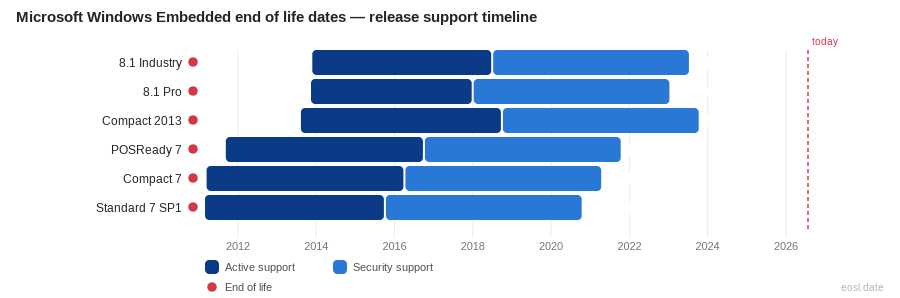
Microsoft Windows Embedded End of Life (EOL) Releases - No Longer Supported (6)
| Release | Released | Security Support | Active Support |
|---|---|---|---|
| 8.1 Industry | (12 years and 11 months ago) | (3 years and 4 months ago) | (8 years and 4 months ago) |
| 8.1 Pro | (13 years ago) | (3 years and 10 months ago) | (8 years and 10 months ago) |
| Compact 2013 | (13 years and 3 months ago) | (3 years and 1 month ago) | (8 years and 1 month ago) |
| POSReady 7 | (15 years and 2 months ago) | (5 years and 1 month ago) | (10 years and 1 month ago) |
| Compact 7 | (15 years and 8 months ago) | (5 years and 7 months ago) | (10 years and 7 months ago) |
| Standard 7 SP1 | (15 years and 8 months ago) | (6 years and 1 month ago) | (11 years and 1 month ago) |
If your devices still run an older Microsoft Windows Embedded edition, the Microsoft Windows Embedded end of life schedule decides when security fixes, technical support and licences stop. Windows Embedded, now called Windows IoT, is the embedded operating system family that Microsoft sells to original equipment manufacturers (OEMs), who preload it on industrial devices, so the lifecycle dates below are the ones to anchor your upgrade planning around. Microsoft licensing for these products differs from desktop Windows, and that difference explains most of the dates.
Microsoft Windows Embedded End of Life Dates
Microsoft separates end of support, when fixes, updates and technical support stop, from the end of license, when OEMs can no longer buy the product. Microsoft embedded licensing includes extended support for up to 10 years, so many Windows Embedded editions outlive their desktop twins. Distributor Avnet publishes the Microsoft lifecycle dates, extended where the licence allows:
| Product | End of support | End of license |
|---|---|---|
| Windows 11 IoT Enterprise LTSC 2024 | Oct 10, 2034 | Jun 30, 2034 |
| Windows 10 IoT Enterprise LTSC 2021 | Jan 13, 2032 | Nov 30, 2031 |
| Windows 10 IoT Enterprise LTSB 2016 | Oct 13, 2026 | Jul 31, 2026 |
| Windows Embedded 8.1 Industry | Jul 11, 2023 | Apr 30, 2028 |
| Windows Embedded 8.1 Pro | Jan 10, 2023 | Mar 31, 2028 |
| Windows Embedded 8 Standard | Jul 11, 2023 | Mar 31, 2028 |
| Windows Embedded 8 Industry | Jan 12, 2016 | Apr 30, 2028 |
| Windows Embedded POSReady 7 | Oct 12, 2021 | Sep 10, 2026 |
| Windows 7 Pro/Ultimate | Jan 14, 2020 | Sep 30, 2024 |
| Windows Embedded Standard 7 | Oct 13, 2020 | Jul 27, 2025 |
| Windows Embedded Compact 2013 | Oct 10, 2023 | May 31, 2028 |
| Windows Embedded Compact 7 | Apr 13, 2021 | Feb 28, 2026 |
| Windows Embedded CE 6.0 | Apr 10, 2018 | Feb 28, 2022 |
| Windows XP Embedded | Jan 12, 2016 | Jan 30, 2017 |
The older Windows XP era products ended first, while the LTSB and LTSC channels carry the longest 10 years of coverage. Microsoft keeps patching these products only inside the dates shown, so a Windows 7 or Windows 8 based device past its row is unsupported, and your OEM or reseller can confirm which Microsoft licensing terms apply.
Windows Server IoT and SQL Server End of License Dates
The same schedule covers server software that ships with embedded hardware. Windows Server IoT 2016 reaches its end of license on Dec 31, 2026, Windows Server IoT 2019 on Dec 31, 2029, and SQL Server 2016 IoT on Jul 31, 2031. Check software and hardware bundles separately, because a database can expire before the operating system, and Microsoft licensing for each component carries its own date.
End of Support Timeline for POSReady and Industry Editions
Windows Embedded Industry, formerly POSReady and Windows Embedded for Point of Service, targets cash registers, automated teller machines and self service checkouts. Each edition moves through mainstream support, then extended support, and the final Windows Embedded 8.1 Industry release was succeeded by Windows IoT Enterprise. Microsoft sold a Pro Retail variant with extra retail features, and the lifecycle of each edition follows its desktop counterpart.
| Edition | Mainstream support ended | Extended support ended |
|---|---|---|
| Windows Embedded for Point of Service | Apr 12, 2011 | Apr 12, 2016 |
| Windows Embedded POSReady 2009 | Apr 8, 2014 | Apr 9, 2019 |
| Windows Embedded POSReady 7 | Oct 11, 2016 | Oct 12, 2021 |
| Windows Embedded 8.1 Industry | Jul 10, 2018 | Jul 11, 2023 |
Windows Embedded for Point of Service Support
WEPOS, released in 2005, was the first edition that could use the Windows Update Agent on a deployed image, and its extended support closed on Apr 12, 2016. Service Pack 3 arrived in 2008, and when Microsoft changed its Internet Explorer policy in January 2016, Internet Explorer 6 support ended here too.
Windows Embedded POSReady Security Updates
POSReady 2009 was the last XP-derived system to receive support, ending in 2019. POSReady 7 was eligible for paid Extended Security Updates, bought yearly through OEMs, with security updates available until Oct 8, 2024. Some users edited the registry to make Windows Update accept POSReady 2009 patches, which is unsupported and not a safe plan for any device you manage.
Windows 8.1 Industry Extended Support
Windows 8 Industry went unsupported on Jan 12, 2016, so you had to install Windows 8.1 to keep receiving patches. Active support for 8.1 Industry closed in 2018 and security support in 2023. Microsoft treats this as the last Windows Embedded 8 release, so there is no Windows Embedded 8 service pack to wait for.
Embedded Systems Risks After Support Ends
Once an edition such as POSReady 2009 or Windows Embedded 8 Industry passes its final support date, running those unsupported embedded systems exposes connected hardware to vulnerabilities, malware and data breaches, and regulated industries may face compliance problems. Microsoft also enforces a no last-time buy policy: once a product reaches its end of license, nobody may buy or resell it, and unsold inventory becomes unsellable. Customers with isolated machines may accept the risk, but connected devices rarely can. Without patching, a system that stays supported on paper only through a licence is not safe in practice. Good planning means tracking every product against the lifecycle table, since the lifecycle of one device can differ from the next; Windows 7 FES remained available for 15 years and still ended.
Windows 7 Downgrade Rights and the Last-Time Buy Rule
Since Sep 30, 2024, Windows 7 for Embedded Systems (FES) licences can no longer be bought, and Microsoft FES part numbers such as 42C-00039-1P and 44C-00039-1P are retired. Arrow explains that downgrade rights let you keep shipping an existing solution if you:
- complete preinstallation of the downgrade image and ship it directly to your customer;
- buy the current high end licence, Windows 11 IoT Enterprise LTSC 2024, and apply its COA license;
- supply your own Windows 7 product key, since the Windows 11 key will not activate it.
Microsoft limits these rights to an existing solution, and for Windows 7 FES the replacement FES order is the Windows 11 high end part.
Moving from Windows CE to Windows IoT Enterprise
Windows CE 6.0 lost support in April 2018 and Compact 7 in April 2021, so for new designs plan a migration to Windows IoT Enterprise, which brings 10 years of Microsoft support, Azure cloud services and a modern upgrade path. Treat the move as a transition project, not an emergency, and match the new solution to your devices.
Real-Time Needs After Windows CE
With Windows CE out of support, note that it and Windows Embedded Compact offered deterministic, real-time behavior that Windows IoT lacks. Acontis suggests a hypervisor that runs a real-time Linux kernel beside Windows, so Linux keeps controlling the machine even if Windows crashes, giving you Linux determinism with a supported Windows front end, a migration path for PLC, robotics and CNC controllers on industrial rugged devices.