Apple visionOS End of Life (EOL) Dates and End of Support (EOS) Dates
Apple visionOS end of life (EOL) and end of support (EOS) dates: 3 Apple visionOS versions have reached EOL, including Apple visionOS 26 (EOL date: Sep 14, 2026) — no longer receiving security updates or patches. Apple visionOS 27.2.1 is the current supported release. Also see Apple Watch end of life dates for related end-of-life information.
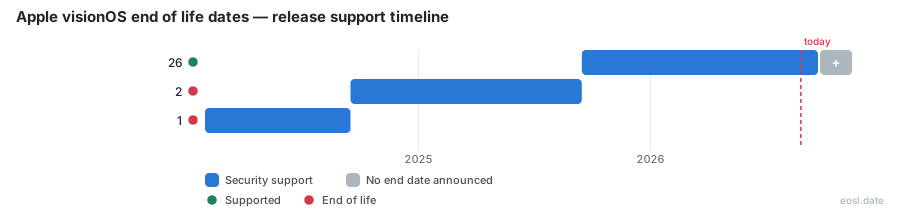
Currently Supported Apple visionOS Releases - Active EOS/EOSL Support (1)
| Release | Released | Security Support | Latest |
|---|---|---|---|
| 27 | (2 months ago) | Active | 27.2.1 (1 week and 5 days ago) |
Apple visionOS End of Life (EOL) Releases - No Longer Supported (3)
If you are tracking Apple visionOS end of life, the key point is that Apple stops shipping security fixes for an older build as soon as the next one arrives, so only the newest operating system for the Apple Vision Pro headset is protected today. This guide shows which releases are already unsupported, how Apple's yearly cycle works on its mixed reality and spatial computing platform, and what the M5 chip refresh means for the device itself.
Apple visionOS End of Life: Version History Overview
Apple unveiled the software at WWDC in June 2023 and shipped it with the first Apple Vision Pro on February 2, 2024. Since then it has followed the same yearly pattern as iOS, iPadOS, macOS, watchOS and tvOS: one new major cycle every September, announced at WWDC months earlier. Apple built the system mostly on iPadOS, so it also reuses frameworks from iOS, which is why its calendar tracks theirs so closely. The table below summarizes the version history and the support position of each entry as of October 27, 2026.
| Major version | Release date | Latest version | Support status | Security support ended |
|---|---|---|---|---|
| visionOS 1 | February 2, 2024 | 1.3 (July 29, 2024) | Unsupported | September 16, 2024 |
| visionOS 2 | September 16, 2024 | 2.6 (July 29, 2025) | Unsupported | September 15, 2025 |
| visionOS 26 | September 15, 2025 | 26.6.1 (August 17, 2026) | Unsupported | September 14, 2026 |
| visionOS 27 | September 14, 2026 | 27.2 (October 26, 2026) | Supported | Not announced |
The release policy behind those dates is simple. Each major version loses support on the day its successor ships, so a build stays protected for roughly one year and no longer. Apple jumped from 2 straight to 26 in 2025 when it moved every platform to year-based numbering. The newest edition shipped on September 14, 2026 alongside iOS 27, iPadOS 27, macOS Golden Gate, watchOS 27 and tvOS 27.
visionOS 1 and visionOS 2 Are Unsupported
The first edition stopped receiving patches in September 2024, only seven months after launch, and its final build was 1.3. The second followed a year later and ended at 2.6. Neither can be updated further, so any Apple Vision Pro still stuck on them is open to every flaw fixed since. The practical answer is to update, because Apple never offers extended bug fixes for these builds.
Latest Version and Release Date
The most recent update, 27.2, landed on October 26, 2026 after a beta cycle and a release candidate on October 19. It is the only branch that still gets patches, and it keeps that role until Apple ships next year's edition. Unlike visionOS 1 and visionOS 2, which each lasted about a year, this branch is still inside its window. Apple lists every build on the Apple Support page, so you can confirm yours in a minute, and Apple Vision Pro owners get new features through the same update screen.
visionOS 26 Security Support Has Ended
The third major cycle shipped on September 15, 2025, and visionOS 26 is now out of security support because the newest branch took over on September 14, 2026. Its last build, 26.6.1 from August 17, 2026, carried only security fixes. Over its life Apple's release notes show ten point updates for visionOS 26, and they trace how the features evolved:
- Widgets and persistence that keep windows where you placed them, even after a restart
- Spatial scenes, spatial video playback and spatial browsing in Safari
- Shared Personas for collaboration in the same room
- Travel Mode extended to cars and busses in 26.2
- Spatial Audio that starts faster in rooms you have visited before, plus AirPods Max 2 support in 26.4
- New APIs and support for spatial accessories aimed at developers and enterprises
Now that support has ended, all of these features are frozen on an unsupported build. That includes the companion Apple Vision Pro app that 26.1 brought to iPhone and iPad, new features and AirPlay viewing included. Third-party apps keep running, including iPhone and iPad apps in windows and native apps that fill your view with an immersive space, but they will stop targeting visionOS 26 as developers move to the supported branch, which is the usual virtual reality platform timeline.
Security Updates and Bug Fixes in visionOS 26
Most point updates were maintenance. Versions 26.0.1, 26.3, 26.5 and 26.6.1 were mainly security updates, while 26.3.1 fixed a flicker in MultiView sports playback. Version 26.6 also prepared the Spotlight index for the next cycle, and 26.0.1 collected important bug fixes for every user. If you still run this branch, install the current one now: you lose nothing, and the headset supports it fully, including eye tracking and hand input. Apple does not backport new bug fixes to visionOS 26.
visionOS 27 and the Next End-of-Life Date
Apple has not published a date, but its pattern makes a good forecast. Previous editions ended on the day the next one shipped, so the current branch should lose security patches around mid-September 2027, when the following edition is expected. Treat that as an inference rather than an announcement. The third beta of 27.2 reached developers in early October 2026, and the finished build followed on October 26, so updates are still arriving at a steady pace. Watch Apple's security releases page for an announcement; developers testing with Xcode and its simulator will see the new branch first, and Apple's Siri team, now led by the former Apple Vision Pro chief, may shape what ships next.
Hardware Support: Which Models Are Unsupported?
Only two Apple headsets exist, both built as mixed reality devices, and the newest software runs on both. The table shows how each model lines up with each major release.
| Model | Version 1 | Version 2 | Version 26 | Version 27 |
|---|---|---|---|---|
| Vision Pro with M2 | Unsupported | Unsupported | Unsupported | Supported |
| Vision Pro with M5 | Not applicable | Not applicable | Unsupported | Supported |
The Apple Vision Pro with M5 arrived in October 2025 with a faster M5 chip at the same $3,499 price, so owners of either model share one software lifecycle. Because both models keep receiving the newest build, the original M2 headset has not reached end of support yet, and Apple has not named a cutoff for it either.
Is Vision Pro Discontinued? What the Rumors Mean
No. MacRumors reported in April 2026 that Apple had all but given up on the Vision Pro after the M5 refresh failed to revive demand, yet the company still sells that model. It has not been discontinued, and the software keeps getting updates. The report said the team was redistributed, with some members moving to Siri, and that the returns rate was unusually high. Roughly 600,000 units sold in total, a small base for an Apple Vision Pro priced like a laptop and aimed at a virtual reality audience.
- A cheaper Vision Air project was reportedly halted in 2025
- A later report described four concepts for a revamped Vision Pro, not expected before late 2028
- Software support continues on the supported branch, regardless of sales
Smart Glasses and the Next Apple Headset
Apple is reportedly shifting effort to smart glasses with AI and no display, comparable to existing camera glasses. That technology cannot reuse the Vision Pro internals because it draws too much power, and Apple still treats mixed reality as a separate bet. For you, the takeaway is that a new device would not end visionOS; it would add a second product beside it, and augmented reality features would arrive there first.
Support Status Checklist for Developers and Users
Keep the plan short. Developers building apps for Apple should target the newest branch with RealityKit, because older ones no longer get patches. Users with older apps installed can follow a few steps, and every Apple app on the headset will update with it:
- Open Settings on your Vision Pro and install every available update.
- Check the build number against the table above.
- Keep your iPhone and iPad current, since the Apple Vision Pro companion app now runs on both.
Developers planning a migration should move to the supported branch and test with RealityKit early, since missing tools such as window pinning and skeleton tracking are unlikely to be patched into an unsupported build. Staying current also keeps the immersive experiences working as designed. Owners of an Apple Vision Pro get the best outcome by staying current, because Apple, for now, keeps supporting the platform with features and fixes.