FoundationDB End of Life (EOL) Dates and End of Support (EOS) Dates
FoundationDB end of life (EOL) and end of support (EOS) dates: 2 FoundationDB versions have reached EOL, including FoundationDB 7.1 (EOL date: Nov 20, 2026) — no longer receiving security updates or patches. FoundationDB 7.4.8 is the current supported release — 2 versions in active support. Also see Apple Watch lifecycle dates for related end-of-life information.
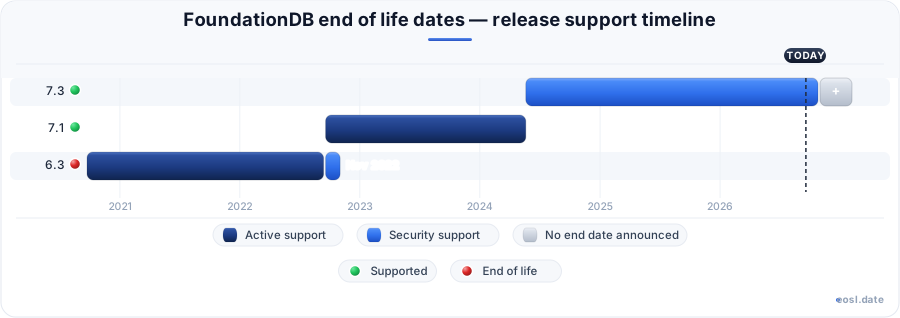
Currently Supported FoundationDB Releases - Active EOS/EOSL Support (2)
FoundationDB End of Life (EOL) Releases - No Longer Supported (2)
If you run an ordered key-value store in production, FoundationDB end of life is a question about branches, not a single shutdown date: the 7.3 line is the supported release, 7.1 only gets bug fixes, and 6.3 is unsupported. Apple's open source project publishes no countdown, so you read the status from its release table and plan your upgrade yourself.
FoundationDB End of Life: Latest Release and Patch Releases
FoundationDB is a distributed database for large volumes of structured data on clusters of commodity servers. Because the project keeps several release lines alive at once, the real FoundationDB support question is which line you run. The latest release is 8.0.0, published on October 2, 2026, while the newest production release on the stable 7.3 branch is 7.3.77, dated April 16, 2026. Both ship as binaries from GitHub and as source.
The latest stable releases are the ones validated by simulation and real cluster tests. A branch is either supported or unsupported, and each patch release only lands on branches the maintainers still publish for. FDB teams should treat the table below as the single source of truth.
FDB Release History by Version
Each major line moves through active support, then security support, then nothing. The FoundationDB release schedule below combines the project README with the endoflife.date tracker.
| Branch | Released | Active support | Security support | Latest patch |
|---|---|---|---|---|
| 7.3 | May 20, 2024 | Yes | Yes | 7.3.77 (April 16, 2026) |
| 7.1 | September 19, 2022 | Ended May 20, 2024 | Yes | 7.1.61 (May 15, 2024) |
| 6.3 | September 23, 2020 | Ended September 19, 2022 | Ended November 2, 2022 | 6.3.25 (November 2, 2022) |
FoundationDB 7.3 and 8.0 Supported Branches
FoundationDB 8.0 is the newest major release, and 7.3 is the branch the maintainers actively maintain with new patches. Choose either for new clusters; 7.3 is the safer pick if you want a long-validated line.
FoundationDB 6.3 and Unsupported Branches
FoundationDB 6.3 sits among the unsupported branches. Its last patch, 6.3.25, arrived in 2022, so it gets no fixes, and the older production branches before it are in the same position.
Supported Branches, Bug Fixes and Experimental Branches
The README groups every branch into four states, and knowing them tells you what "support" means in practice:
- Supported: actively maintained, with new patch releases published.
- Bug fixes: the project still accepts bug fixes but may not publish a new binary, so you build the release yourself if you need one.
- Experimental: internal feature testing only, such as 7.2 and 7.0. These experimental branches are never meant for production use.
- Unsupported: no further updates of any kind.
The latest branch always receives the most attention. If you run an older version, the maintainers advise moving to the next major release's newest patch, then repeating. The software has no extended-support contract, so the table is your service level.
Release Support Dates and Active Support Windows
Active support for 7.1 ended the day 7.3 arrived, May 20, 2024, which shows the pattern: active support typically ends when the next stable line ships, and security support trails it. That gap on 7.1 is already more than two years long, so it cannot be relied on to last.
Known Limitations and Unsupported Workloads
Moving to a supported release does not remove engine limits, so know which problems an upgrade will not solve. Support also has a technical meaning. The documentation's known limitations page lists what the engine will not do on any version, and these limitations explain many production incidents that upgrading will not fix. Transactions are ACID transactions across the whole key space, but they have hard edges. Storage choice, disk performance and the right hardware matter as much as the version, because slow storage drags down commit performance for every client. To scale reads you add storage servers, yet read load balancing stays limited, so performance does not always scale evenly with node count.
- Spinning disks are not recommended with the ssd storage engine, since its storage algorithms target solid-state drives.
- Anyone who can connect to a cluster can read and write every key, so it is not a security boundary.
- Key selectors with large offsets resolve in O(offset) time.
Large Transactions and Keys in Production Use
These ceilings are identical on every supported branch, so an upgrade will not raise them. A transaction cannot affect more than 10,000,000 bytes of data. Keys are capped at 10,000 bytes and values at 100,000 bytes, and transactions that run past five seconds fail. Plan these ceilings into any design, whichever release you run in production.
Cluster Size and Database Size
These limits also hold across supported releases. The documentation also lists limits on cluster size and database size. A cluster that scales past the tested range risks reliability, so test large deployments before trusting them with servers full of critical data.
FoundationDB EOL Risks of Running Unsupported Versions
Running an unsupported branch means every defect found after its last patch stays open for you. A 6.3 cluster carries years of fixes it never received, and new client libraries may stop talking to it.
Planning a FDB Upgrade Using Release Notes
Start with the release notes for each version between yours and the target, then follow the upgrade instructions on the forums and in the docs. An upgrade normally moves one line at a time: 6.3 to 7.1, then 7.1 to 7.3, then onward. Developers should fetch matching binary downloads from the GitHub releases page, and pin the same version on every machine. The GitHub repository also hosts the source, the issue tracker and the README branch table, so check GitHub again before each upgrade window; developers who build from GitHub should confirm the tag they compile.
Binary Downloads and Language Bindings
Binary downloads exist for macOS and Linux, while Windows users build from source. Language bindings must match the server's client version, so update application libraries in the same window.
Testing Compatibility Before You Upgrade
Verify compatibility in a staging cluster first. FoundationDB's simulation testing covers the core, but your workload, client library and layers are yours to test. Run representative load, watch latency, and keep a rollback plan.
Support Dates for Older FoundationDB Versions
Anything older than 6.3, including 5.x, belongs to the same unsupported history, and no date will bring it back. Treat a 5.2 or 6.0 deployment as a migration project, not a patch task.
Choosing a Supported Release Before Support Ends
Pick a supported branch with room left on its window. Today that means 7.3 or 8.0; 7.1 works only as a short stop on the way. Schedule the move while the current branch still gets fixes, so you are never forced to upgrade in the middle of an incident.
FoundationDB Release Highlights from 7.0 to 8.0
Upgrading is easier to justify when you know what changed. FoundationDB 7.0, now an experimental and unsupported branch, cut p99 tail latencies by 30 percent by splitting the proxy role into commit proxies and GRV proxies. Earlier 6.3 patches added transaction tagging, and multi-region support with seamless failover came in the 6.x line.
FoundationDB 8.0 adds native change data capture, durable named streams over key ranges that consumers can resume, and moves the codebase to standard C++20 coroutines. For Apple and other large operators, that is a reason to prefer 8.0. These features, including multi-region designs, ship in the supported lines, and the support policy for 8.0 follows the pattern above.
Open Source FDB Layers, Forums and Community
FoundationDB became open source in April 2018, and its community now owns its future. The core is a small key-value store; layers add document, record and other data models on top, so a single cluster can host several. That design keeps the core lean, and the community builds the rest.
Because FoundationDB sits underneath other systems, its data guarantees reach every layer you build. If a layer you depend on is abandoned, your data model has the same support problem as an old branch, so ask which community members maintain each of your layers and check the last commit before relying on it.
The forums are the main place the community discusses releases, and the GitHub issue tracker takes bug reports. The documentation covers API usage and design. If you hit trouble on FoundationDB end of life questions, ask the community before assuming a branch is abandoned. A healthy community answers questions about older releases and decides which patches reach the bug fix branches. Join the community early rather than during an outage, because community members who run older releases know which upgrade paths work, and a responsive community keeps strong consistency guarantees intact across versions. The community also reviews the design documents behind each major change. The NoSQL distributed database keeps data consistent, and the project's governance gives contributors a voice in future support decisions.