TrueNAS End of Life (EOL) Dates and End of Support (EOS) Dates
TrueNAS end of life (EOL) and end of support (EOS) dates: 3 TrueNAS versions have reached EOL, including TrueNAS 24.10 (Electric Eel) (EOL date: Aug 07, 2025) — no longer receiving security updates or patches. TrueNAS 25.10.7 is the current supported release — 2 versions in active support. Also see AlmaLinux OS end of support dates for related end-of-life information.
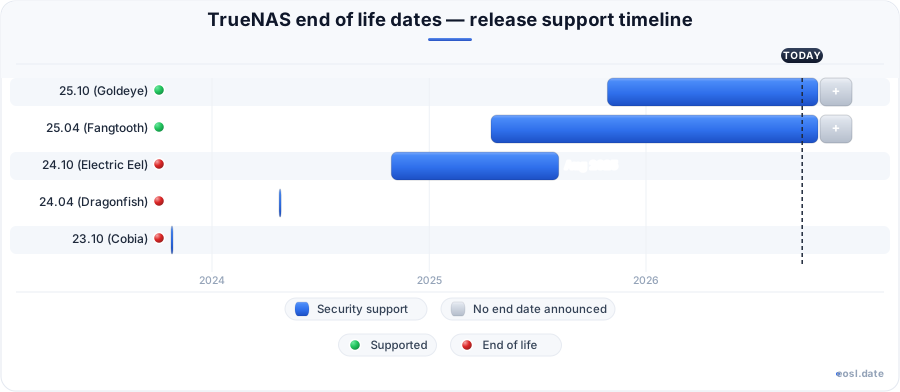
Currently Supported TrueNAS Releases - Active EOS/EOSL Support (2)
TrueNAS End of Life (EOL) Releases - No Longer Supported (3)
Planning around TrueNAS end of life starts with a surprise: iXsystems never publishes a fixed expiry date for any release. TrueNAS is a family of network-attached storage systems built on Debian, sold as Enterprise appliances and shared with the open-source community under the former name TrueNAS SCALE. This guide shows you how to tell when a version has aged out, which releases still receive fixes, and what to do before yours stops being recommended.
What TrueNAS End of Life Means for Your Storage
In practice, a release reaches end-of-life when the TrueNAS team no longer recommends it for any user type. There is no countdown clock, so you read the signals instead: the version drops off the recommendations, its pages move into the documentation archive, and new fixes stop arriving. Third-party trackers describe the same moment as the end of security support, and they currently list only the two newest families as actively maintained.
Treat an unsupported system as a risk to production data. A box with no update path misses every future patch, and an unpatched server on your network is exactly the exposure admins warn about. If you hold a support contract, contact TrueNAS Support before you change anything.
- The release disappears from the official recommendations.
- Its documentation is frozen instead of revised.
- No new update appears for it, even after a published fix lands in a newer family.
The TrueNAS Software Lifecycle From Planning to Maintenance
The software lifecycle explains why end dates stay informal. TrueNAS follows an open-core model: Community and Enterprise systems install from the same image, and Enterprise features unlock through licensing. Community members test pre-release builds and the team gathers feedback from both sides, while iXsystems tracks work in Jira, where you can file a bug or a feature request.
Planning and Development Stages
During planning, the team turns Enterprise requirements and community ideas into a prioritized list. Engineers peer-review each approved change before an engineer writes it. Automated nightly builds then publish whenever the automated tests pass, so any member can try an early build.
Evaluation Stage and Security Review
Evaluation folds changes into the codebase and applies regression testing to nightly builds, with deeper validation after code freeze. A BETA build reaches wider testing next, followed by a release candidate. The team also completes a security review of the code and publishes security advisories for anything users should know, while the documentation team writes the public change notes in parallel.
Maintenance Release Stage and Bug Fixes
After launch, every version enters ongoing maintenance. Each maintenance release bundles bug fixes and security patches, and small hotpatches numbered like 25.10.3.1 handle urgent single problems. iXsystems posts each maintenance release on its status page. A healthy version keeps getting a fresh patch every few weeks; a quiet one is heading toward retirement.
TrueNAS Release Schedule and Each Major Version
Starting with TrueNAS 27, the project follows an annual release cadence with one major version per year, and the number reflects the year it becomes the stable build. Each family also carries a codename, and a full version reads YY.MINOR.PATCH, such as 25.10.7. Individual builds are labelled early, stable or maintenance, and the latest release in a family is the one worth running. Bug tickets are typically accepted only for the newest stable family.
| Family | Codename | Released | Security support |
|---|---|---|---|
| 25.10 | Goldeye | 28 Oct 2025 | Yes |
| 25.04 | Fangtooth | 15 Apr 2025 | Yes |
| 24.10 | Electric Eel | 29 Oct 2024 | Ended 7 Aug 2025 |
| 24.04 | Dragonfish | 23 Apr 2024 | No |
| 23.10 | Cobia | 24 Oct 2023 | No |
Dates and status come from the public tracker as of late September 2026, so confirm them against the official page before you act. Looking ahead, TrueNAS 27 published its first release candidate on 6 October 2026, after three BETA builds in April, June and August, while 28 nightlies remain experimental.
Reading the Software Status Page for Version Recommendations
The official software status page pairs each release with an audience, so you can decide how much risk you accept. A developer build is for contributors, an early adopter build offers pre-release access with rough edges, a general build is field tested, and a mission critical build suits high availability work where changes are infrequent.
| User type | What to expect |
|---|---|
| Developer | New features and bugs alike |
| Early adopter | Workarounds and patience |
| General | Mature features, few issues |
| Mission critical | Infrequent update for 24x7 operations |
For Enterprise customers, the page recommends the default update profile named for production-grade installs. Check the version recommendations there whenever you decide whether to upgrade or hold the current update, because that page is the authority the lifecycle policy points to.
TrueNAS CORE Is Discontinued as Community Edition Takes Over
TrueNAS CORE, the FreeBSD edition, is no longer developed as an active product and sits in maintenance mode. Its final 13.0 build, 13.0-U6.8, shipped in July 2025, and the Debian-based line is now the only one under active development. In January 2025 iXsystems announced that SCALE had reached feature parity with CORE and renamed it Community Edition.
Upstream FreeBSD 13.2 reached its own end-of-life in 2024, which made the jails, plugins and virtual machines in 13.0 obsolete. Anyone still depending on those plugins should plan an update path and a migration, and Enterprise customers can ask iXsystems to schedule one. Your ZFS pools carry over, but treat the move as a project:
- Export your configuration and note every FreeBSD jail and plugin you rely on.
- Confirm each ZFS dataset is healthy before you migrate, and snapshot anything shared by TrueNAS CORE.
- Rebuild virtual workloads on the new platform, since jails do not transfer; ZFS replication moves only the data.
- Keep the old ZFS pool read-only until the new system has proven itself.
Deprecated Features and Release Notes to Read Before Upgrading
Retirement often arrives feature by feature before it reaches a whole family, so read the release notes for every major version you cross. The CORE 13.0 notes flag several deprecated items:
- The S3 service is deprecated for maintainability reasons and was removed in CORE 13.3, so move data off it first.
- SAS multipath is supported as-is with no further maintenance, so avoid creating new setups.
- Netatalk has been on the way out since 13.0-U3, and the web interface raises an S3 service alert while that service runs.
- The final CORE builds were narrow in scope, touching iSCSI and Fibre Channel handling (including how a removed iSCSI LUN is advertised), Active Directory idmap interruptions and TrueCommand Cloud connectivity, a pattern that signals a line winding down toward retirement.
The same notes show that 13.0-U6.3 fixed a python deserialization vulnerability tracked as CVE-2020-22083, which is why the project urged every CORE user to update. Together these entries form a feature deprecations trail worth reviewing before any jump. A deprecated service is a warning that the next major version will not carry it, and a family whose notes shrink to small fixes is close to losing support altogether.
Upgrade Paths When a Release Reaches EoL
Before upgrading, move to the latest maintenance release of your current family, then step to the newest build of the next one. Update to a release at the end of its family first, and only then cross to a newer family. Each listed release links to its downloads, and your hardware, deployment size and tolerance for downtime decide how fast you go.
Update Versus ISO Install
TrueNAS supports two methods, and not every path allows both:
- Update: apply the update from the web interface or install a manual update file; run the last update of your current family first.
- ISO install: keep your ZFS pools untouched, save your configuration file, perform a fresh installation from an ISO image of the target version, then upload the saved file.
Skipping a Major Version Safely
A fresh install lets you skip several steps, but never run zpool upgrade early, because a ZFS feature flag upgrade cannot be undone; but each skipped family may have retired a service, so read its notes first. When a family introduced many changes, upgrade through it step by step. The supported chain runs from 22.02 (Angelfish) to 22.12 (Bluefin), through 23.10, 24.04, 24.10 and 25.04, up to 25.10, with 27 anticipated next. Teams should rehearse on spare machines, since an important pool rarely forgives a rushed upgrade.
Where Security Patches Fit in the Life Cycle
A supported family keeps receiving patches on a steady beat, and that beat is how you spot the end of coverage. Version 25.10.7 arrived as an update on 2 September 2026, three weeks after 25.10.6, which signals stability. By contrast, 24.10 lost security coverage on 7 August 2025 and no longer gets new patches. When the interval between builds stretches into months and testing attention moves to a newer family, your release is aging toward retirement.
Stable Release Choices for Enterprise Systems and Discontinued Versions
Your decision depends on who depends on the box. Enterprise systems should follow the recommended profile and call support before any change. Home labs, including those still on TrueNAS CORE, can run the newest stable family sooner, though FreeBSD-based installs have no future family to reach. Whichever you are, do not run a retired line longer than your recovery plan allows.
- Check the status page quarterly and after every major announcement.
- Follow what iXsystems announces, and subscribe to the tracker feed so an EoL change reaches you early.
- Back up your configuration before every update, and read the notes attached to that update.
- File a bug with the exact version string when something breaks.
- Test the next family on spare machines before touching your live pool.