Rocky Linux End of Life (EOL) Dates and End of Support (EOS) Dates
Rocky Linux 10.2 is the current supported release, with support through May 31, 2035 — 3 versions currently in active support. Track Rocky Linux end of life dates — EOL, EOS and EOSL dates — across all 3 releases. Also see CentOS Stream EOSL information for related end-of-life information.
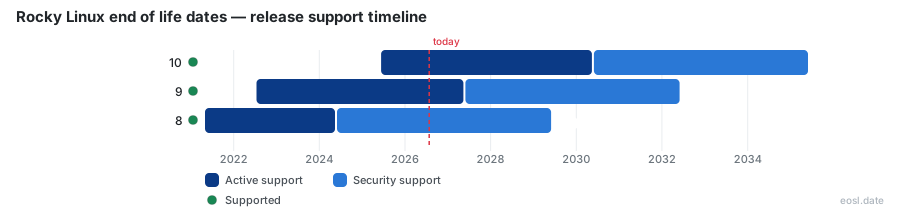
Currently Supported Rocky Linux Releases - Active EOS/EOSL Support (3)
| Release | Released | Security Support | Active Support | Latest |
|---|---|---|---|---|
| 10 | (1 year and 4 months ago) | (in 8 years and 6 months) | (in 3 years and 6 months) | 10.2 (5 months ago) |
| 9 | (4 years and 3 months ago) | (in 5 years and 6 months) | (in 6 months) | 9.8 (5 months ago) |
| 8 | (5 years and 6 months ago) | (in 2 years and 6 months) | (2 years and 5 months ago) | 8.10 (2 years and 5 months ago) |
Planning around Rocky Linux end of life starts with knowing which release you run. This free, open source Linux distribution is a downstream, binary-compatible and bug-for-bug compatible rebuild of Red Hat Enterprise Linux, a community-run enterprise operating system. Version 8 ends on 31 May 2029, version 9 on 31 May 2032 and version 10 on 31 May 2035.
Rocky Linux EOL Dates for Every Supported Release
As of 26 October 2026, three supported release lines exist. The table shows when each stops receiving full updates, when it is retired, and how many days remain until then.
| Release | Codename | Release date | Active support ends | Security support ends | Latest version | Days until retirement |
|---|---|---|---|---|---|---|
| Rocky Linux 8 | Green Obsidian | 1 May 2021 | 31 May 2024 | 31 May 2029 | 8.10 | 948 |
| Rocky Linux 9 | Blue Onyx | 14 July 2022 | 31 May 2027 | 31 May 2032 | 9.8 | 2,044 |
| Rocky Linux 10 | Red Quartz | 11 June 2025 | 31 May 2030 | 31 May 2035 | 10.2 | 3,139 |
Rocky Linux 8 has already left full support and sits in its five-year tail. Rocky Linux 9 leaves it in about seven months, a good moment to schedule your Linux move to Rocky Linux 10.
Release Date and Latest Version at a Glance
The date column marks general availability of the first release in each line. Every line has since gained newer builds: the newest are 8.10, 9.8 and 10.2. Each ships its own kernel version (4.18, 5.14 and 6.12), and the architectures differ too: Rocky Linux 8 covers x86-64 and aarch64, Rocky Linux 9 adds ppc64le and s390x, and Rocky Linux 10 adds riscv64. Each codename (Green Obsidian, Blue Onyx, Red Quartz) is just an internal label for a major Linux line.
How the Rocky Linux Support Lifecycle Works
Each major line follows a 10-year support lifecycle built on a ten-year promise: five years of full updates, then five years of security-only fixes. The Release Engineering team and the wider Rocky Linux community ship builds shortly after upstream, but as an open community they cannot guarantee a general availability date, and the Linux ecosystem around it counts on that steady rhythm.
Release Schedule and the Final Minor Release
The release schedule mirrors RHEL: a new major version lands in May, and minor versions arrive in May and November. Every Rocky Linux line ends with a final minor release, numbered .10, which starts maintenance mode and brings maintenance-only updates for five more years. At that point CentOS Stream stops upstream development too, and older builds move to the vault.
Terminology for Active Support and Security Support
The first period, also called full support, delivers new features and software rebases. The second, also called maintenance support, delivers security updates and the occasional bug fix. Under the lifecycle policy, both count as supported; only retirement ends them.
Major Version and Minor Version Support Rules
A major version such as Rocky Linux 9 stays supported until its retirement date, yet only its latest minor release is. When 9.8 shipped, 9.7 became unsupported, and 8.9 lost coverage the day 8.10 arrived. Apply sudo dnf upgrade after each minor version appears to stay current inside a major version.
What Rocky Linux End of Life Means for an Unsupported Version
When a Rocky Linux release reaches end of life, the Linux project stops all updates: no fixes, no new packages and no patches. Its final build sits in the vault repositories, and any new vulnerability, including a fresh CVE, stays open. That creates real security risks and can break compliance rules for regulated infrastructure or a production server. Treat the end-of-life date as a hard deadline, not a suggestion, since an unsupported system gets no help from the project even if it keeps running.
Rocky Linux Versus RHEL: Where End of Support Differs
Unlike RHEL, Rocky Linux keeps no point release alive once a newer one appears, so older minor builds reach end of support immediately. Red Hat sells an extended life cycle add-on; Rocky has no equivalent, so its cycle is shorter. It also lacks live kernel patching, which admins fill with a third party paid service.
The project began after Red Hat moved CentOS toward CentOS Stream, leaving many Linux admins without a free Red Hat Enterprise Linux clone. Gregory Kurtzer, a CentOS co-founder, launched it, and the Rocky Enterprise Software Foundation (RESF) now stewards it. Because it rebuilds RHEL sources, compatibility with Red Hat software is the goal, and its stability makes this enterprise Linux operating system enterprise-ready for many Linux teams in the open source community. Pre-release Rocky Linux builds, such as a release candidate or beta, are not meant for production, so use only stable images from the downloads page. Since Rocky Linux tracks RHEL releases, its end-of-life dates trail Red Hat's schedule, but without the paid extensions Red Hat offers.
Long-Term Support Options for an Unsupported Release
If you cannot migrate in time, a vendor can extend coverage. CIQ, founding sponsor of RESF, offers Rocky Linux customers long-term support (LTS) that adds up to five years of coverage for a major version and 18 months for selected minor versions. Its backports target packages rated Important or Critical, generally a CVE score of 7.0 or higher. A subscription unlocks the LTS packages and images, with pricing set by CIQ after a sales call, and CIQ staff also contribute to the project.
Choosing a Support Provider
Any support provider maintains its own packages and policies outside the project, so the release is still unsupported upstream. Compare commercial support providers on backport scope, response time and price, and ask what date their coverage itself ends.
Upgrade and Migration Steps Before the EOL Date
The project advises against in-place jumps between major versions. The safer migration looks like this:
- Check which Linux release you run with
cat /etc/os-releaseand compare it to the table above. - Back up your important data, then install a fresh Rocky Linux 10 system on a staging server.
- Restore the data, test your software, then switch traffic over.
- Run
sudo dnf upgradeweekly so the new system stays on the newest minor version.
With Rocky Linux 8 retiring in 948 days, start planning at least a year early.