AlmaLinux OS End of Life (EOL) Dates and End of Support (EOS) Dates
AlmaLinux OS 10.3 is the current supported release, with support through May 31, 2035 — 3 versions currently in active support. Track AlmaLinux OS end of life dates — EOL, EOS and EOSL dates — across all 3 releases. Also see Red Hat Enterprise Linux end of support dates for related end-of-life information.
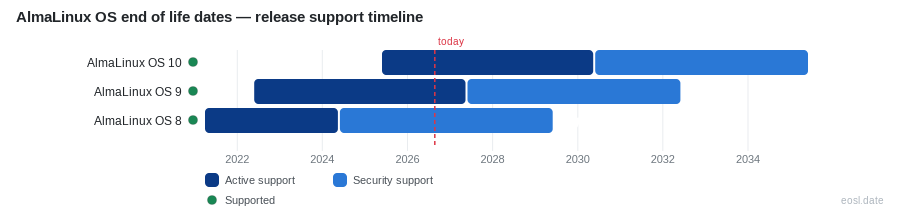
Currently Supported AlmaLinux OS Releases - Active EOS/EOSL Support (3)
| Release | Released | Security Support | Active Support | Latest |
|---|---|---|---|---|
| 10 | (1 year and 5 months ago) | (in 8 years and 6 months) | (in 3 years and 6 months) | 10.3 (1 week and 1 day ago) |
| 9 | (4 years and 5 months ago) | (in 5 years and 6 months) | (in 6 months) | 9.9 (1 week and 1 day ago) |
| 8 | (5 years and 7 months ago) | (in 2 years and 6 months) | (2 years and 5 months ago) | 8.10 (2 years and 5 months ago) |
Planning around AlmaLinux OS end of life comes down to a few dates per release. AlmaLinux OS is a stable, free, open source enterprise Linux distribution owned by its community and built for long-term stability. Every major version has a published date when updates stop, so you can schedule your move long before that day arrives.
AlmaLinux OS End of Life Dates for Versions 8, 9 and 10
Each major release carries long-term support of 10 years from its release date, a 10-year lifecycle split into two phases. The table shows the published dates.
| Major release | Release date | Active support ends | Security support ends | Latest minor |
|---|---|---|---|---|
| AlmaLinux 8 | 30 Mar 2021 | 31 May 2024 (ended) | 31 May 2029 | 8.10 |
| AlmaLinux 9 | 26 May 2022 | 31 May 2027 | 31 May 2032 | 9.8 |
| AlmaLinux 10 | 27 May 2025 | 31 May 2030 | 31 May 2035 | 10.2 |
The security support date is the real end-of-life date for a major release. AlmaLinux 8 already sits past active support, while AlmaLinux 9 has about seven months of it left.
Active Support vs Security Support
Active support brings new features, hardware enablement and routine bug fixes. Security support is the long tail afterwards: you receive only security updates, so plan any application changes before the active phase closes. A stable release in this phase is still safe, but the community stops adding features.
AlmaLinux OS Minor Versions and Their Cutoff
A minor version has no calendar date. It reaches end of life when the next minor release ships, so 9.2 ended with 9.3 and 8.9 ended with 8.10. Applying regular updates keeps you current, and an upgrade inside one major release is routine rather than a migration.
How the AlmaLinux OS Support Lifecycle Differs From RHEL
AlmaLinux OS is binary compatible with RHEL, the upstream it follows, and typically ships updates within one business day of Red Hat. In July 2023 the project moved from a downstream rebuild to ABI compatibility, which also freed it to restore hardware support that RHEL removed and to add architectures beyond Red Hat's list.
The lifecycle is where the two diverge, and RHEL's own schedule shapes yours. Like RHEL, AlmaLinux keeps its support commitments for a decade per major release, but it retires each minor version the moment the next arrives. The practical risk is a server left on an old minor release: it stops receiving fixes even though its major release is still supported. Other enterprise Linux options such as Rocky Linux also advertise a 10-year window, so the dates alone rarely decide the choice.
Release Notes and Supported Architectures for Each AlmaLinux OS Version
The release notes list every release with its codename, beta date, release date and kernel. For example, 10.2 "Lavender Lion" shipped on 26 May 2026 with a 6.12 kernel, 9.8 "Olive Jaguar" shipped the same day on 5.14, and 8.10 "Cerulean Leopard" arrived on 28 May 2024 on 4.18. A beta of 10.3 and of 9.9 is available now. You can download ISO images, cloud images and container images for hardware, cloud and container deployments.
Supported Architectures and x86_64-v2
Every current release covers four architectures: x86_64, aarch64, ppc64le and s390x. Version 10 requires the x86_64-v2 level, so very old x86_64 CPUs cannot run it.
| Release | Kernel | Architectures |
|---|---|---|
| 10.2 | 6.12 | x86_64, x86_64-v2, aarch64, ppc64le, s390x |
| 9.8 | 5.14 | x86_64, aarch64, ppc64le, s390x |
| 8.10 | 4.18 | x86_64, aarch64, ppc64le, s390x |
AlmaLinux OS Kitten 10 as the Upstream Preview
Kitten is the project's direct upstream for version 10, where fixes land first. Its active support matches the end of CentOS Stream 10, so treat it as a preview where the community tests changes, not a stable production target.
Security Updates Until the End of Support Date
Once a release hits its end of support date, security updates and security patches stop leaving newly discovered vulnerabilities unpatched on every installed package set. Until then, the operating system's packages receive bug fixes and patches, and AlmaLinux 9.2 earned FIPS 140-3 validation, which matters for FIPS-driven compliance work in regulated software environments. The foundation publishes each fix with a rating so you can prioritise by security impact.
Errata, OpenSCAP and SBOM Data
Each update ships with errata describing the issue and its importance. Audit tools include OpenSCAP with OVAL streams, the SBOM built into the pipeline traces every package, and patched packages carry an .alma suffix, and Secure Boot is supported.
CVE Patches Ahead of RHEL
Occasionally the community asks for a CVE or bug to be patched before RHEL does, as with CVE-2024-1086. That patch is reverted if the upstream fix later differs.
Commercial Support for Your AlmaLinux OS Lifecycle
The AlmaLinux community supports itself freely, community members vote on the board, and the project is run by a non-profit foundation under open governance, with sponsors funding development. For production workloads that must outlive the dates above, commercial support is available from third party providers. Extended life cycle support, live kernel patching and paid patching come from vendors such as TuxCare, a division of CloudLinux, the founding sponsor. Enterprise teams can rely on AlmaLinux OS because the enterprise-grade distribution itself stays free of license fees and open-source throughout, and the Linux distribution remains shaped by its community.
Migrating From CentOS Before AlmaLinux 9 Support Ends
A planned migration beats a rushed one. The project built tools so the CentOS you run today becomes AlmaLinux OS without reinstalling the operating system. Because AlmaLinux is binary compatible with RHEL, your applications should keep working.
ELevate for Moving From CentOS 7
ELevate performs an in-place upgrade from CentOS 7 to a newer major release using Leapp, which is the path for hosts that cannot jump straight to AlmaLinux 9.
Single Host and Fleet Moves With almalinux-deploy
For CentOS 8 and CentOS Stream, the almalinux-deploy script converts a host in place, and the same command scales across a whole fleet of servers. Community guides cover each step. Check where you stand with cat /etc/almalinux-release before you start.