Tails End of Life (EOL) Dates and End of Support (EOS) Dates
Tails end of life (EOL) and end of support (EOS) dates: 6 Tails versions have reached EOL, including Tails 6 (EOL date: Sep 18, 2025) — no longer receiving security updates or patches. Tails 7.16 is the current supported release. Also see AlmaLinux OS EOSL information for related end-of-life information.
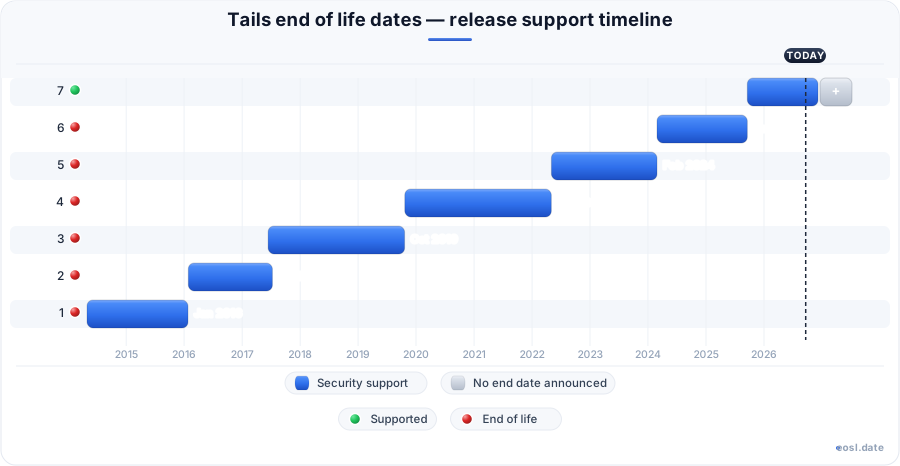
Currently Supported Tails Releases - Active EOS/EOSL Support (1)
| Release | Released | Security Support | Latest |
|---|---|---|---|
| 7 | (1 year and 1 month ago) | Active | 7.16 (6 days ago) |
Tails End of Life (EOL) Releases - No Longer Supported (6)
| Release | Released | Security Support | Latest |
|---|---|---|---|
| 6 | (2 years and 8 months ago) | (1 year and 1 month ago) | 6.19 (1 year and 2 months ago) |
| 5 | (4 years and 6 months ago) | (2 years and 8 months ago) | 5.22 (2 years and 9 months ago) |
| 4 | (7 years ago) | (4 years and 6 months ago) | 4.29 (4 years and 7 months ago) |
| 3 | (9 years and 4 months ago) | (7 years ago) | 3.16 (7 years and 2 months ago) |
| 2 | (10 years and 9 months ago) | (9 years and 3 months ago) | 2.12 (9 years and 6 months ago) |
| 1 | (12 years and 6 months ago) | (10 years and 9 months ago) | 1.8.2 (10 years and 9 months ago) |
If you are asking about Tails end of life, the short answer is that the project supports only its newest build, so end of support arrives for every release as soon as a successor ships. As of late October 2026, Tails 7.15.1 is the build to run, and this guide gives you the dates, the risks and the safest way to stay on a supported Linux operating system.
Tails End of Life Explained: The Rolling Release Model
Tails is a Debian-based Linux distribution built by the Tails Project, now part of the Tor Project. Unlike most Linux distributions, it has no long-term maintenance tracks. This amnesic Linux operating system is built for anonymity and privacy, and it follows a rolling release approach: each new stable version replaces the last, and only that newest supported release gets security support. Every build therefore stays current only until the next one appears, and anything older should be treated as unsupported, however well it still boots.
Think of Tails as a security-focused Linux distribution that is replaced rather than patched in place. The Linux kernel and the Debian packages underneath change with each build, and the distribution promises security only for the newest image, so an expired build has nobody maintaining it.
From Six Weeks to a Two-Week Release Cadence
For years Tails shipped about every six weeks. Starting with Tails 7.12, the project moved to a two-week schedule that tracks Firefox and Tor Browser. Mozilla's Firefox 155, released on 1 September 2026, began that faster cycle, and the shorter release cadence means a Tails build now expires sooner than before. Skim the release notes of each build so you know what changed, and expect browser fixes to reach you quickly.
Tails EOL Dates for Tails 7 and Tails 6
Tails does not publish a retirement notice per build, so the dates below follow the endoflife.date tracker. Tails 6.0 launched on 27 February 2024 on Debian 12 "Bookworm", and its final build, 6.19, arrived on 20 August 2025. The whole 6.x series stopped receiving fixes on 18 September 2025, the day the 7.x series became the supported release. Treat the table like a Linux lifecycle chart with no grace period.
| Series | Release date | Retired | Last build |
|---|---|---|---|
| 7.x | 18 Sep 2025 | Still supported | 7.15.1 (23 Oct 2026) |
| 6.x | 27 Feb 2024 | 18 Sep 2025 | 6.19 (20 Aug 2025) |
| 5.x | 3 May 2022 | 27 Feb 2024 | 5.22 (29 Jan 2024) |
| 4.x | 22 Oct 2019 | 2 May 2022 | 4.29 (4 Apr 2022) |
| 3.x | 13 Jun 2017 | 21 Oct 2019 | 3.16 (3 Sep 2019) |
The pattern is steady: each series loses support within a day of the next series' first release date, so there is never a long overlap in which you can safely stay behind.
Check Your Latest Version Before Your Build Expires
Open a terminal and run cat /etc/amnesia/version to read your build number, then compare it with the latest version on the official site. A stick that still reports Tails 6.0, for example, is running an unsupported build and needs attention today.
Security Updates Stop at End of Support
Once a release is superseded, you no longer receive security updates for it. Tails bundles software such as Tor Browser, a Debian base and a Linux kernel, and each of those collects patches constantly. Linux kernel flaws, Debian package bugs and browser exploits are fixed upstream first, then reach Tails only inside a new build. An old build therefore piles up known vulnerabilities that attackers can target, which defeats the privacy Tails exists to provide. Every build also refreshes firmware and Electrum, so skipping one leaves further gaps.
The Thunderbird story shows how real this is. Through Tails 7.5, the Thunderbird bundled in the image was almost always outdated and affected by known vulnerabilities, because the Debian package arrived just after each Tails release. Since version 7.8, Thunderbird is no longer bundled; you add it through the Additional Software feature so Debian can update it on its own schedule. Even supported builds can lag on bundled apps, so an expired build is worse off. Moving it fixes one lag, but the project warns that extra packages can change security-sensitive behavior such as firewall rules.
Upgrade With Tails Upgrader Before Tails EOL
The Tails Upgrader checks for a newer build once you connect to the Tor network and downloads it through Tor, so the whole process stays private. Most Linux users upgrade packages in place, but Tails replaces the whole image. It only works when your build is recent enough, so anyone on Tails 6.0 or older has to reinstall instead. In practice you follow these steps:
- Start Tails from your USB stick and connect to the Tor network.
- Wait for the prompt that offers an update, then confirm it.
- Let the upgrader apply the update and restart when asked.
- If no prompt appears, download the newest image from the official site and install it again on a fresh stick.
Persistent Storage and Encrypted Data
When you leave an expired build, your Persistent Storage carries over because it sits in a separate encrypted partition protected with LUKS2. Unlock it from the Welcome Screen after restarting and your files, settings and Additional Software packages return. It is protected, but not hidden, so keep truly sensitive material elsewhere.
Security Support and Minimum Requirements for Tails Hardware
Staying supported also means your computer must run the current operating system image, and for security reasons Tails must live on a dedicated stick. The minimum requirements are modest: a 64-bit x86-64 processor, 2 GB RAM and an 8 GB USB stick. Tails runs as a live system from that stick or from a live DVD, with the GNOME desktop on top. ARM and PowerPC machines are not supported. Linux generally supports a wide range of hardware, so most machines work, but a laptop that cannot meet these requirements cannot move to newer builds and ends up stuck on an expired one.
Hardware that needs proprietary drivers can misbehave. Wi-Fi adapters, touchpads and some graphics chips may need workarounds, because Tails leaves out proprietary Nvidia drivers. You can run it inside a virtual machine, but that is potentially insecure, so use real hardware when you can.
Tails Privacy Features and the History Behind Its EOL Policy
Everything Tails promises depends on running current code. The system is amnesic: it runs from memory, writes nothing to the internal drive and overwrites most RAM at shutdown, so the whole operating system leaves no trace to blunt a cold boot attack. All traffic goes through Tor, which gives you anonymity and shields your privacy from surveillance and censorship. The toolbox adds GnuPG, KeePassXC, Metadata Cleaner, OnionShare and uBlock Origin in Tor Browser, and strong encryption guards your stored data. Journalists and activists rely on this Linux toolbox, and security researchers can verify the open source code, for exactly that reason. The wider Linux and Tor communities back it too.
In September 2024 the Tails Project merged into the Tor Project, which now maintains it. Past incidents show why patch discipline matters: in 2017 the FBI used a zero-day flaw in GNOME Videos, the default video player, to unmask a Tails user, and the flaw was patched later. That history is why the project insists you run only the newest build.