SUSE Linux Micro End of Life (EOL) Dates and End of Support (EOS) Dates
SUSE Linux Micro end of life (EOL) and end of support (EOS) dates: 4 SUSE Linux Micro versions have reached EOL, including SUSE Linux Micro 5.3 (EOL date: Oct 30, 2026) — no longer receiving security updates or patches. SUSE Linux Micro 6.2 is the current supported release, with support through Nov 30, 2029 — 5 versions in active support. Also see CentOS Stream EOSL dates for related end-of-life information.
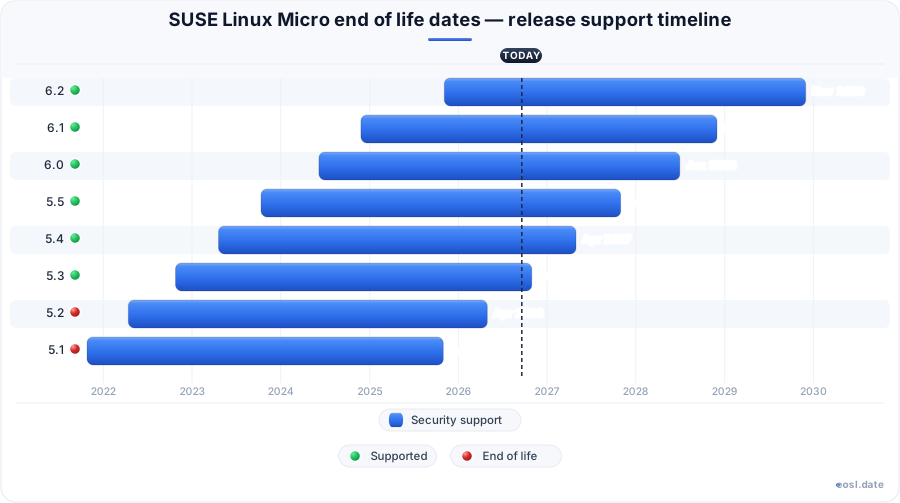
Currently Supported SUSE Linux Micro Releases - Active EOS/EOSL Support (5)
| Release | Released | General Support |
|---|---|---|
| 6.2 | (1 year ago) | (in 3 years) |
| 6.1 | (1 year and 11 months ago) | (in 2 years) |
| 6.0 | (2 years and 5 months ago) | (in 1 year and 7 months) |
| 5.5 | (3 years ago) | (in 11 months) |
| 5.4 | (3 years and 6 months ago) | (in 5 months) |
SUSE Linux Micro End of Life (EOL) Releases - No Longer Supported (4)
| Release | Released | General Support |
|---|---|---|
| 5.3 | (4 years ago) | (1 week ago) |
| 5.2 | (4 years and 6 months ago) | (6 months ago) |
| 5.1 | (5 years ago) | (1 year ago) |
| 5.0 | (5 years and 7 months ago) | (4 years and 7 months ago) |
Running a SUSE Linux Micro end of life check before your next maintenance window tells you how many months of supported updates your hosts still have. SUSE Linux Micro, formerly SUSE Linux Enterprise Micro, is a lightweight, containerized operating system built for edge computing and virtual workloads, and the lifecycle dates below show which release is supported, which has reached EOL, and when your infrastructure needs an upgrade. SUSE ships it inside SUSE Rancher Prime and SUSE Virtualization, so the same Linux dates govern those stacks too.
SUSE Linux Micro End of Life Dates by Release
Every minor version of the operating system gets four years of General Support, and the table lists each release, its FCS date (first customer shipment) and the day General Support Ends. Because the SUSE lifecycle page shows Not Applicable in the LTSS column for every Micro release, there is no paid extended support to fall back on once a date passes.
| SUSE Linux Micro release | FCS date | General Support ends | LTSS |
|---|---|---|---|
| SUSE Linux Micro 5.0 | 30 Mar 2021 | 31 Mar 2022 | Not Applicable |
| SUSE Linux Micro 5.1 | 26 Oct 2021 | 31 Oct 2025 | Not Applicable |
| SUSE Linux Micro 5.2 | 14 Apr 2022 | 30 Apr 2026 | Not Applicable |
| SUSE Linux Micro 5.3 | 25 Oct 2022 | 30 Oct 2026 | Not Applicable |
| SUSE Linux Micro 5.4 | 20 Apr 2023 | 30 Apr 2027 | Not Applicable |
| SUSE Linux Micro 5.5 | 12 Oct 2023 | 31 Oct 2027 | Not Applicable |
| SUSE Linux Micro 6.0 | 06 Jun 2024 | 30 Jun 2028 | Not Applicable |
| SUSE Linux Micro 6.1 | 26 Nov 2024 | 30 Nov 2028 | Not Applicable |
| SUSE Linux Micro 6.2 | 04 Nov 2025 | 30 Nov 2029 | Not Applicable |
As of late October 2026, SUSE Linux Micro 5.0, 5.1 and 5.2 are past their end of life date, and 5.3 follows on 30 October 2026. The newest release, SUSE Linux Micro 6.2, is the one that carries support the furthest, to 30 November 2029.
Lifecycle Dates for Every SUSE Linux Micro 5.x and 6.x Release
Read the lifecycle dates as a countdown rather than a deadline you can negotiate. The 5.x family loses General Support one release at a time between 2025 and 2027, with SUSE Linux Micro 5.5 the last of that series on 31 October 2027. The 6.x releases then run to 2028 and 2029. Since the product lifecycle is the same for every customer, a host on 5.4 has until 30 April 2027, whatever its subscription says.
The one odd row is 5.0, which received only one year of General Support, so treat it as long gone. Every later release was released with the full four-year window, and nothing on the lifecycle page suggests a longer one.
How the Release Cycle Sets Each SUSE Linux Micro EOL Date
SUSE follows a steady release cycle: a new minor version roughly every six to twelve months, each with its own fixed end date. Counting forward from the FCS date gives the EOL date, which is why 6.2, shipped on 4 November 2025, ends on 30 November 2029. Staying on the newest release resets your clock; staying put means each passing month brings the end of support closer without any change to your hosts.
The same page also lists the cloud native products and SUSE Edge on their own rows, so check that the product bundle you run is not on an earlier date than the operating system underneath it. A vulnerability in a stale release is no less a risk just because the surrounding product still has time left.
SUSE Linux Micro Lifecycle: What Each Support Phase Covers
The support lifecycle has a clear shape, and the SUSE support lifecycle for Micro is shorter than that of SUSE Linux Enterprise Server. During the General Support phase, SUSE provides technical support, security updates, bug fixes and routine maintenance, and you can open new deployments. Once General Support stops, that support phase ends outright for Micro: you may keep using the software under your license terms, but no further code-level maintenance follows. A shorter window of overlap exists between releases, so you can upgrade without an outage.
That is a firm contrast with SUSE Linux Enterprise Server, where a second extended support phase can follow. Many administrators assume every SUSE Linux product works that way, and with Micro it does not.
Product Lifecycle Rules for SUSE Linux Enterprise Server Service Packs
SUSE Linux Enterprise Server gets a longer product lifecycle because each service pack has its own General Support date and an LTSS date after it. The table shows the dates SUSE publishes for the SUSE Linux Enterprise 15 and 12 families, which is useful when a Micro host sits next to enterprise servers on the same patch schedule.
| SUSE Linux Enterprise Server service pack | FCS date | General Support ends | LTSS ends |
|---|---|---|---|
| SUSE Linux Enterprise Server 15 SP1 | 24 Jun 2019 | 31 Jan 2021 | 31 Jan 2024 |
| SUSE Linux Enterprise Server 15 SP2 | 21 Jul 2020 | 31 Dec 2021 | 31 Dec 2024 |
| SUSE Linux Enterprise Server 15 SP3 | 22 Jun 2021 | 31 Dec 2022 | 31 Dec 2025 |
| SUSE Linux Enterprise Server 15 SP4 | 21 Jun 2022 | 31 Dec 2023 | 31 Dec 2026 |
| SUSE Linux Enterprise Server 15 SP5 | 20 Jun 2023 | 31 Dec 2024 | 31 Dec 2027 |
| SUSE Linux Enterprise Server 15 SP6 | 26 Jun 2024 | 31 Dec 2025 | 31 Dec 2028 |
| SUSE Linux Enterprise Server 15 SP7 | 17 Jun 2025 | 31 Jul 2031 | 31 Jul 2034 |
| SUSE Linux Enterprise Server 12 SP1 | 15 Dec 2015 | 31 May 2017 | 31 May 2020 |
| SUSE Linux Enterprise Server 12 SP2 | 08 Nov 2016 | 31 Mar 2018 | 31 Mar 2021 |
| SUSE Linux Enterprise Server 12 SP3 | 07 Sep 2017 | 30 Jun 2019 | 30 Jun 2022 |
| SUSE Linux Enterprise Server 12 SP4 | 12 Dec 2018 | 30 Jun 2020 | 30 Jun 2023 |
| SUSE Linux Enterprise Server 12 SP5 | 09 Dec 2019 | 31 Oct 2024 | 31 Oct 2027 |
| SUSE Linux Enterprise Server 11 SP1 | 02 Jun 2010 | 31 Aug 2012 | 30 Aug 2015 |
| SUSE Linux Enterprise Server 11 SP2 | 29 Feb 2012 | 31 Jan 2014 | 30 Jan 2017 |
| SUSE Linux Enterprise Server 11 SP3 | 01 Jul 2013 | 31 Jan 2016 | 30 Jan 2019 |
| SUSE Linux Enterprise Server 11 SP4 | 15 Jul 2015 | 31 Mar 2019 | 31 Mar 2022 |
Notice that SP7 of version 15 is the last service pack in its family, so its General Support runs until 31 July 2031 instead of the roughly 18 months earlier packs received. Micro has no such split, which keeps its table simple but its decisions urgent.
SUSE provides a thirteen-year product lifecycle for most products in SUSE Linux Enterprise 12 and SUSE Linux Enterprise 15, which is why enterprise administrators plan around SUSE Linux Enterprise Server dates for a decade. SUSE Linux Enterprise High Performance Computing uses the same modular packaging as SUSE Linux Enterprise Server 15, while SUSE Linux Enterprise Server for SAP Applications receives 4.5 years of General Support per version. In each of these enterprise products the service pack is the unit that expires, so track every service pack as its own line item: only a service pack in General Support qualifies for new deployments, and once General Support stops, the LTSS subscription is what keeps patches flowing for that service pack. SUSE Linux Enterprise Real Time 15 SP7 also runs to 31 Jul 2031, and the Linux module lifecycles inside each service pack differ again. Micro has none of this layering, so for a Micro host you read the single row in the first table and ignore these service pack dates.
Choosing between families matters because the SUSE lifecycle page lists many separate rows: SUSE Linux Enterprise Server, SUSE Linux Enterprise High Performance Computing, SUSE Linux Enterprise Real Time and SUSE Linux Enterprise Point of Service each carry their own dates. An older SUSE Linux Enterprise Server 10 release reached the end on 31 Jul 2016, and SUSE Linux Enterprise Server 11 SP4 holds the longest LTSS Core date in its family, to 31 Mar 2028. If a team migrates a SUSE Linux Enterprise host to Micro, the SUSE Linux Enterprise date no longer applies, and the Micro row in the first table takes over.
Extended Support Through LTSS
LTSS, short for Long Term Service Support, lets a customer stay on one service pack for up to three more years without an upgrade. SUSE sells several flavours: standard LTSS (ESPOS for SAP customers), LTSS Extended Security for the last service pack, LTSS Core and LTSS Reactive. Support under LTSS covers existing systems only, delivers security patches and fixes, and offers no hardware enablement or new deployments. Reactive LTSS delivers patches only on request.
The LTSS flavours differ in who can buy them. LTSS (ESPOS) comes bundled with SUSE Linux Enterprise Server for SAP Applications; LTSS Extended Security gives deeper security coverage for the last service pack of each SUSE Linux Enterprise Server family, and LTSS Core adds three more years beyond the standard LTSS period for that same last service pack. LTSS Reactive covers every service pack except the last, with each fix requested through a support request and delivered as a PTF. Under every LTSS flavour, the LTSS subscription covers only existing systems or replacements on identical hardware, a change to the virtualization platform counts as a hardware change, and the issue must occur while the LTSS subscription is active. For SUSE Linux Enterprise Server 12 SP5, LTSS ends 31 Oct 2027 and LTSS Extended Security runs to October 2030. LTSS excludes enhancement requests, so LTSS is a bridge to a newer release, not a destination.
All of this applies to SUSE Linux Enterprise Server and not to Micro. If a policy document mentions LTSS for an edge host, check the product name, because LTSS never extends a Micro release past the General Support date.
SUSE Linux Micro Support Policy and Lifecycle Validation
The SUSE support policy bundles Micro with its cloud native products. As standard, SUSE Linux Micro is included in SUSE Rancher Prime, SUSE Rancher Suite and SUSE Virtualization, so customers with an active subscription to any of them receive continuous updates for the operating system alongside regular product releases. SUSE performs validation on the two most recent minor releases of SUSE Linux Micro and SUSE Linux Enterprise on a rolling basis, so a combination such as Kubernetes on SUSE Linux Micro 6.2 is tested, while a retired 5.x host stops receiving that checking.
Your subscription also decides which security patches and updates reach a host, and a lapsed subscription ends them. Once a Micro release passes its end of life date, the subscription no longer brings updates for it. Binary compatible derivatives of enterprise releases, such as openSUSE Leap, count as validated through the SUSE Linux Enterprise testing, and third-party systems are validated separately. None of those operating systems is supplied by SUSE as part of the cloud native software, so you need to ask the relevant distribution for operating system support.
Which SUSE Multi-Linux Manager Releases Run on a SUSE Linux Micro Host
The SUSE Multi-Linux Manager server and proxy are supported on top of either SUSE Linux Micro or SUSE Linux Enterprise Server. SUSE Multi-Linux Manager Proxy and SUSE Multi-Linux Manager Retail Branch Server follow the same lifecycle as the SUSE Multi-Linux Manager server, so the host limits how long the whole stack is supported.
| SUSE Multi-Linux Manager release | Supported Micro host | Supported SLES host | Support ends |
|---|---|---|---|
| SUSE Multi-Linux Manager 5.1 | SUSE Linux Micro 6.1 | SUSE Linux Enterprise Server 15 SP7 | 31 Jul 2027 |
| SUSE Multi-Linux Manager 5.2 | SUSE Linux Micro 6.2 | SUSE Linux Enterprise Server 15 SP7 | 31 Jul 2029 |
Release 5.0 of SUSE Multi-Linux Manager was supported on SUSE Linux Micro 5.5 and SUSE Linux Enterprise Server 15 SP6. Plan the manager and host moves together, because each SUSE Multi-Linux Manager release names one supported Micro version.
What Happens at EOL for SUSE Linux Micro
Once a release hits its end-of-life date, you can keep running it within your license, but SUSE publishes no more code changes, patches or security updates for it. The system boots and your containers still run, which is exactly why neglected hosts survive for years past the date and why the exposure builds quietly.
Security Risks of an Unpatched Operating System
A SUSE Linux Micro 5.1 or 5.2 host is already in this position: without regular fixes after the end of life date, every newly disclosed vulnerability stays open on that host. A survey cited by SUSE attributes 60% of cyberattacks to unpatched or unmaintained systems, and each month without fixes adds vulnerabilities an attacker can reach. Beyond the risk of a breach, stability suffers as applications move to newer libraries, and security reviews and compliance auditors tend to flag unsupported software on sight. The cost of cleaning up after an incident is usually higher than that of a planned upgrade, and it falls on your customers too.
Plan Before SUSE Linux Micro End of Support
The right migration plan starts well before the date in the first table: hosts on 5.3 must move by 30 October 2026, and 6.2, supported to 30 November 2029, is the natural target. A good rule is to begin eighteen months out for production fleets: pick the target release, test your containerized workloads on it, then roll hosts in waves. Because the distribution is image-based and lightweight, moving a host usually means rebasing it rather than repairing it in place, which keeps downtime short and protects stability. Weigh the cost of an upgrade against the security exposure of waiting, and record the security patches each host still needs.
A Practical Upgrade Checklist for Edge and Container Hosts
- List every host and its SUSE Linux Micro release, then sort by the General Support ends date.
- Check that your Rancher Prime, SUSE Virtualization or SUSE Edge version supports the target Micro release before you upgrade.
- Test a Kubernetes node on the new release first and keep the old one as a rollback.
- Do not wait for the final month, since security teams need time to sign off.
Treat the EOL dates as a maintenance calendar, and rerun this check every quarter so no host slips past its end of life date unnoticed. The newest release, SUSE Linux Micro 6.2, remains the safest default for any new edge computing rollout.