openSUSE End of Life (EOL) Dates and End of Support (EOS) Dates
openSUSE end of life (EOL) and end of support (EOS) dates: 20 openSUSE versions have reached EOL, including openSUSE Leap 15.6 (EOL date: Apr 30, 2026) — no longer receiving security updates or patches. openSUSE Leap 16.0 is the current supported release, with support through Oct 31, 2027. Also see CentOS Stream lifecycle dates for related end-of-life information.
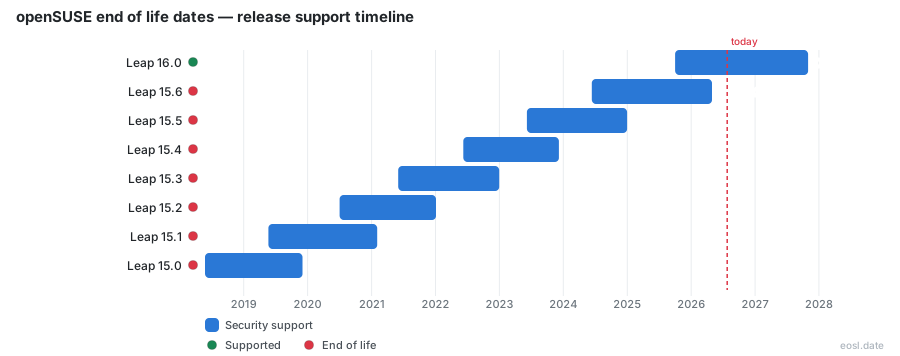
Currently Supported openSUSE Releases - Active EOS/EOSL Support (1)
| Release | Released | End of Life |
|---|---|---|
| Leap 16.0 | (1 year and 1 month ago) | (in 11 months) |
openSUSE End of Life (EOL) Releases - No Longer Supported (20)
| Release | Released | End of Life |
|---|---|---|
| Leap 15.6 | (2 years and 4 months ago) | (6 months ago) |
| Leap 15.5 | (3 years and 4 months ago) | (1 year and 10 months ago) |
| Leap 15.4 | (4 years and 4 months ago) | (2 years and 10 months ago) |
| Leap 15.3 | (5 years and 5 months ago) | (3 years and 10 months ago) |
| Leap 15.2 | (6 years and 4 months ago) | (4 years and 10 months ago) |
| Leap 15.1 | (7 years and 5 months ago) | (5 years and 9 months ago) |
| Leap 15.0 | (8 years and 5 months ago) | (6 years and 11 months ago) |
| Leap 42.3 | (9 years and 3 months ago) | (7 years and 4 months ago) |
| Leap 42.2 | (9 years and 11 months ago) | (8 years and 9 months ago) |
| Leap 42.1 | (11 years ago) | (9 years and 5 months ago) |
| 13.2 | (12 years ago) | (9 years and 9 months ago) |
| 13.1 | (12 years and 9 months ago) | (10 years and 9 months ago) |
| 12.3 | (13 years and 7 months ago) | (11 years and 9 months ago) |
| 12.2 | (14 years and 2 months ago) | (12 years and 9 months ago) |
| 12.1 | (14 years and 11 months ago) | (13 years and 5 months ago) |
| 11.4 | (15 years and 7 months ago) | (14 years ago) |
| 11.3 | (16 years and 3 months ago) | (14 years and 9 months ago) |
| 11.2 | (16 years and 11 months ago) | (15 years and 5 months ago) |
| 11.1 | (17 years and 10 months ago) | (15 years and 9 months ago) |
| 11.0 | (18 years and 4 months ago) | (16 years and 3 months ago) |
Whether you run a single Linux laptop or a fleet of Linux servers, the openSUSE End of Life schedule tells you exactly when your Linux distribution stops receiving fixes from SUSE and the community. openSUSE Leap 15.6 reached its final supported day on 30 April 2026, so any Linux machine still on that version needs to move to Leap 16. The sections below list every release date, explain how the SUSE-backed support model works and show you how to upgrade a Linux distribution safely.
openSUSE End of Life Dates for Every Leap Release
Each stable openSUSE Leap version has a release date and a final supported date. The table shows when every openSUSE Leap 15 version and the first Leap 16 version were released and when each one stops getting updates. It is the run most Linux administrators still care about, and the newest version comes first.
| Leap version | Released | Supported until |
|---|---|---|
| 16.0 | 1 October 2025 | 31 October 2027 |
| 15.6 | 12 June 2024 | 30 April 2026 |
| 15.5 | 7 June 2023 | 31 December 2024 |
| 15.4 | 9 June 2022 | 7 December 2023 |
| 15.3 | 2 June 2021 | 31 December 2022 |
| 15.2 | 2 July 2020 | 4 January 2022 |
| 15.1 | 22 May 2019 | 2 February 2021 |
| 15.0 | 25 May 2018 | 3 December 2019 |
Treat the supported until column as the date your security updates stop. The date can still move: the openSUSE Project rescheduled the end of the final Leap 15 version once already. Recheck the roadmap and the announcements from the project before you plan a maintenance window, because each version of the Linux distribution follows its own schedule.
Current Leap Release Schedule
The openSUSE Leap 15 series began when 15.0 was released in May 2018 and ran for nearly eight years. Its last version received close to 24 months of coverage. The newer openSUSE Leap 16 line is expected to continue to 16.6 in autumn 2031, and each version in it should get a full two years of community support. Official news announcements describe Leap 16 as the branch to deploy now, and the release team keeps its roadmap public.
Older Release Series Before Leap 15
Before Leap 15 came the 42.x series and, earlier still, plain numbered Linux versions from 11.0 to 13.2 that Novell and later SUSE shipped. Every one of those fixed release branches is already past its final support date, and the full version history of each one is public. If you find a Linux host running one, the safest plan is a fresh download of a current ISO, not an in-place jump across many versions that were released years apart.
How the openSUSE Leap Lifecycle and Support Period Work
openSUSE Leap is the stable release of the openSUSE family, a Linux distribution built from the same sources as the enterprise product from SUSE. The lifecycle is simple: a new minor version of this Linux distribution is released about once a year, and each one is supported for a limited support period. Support means two things: security updates for every included package and critical fixes for serious bugs. It is a community distribution, so this community support comes from volunteers and SUSE engineers rather than a paid contract. As an open source and free software operating system it carries no licence fee, but it carries no service-level promise either.
Minor Release Maintenance Life Cycle
A new minor release of openSUSE Leap appears roughly every 12 months. You are expected to upgrade to the latest version within that window, which gives each one a maintenance life cycle of two years. Older documents mention a traditional 18 months, and the lifetime of the last Leap 15 version was extended by roughly six months beyond that. During the window you receive maintenance and security updates plus critical bugfix updates, nothing more.
Major Release Support and SUSE Linux Enterprise
A major release such as Leap 16.x is supported until the next major release arrives. The Leap 15 series followed SUSE Linux Enterprise (SLE) 15 closely, because the two share the same sources and are source and binary compatible. One quirk matters: SLE 15 SP7 had no Leap twin, so SUSE and the community stretched Leap 15.6 instead. SUSE Linux Enterprise remains the enterprise upstream, while Leap is its community-built Linux sibling for Linux desktop and server users.
What an End-of-Life Release Means for Security Updates
An unsupported release, meaning one past its final support date, is not broken on the day support ends, which is why people postpone the move. The risk grows slowly instead. Your Linux system stops receiving security updates from SUSE and the openSUSE Project, so every newly disclosed hole stays open on that machine. Over months that becomes a real security risk, particularly for Linux servers exposed to the internet or any host that handles customer data.
Vulnerabilities, Patches and Platform Support
Once a version is retired, new vulnerabilities in the Linux kernel, libraries and desktop software no longer get fixes from the openSUSE repository. Third-party projects drop a Leap version once its support ends, so your own builds may stop working on it. When the last Leap 15 version approached its cutoff, the Netdata developers opened an issue to remove platform support for it from their packaging, CI and distro lists. If you maintain software for Linux users, expect the same cleanup in your own package pipeline, and warn sysadmins and developers early.
Upgrade Path to Leap 16 with the Migration Tool
Because the last Leap 15 version is past its support date, the recommended upgrade path is to move straight to Leap 16, because it keeps you on a supported version with the same SUSE-based foundations. Download the new media, back up your data and run the opensuse-migration-tool to upgrade in place. Desktop users get the KDE Plasma setup by default, while server and cloud admins can rely on transactional updates, server roles and scalable cloud images that arrived with the Leap 15 series. Because the release is a Linux distribution with a stable package base, the jump is usually predictable.
- Back up configuration and data, and note which third-party repositories you use.
- Update the system fully while it is still on the older version.
- Run the migration tool and follow its prompts.
- Reboot, then confirm the new version in your release file.
Maintainers and contributors recommend testing on a clone first, because a mistake on production is slow to undo.
Tumbleweed as a Rolling Release Alternative
Tumbleweed has no fixed retirement date at all. If fixed dates annoy you, openSUSE Tumbleweed is the rolling release alternative. Tumbleweed continuously integrates the newest stable Linux software, built in the Factory development project, so it never reaches a final date the way a fixed Leap version does. The trade-off is a faster flow of change in the kernel, the desktop and every package. openSUSE MicroOS is another option when you want an immutable base for containers, and MicroOS follows the same community distribution model. Tumbleweed, MicroOS and Leap share one distribution family, and Factory feeds all of them.
Point Release Planning for Leap 16
Plan your calendar around each point release rather than the whole series. Leap 16.0 is supported until 31 October 2027, so start planning the move to the next release by mid-2027 and apply fixes in the meantime.
Tracking openSUSE EOL Dates with Feeds and Identifiers
You do not have to remember dates by hand. The endoflife.date project publishes the openSUSE schedule as a JSON endpoint, an RSS feed and an iCalendar feed, so you can add reminders to your calendar or monitoring. Its product identifiers include cpe:/o:opensuse:leap, which helps inventory tools match a host to its version. On a machine, read /usr/lib/os-release to learn which release is installed, and use zypper or any RPM query to list each installed Linux package. These pieces make platform support audits much easier across many Linux servers.
openSUSE Project Lifetime and Community History
The openSUSE Project grew out of SUSE Linux, first sold in 1994, and its development was opened to the community in 2005. Novell had taken over SUSE, and the openSUSE name arrived with version 10.2 in 2006. The project is sponsored by SUSE and maintains the Factory codebase that feeds both Tumbleweed and Leap. Its history spans several owners, from Novell to Attachmate to Micro Focus, and the openSUSE Project now covers the YaST configuration tool, the Open Build Service and other Linux tools that SUSE users know well.
YaST remains the best-known administration tool, and the YaST control center, AutoYaST and WebYaST all grew from it. The distribution supports many architectures and offers KDE Plasma, GNOME, XFCE and other desktop environments. GNOME and KDE are both well supported, and the GNOME and KDE teams ship their own updates through the community. Several derivatives build on its sources too. Whichever desktop you pick, the same support dates apply, so check the table above before you commit to a long-term install of this Linux distribution. Knowing who maintains each release also tells you who decides when its support stops.
Because SUSE released its enterprise Linux first, a Linux admin who knows SUSE finds openSUSE Leap familiar. A Linux kernel fix from SUSE reaches Leap soon after, and each openSUSE Leap build is released from the same sources. YaST modules and GNOME applications are covered by the same window: once the release is retired, YaST and GNOME updates stop together with the rest of the Linux stack. That is why a GNOME desktop on an old SUSE Linux install deserves the same attention as a server.