CentOS Stream End of Life (EOL) Dates and End of Support (EOS) Dates
CentOS Stream end of life (EOL) and end of support (EOS) dates: 8 has reached EOL — EOL date: May 31, 2024. This version no longer receives security updates, patches, or support. CentOS Stream 10 is the current supported release, with support through May 31, 2030 — 2 versions in active support. Also see Red Hat Enterprise Linux EOSL dates for related end-of-life information.
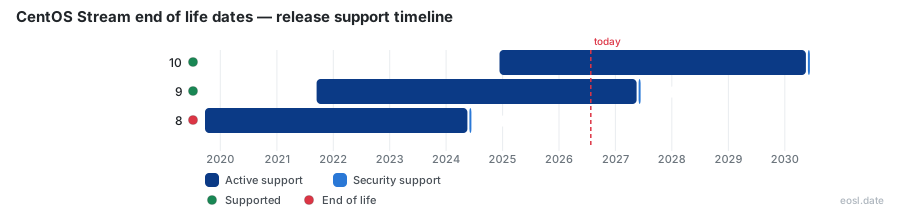
Currently Supported CentOS Stream Releases - Active EOS/EOSL Support (2)
| Release | Released | Security Support | Active Support |
|---|---|---|---|
| 10 | (1 year and 10 months ago) | (in 3 years and 6 months) | (in 3 years and 6 months) |
| 9 | (5 years and 1 month ago) | (in 6 months) | (in 6 months) |
CentOS Stream End of Life (EOL) Releases - No Longer Supported (1)
| Release | Released | Security Support | Active Support |
|---|---|---|---|
| 8 | (7 years and 1 month ago) | (2 years and 5 months ago) | (2 years and 5 months ago) |
Planning around CentOS Stream end of life starts with one rule: each CentOS Stream release is supported only until its matching Red Hat Enterprise Linux (RHEL) release leaves full support. Below you get every EOL date, how this Linux distribution differs from CentOS Linux, and what to do before updates stop.
CentOS Stream End of Life Dates by Release
CentOS Stream only has major versions, with no minor release numbers of its own. Active support and security support end together, so one date covers both, as the table shows. The CentOS Stream 8 and CentOS Stream 9 dates match the published support information.
| Release | Version released | EOL date |
|---|---|---|
| CentOS Stream 8 | 24 September 2019 | 31 May 2024 (ended) |
| CentOS Stream 9 | 15 September 2021 | 31 May 2027 |
| CentOS Stream 10 | 12 December 2024 | 31 May 2030 |
Stream 8 EOL: Already Over
Stream 8 stopped getting updates on 31 May 2024, so any server still on it has no fixes. Its RHEL 8 counterpart kept going; the distribution did not.
CentOS Stream 9 Support Timeline
The expected EOL for Stream 9 is the end of RHEL 9 full support, which lands on 31 May 2027. After that date the release gets no more fixes.
CentOS Linux EOL: What Happened to Versions 7 and 8
CentOS Linux 8 reached its CentOS Linux end of life on 31 December 2021, and CentOS Linux 7 followed on 30 June 2024. Neither release gets security patches, bug fixes or feature updates now, and nobody was moved to the next version automatically. A final rebuild of RHEL 8.5 shipped with its zero-day updates, then updates stopped. Any "CentOS Linux" support sold today is a fork, separate from the CentOS Project.
Security Support After the Final Update
With no patches arriving, every new vulnerability stays open on a retired release. Treat unpatched security exposure as the real cost of staying put.
Where the Archived Content Went
Once a release retires, its packages leave the mirrors and are archived permanently at vault.centos.org, which exists for reference rather than updates. Stream 8 packages follow the same path after its 31 May 2024 EOL.
Lifecycle Role: Upstream, Downstream and RHEL
CentOS Linux was a rebuild of RHEL, so it sat downstream. CentOS Stream is the upstream variant: a continuously delivered, midstream step between Fedora and the next minor release of RHEL, shaped by the CentOS Project and Red Hat engineers. That design explains the shorter lifecycle, because Stream tracks its RHEL release rather than outliving it.
Frequency of Updates and Testing
Updates arrive as they are ready, not in large batches. Changes get rigorous testing, both inside Red Hat and in the public test suite, before they reach RHEL. Those updates stop on a release's EOL date, so Stream gets no fixes after it.
Contribution Model and SIGs
Any contributor can send changes straight into the development stream, cutting the path from years to weeks. The community's special interest groups (SIGs) such as the Hyperscale SIG, Automotive SIG and Virtualization SIG build on the same release, so they share its EOL date.
Enterprise Linux Innovation
Kernel advances flow from Fedora into this open source operating system, so hardware makers can test drivers before the enterprise platform ships. It lacks the backporting and hardening of RHEL and is not meant for long-term production, which is why its support is short.
What to Do Before Support Ends
Before Stream 9 reaches its end on 31 May 2027, pick your path early: proof-of-concept and development machines tolerate the churn that production servers do not. Check infrastructure, containers and cloud images for the release in use, then follow the announcement notes, since CVE updates stop on that date.
Migration Options
Stream 8 hosts are already past EOL and Stream 9 ends 31 May 2027. For a planned migration, move Stream 9 hosts to Stream 10 or to RHEL itself, and rebuild images instead of upgrading in place. Moving early leaves time to test your ecosystem and software.
Developer Subscription for Small Fleets
If you want a longer lifecycle than Stream offers, Red Hat's developer subscription gives no-cost, self-supported RHEL, usable for up to 16 systems in production, with a predictable lifecycle.