Spring Framework End of Life (EOL) Dates and End of Support (EOS) Dates
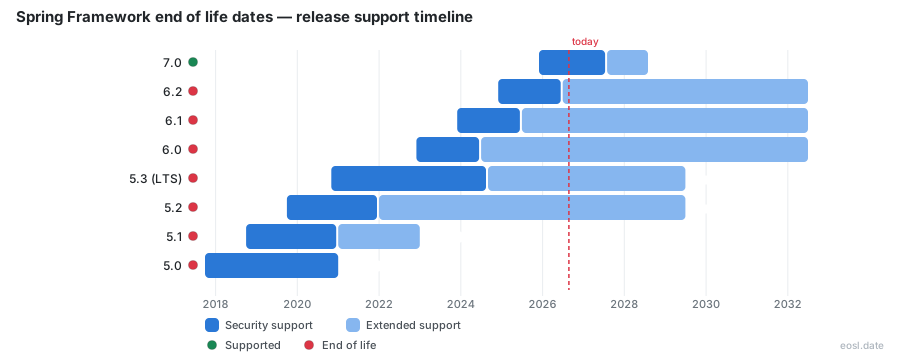
Spring Framework end of life (EOL) and end of support (EOS) dates: 9 Spring Framework versions have reached EOL, including Spring Framework 6.2 (EOL date: Jun 30, 2026) — no longer receiving security updates or patches. Spring Framework 7.0.11 is the current supported release, with support through Jul 31, 2027. Also see Dependency-Track EOSL information for related end-of-life information.
Currently Supported Spring Framework Releases - Active EOS/EOSL Support (1)
| Release | Supported Jakarta Eeversions | Supported Java Versions | Released | OSS support | Commercial Support | Latest | LTS |
|---|---|---|---|---|---|---|---|
| 7.0 | 11 - 12 | 17 - 25 | (11 months ago) | (in 8 months) | (in 1 year and 8 months) | 7.0.11 (2 days ago) | - |
Spring Framework End of Life (EOL) Releases - No Longer Supported (9)
| Release | Supported Jakarta Eeversions | Supported Java Versions | Released | OSS support | Commercial Support | Latest | LTS |
|---|---|---|---|---|---|---|---|
| 6.2 | 9 - 10 | 17 - 25 | (1 year and 11 months ago) | (4 months ago) | (in 5 years and 7 months) | 6.2.19 (5 months ago) | - |
| 6.1 | 9 - 10 | 17 - 23 | (2 years and 11 months ago) | (1 year and 4 months ago) | (in 5 years and 7 months) | 6.1.21 (1 year and 5 months ago) | - |
| 6.0 | 9 - 10 | 17 - 21 | (3 years and 11 months ago) | (2 years and 4 months ago) | (in 5 years and 7 months) | 6.0.23 (2 years and 3 months ago) | - |
| 5.3 (LTS) | 7 - 8 | 8 - 21 | (6 years ago) | (2 years and 2 months ago) | (in 2 years and 7 months) | 5.3.39 (2 years and 3 months ago) | LTS |
| 5.2 | N/A | 8 - 11 | (7 years and 1 month ago) | (4 years and 10 months ago) | (in 2 years and 7 months) | 5.2.25 (3 years and 4 months ago) | - |
| 5.1 | N/A | 8 - 11 | (8 years and 1 month ago) | (5 years and 10 months ago) | (3 years and 10 months ago) | 5.1.20 (5 years and 11 months ago) | - |
| 5.0 | N/A | 8 | (9 years and 1 month ago) | (5 years and 10 months ago) | Active | 5.0.20 (5 years and 11 months ago) | - |
| 4.3 | N/A | 6 - 8 | (10 years and 5 months ago) | (5 years and 10 months ago) | Active | 4.3.30 (5 years and 11 months ago) | - |
| 3.2 | N/A | 5 - 6 | (13 years and 11 months ago) | (9 years and 10 months ago) | Active | 3.2.18 (9 years and 11 months ago) | - |
When does Spring Framework end of life reach your stack? Only the 7.0 line still gets free fixes today, so this guide lays out each version's support window, what the open source maintainers stop doing, and how to choose between upgrading and paying for cover.
Spring Framework End of Life Dates by Version
Every release follows a defined lifecycle: the open source community patches a branch for a year or more, then the version hits EOL and the free fixes stop. A longer commercial support period, sold by VMware, continues after that. The table shows the support timeline for all Spring Framework versions still in circulation, as listed by endoflife.date on 23 October 2026.
| Version | Released | Open source support | Commercial support | Java range |
|---|---|---|---|---|
| 7.0 | 30 Nov 2025 | Ends 31 Jul 2027 | Ends 31 Jul 2028 | 17 - 25 |
| 6.2 | 30 Nov 2024 | Ended 30 Jun 2026 | Ends 30 Jun 2032 | 17 - 25 |
| 6.1 | 30 Nov 2023 | Ended 30 Jun 2025 | Ends 30 Jun 2032 | 17 - 23 |
| 6.0 | 30 Nov 2022 | Ended 30 Jun 2024 | Ends 30 Jun 2032 | 17 - 21 |
| 5.3 (LTS) | 31 Oct 2020 | Ended 31 Aug 2024 | Ends 30 Jun 2029 | 8 - 21 |
Spring Framework 6.2 reached end-of-life on 30 June 2026, which makes 7.0 the latest release line with community patches. Spring Framework 6.1 closed a year earlier, and 6.0 a year before that, so the whole 6.x family below 6.2 has lost its free updates. When support ends for 7.0, the same drill starts again, because each feature branch gets only a short free window.
Spring Framework 5.3 EOL and the Java 17 Migration Wall
Spring Framework 5.3 was the final LTS release of the 5.x generation, and open source updates stopped on 31 August 2024 with 5.3.39. Spring 5.3 end of life stings because 5.3 runs on Java 8 and 11, while every 6.x and 7.x version needs Java 17 as a minimum. Teams cannot reach a supported line without also moving the JDK.
The jump carries real work. Code moves from the javax namespace to Jakarta, so imports, servlet containers and validation libraries change, and the breaking changes force refactoring across the codebase. That is why Spring 5 end of life feels like a project rather than a patch.
Standing still is a risk. CVE-2024-38816 and CVE-2024-38819, path traversal flaws in the functional web frameworks rated CVSS 7.5, were among the last issues to get a free fix, and anything disclosed afterwards gets no patch on Maven Central.
Spring Framework 6.2 EOL: Moving to Jakarta EE 11 in Spring 7.0
Spring Framework 6.2 left community support on 30 June 2026 with 6.2.19 as its last release. It sits under Spring Boot 3.5, so many production apps inherit the exposure. The current target, Spring Framework 7.0, shipped on 30 November 2025. It lifts the baseline to Jakarta EE 11 (Servlet 6.1, JPA 3.2), keeps the Java 17 minimum, supports Java 25, and adds Jackson 3, Kotlin 2.2 and JUnit 6 support alongside Tomcat 11 compatibility.
For cloud-native teams the payoff is better performance, modern tooling and declarative HTTP clients. The cost is that libraries lagging behind the new baseline need replacing, so treat 6.2 to 7.0 as a true major migration and not a routine patch.
Spring Boot Release Trains and Your Support Window
Spring Boot and Spring Framework run on separate lifecycles, and mixing them up causes most EOL confusion. The framework is the core: dependency injection, Spring MVC, WebFlux, transactions and data access. Spring Boot adds auto-configuration and starters on top, and each release train pins one framework version. Boot 3.5 rides on 6.2 and Boot 4.0 rides on 7.0.
That pinning makes the framework a transitive dependency of every enterprise application you build. A Boot release that looks current can still carry a version past Spring Framework EOL, so check the framework line itself, then the other dependencies, such as Spring Security, which keeps its own schedule.
What Happens After Spring Framework EOL
Code keeps running after Spring Framework end of life, but nobody maintains it. The community stops shipping security updates and bug fixes, new flaws stay open, and the risk compounds every month in production.
Security Patches and Unpatched Vulnerabilities
Once a branch closes, security patches land only on newer lines. CVE-2025-41242, a path traversal issue disclosed on 14 August 2025, was fixed in 6.2.10 but never in 6.1, so a team on 6.1 must upgrade or find another source of fixes. Severity differs by source, which is why one CVSS score reads medium and another high, and the unpatched code stays exposed either way. These vulnerabilities do not wait for your sprint plan.
Compliance and Operational Risk
Auditors in regulated industries expect patched software, and an unsupported framework can sink a GDPR, HIPAA, PCI DSS or ISO 27001 compliance audit. Operational risk grows as tooling moves on, and technical debt grows with it. Support cost rises too, since commercial support is priced for large enterprises.
Upgrade or Pay: Options for an End-of-Life Spring Framework
Start with a readiness check: list your javax imports, deprecated APIs and third-party libraries that lag behind Jakarta. Then pick a migration strategy that matches what your teams can change before the next deadline, with VMware's commercial support as the paid first-party fallback.
Direct Migration to Spring Framework 7.0
Direct migration suits modern, actively maintained codebases. Update the Jakarta dependencies, fix the breaking API changes, and test thoroughly before release.
Incremental Upgrade Path
Large, tightly coupled systems are safer to move in stages. Upgrade Java and the Jakarta foundations first, then migrate modules one at a time. An incremental route keeps services running and lets you validate each step.
Extended Support and Long-Term Support from Vendors
When time or budget runs out, vendors sell cover past EOL. HeroDevs offers Never-Ending Support, TuxCare provides Endless Lifecycle Support for 5.3, and OpenLogic sells LTS for 6.2. This extended support buys a runway for a safe migration while security patches keep flowing.