Dependency-Track End of Life (EOL) Dates and End of Support (EOS) Dates
Dependency-Track end of life (EOL) and end of support (EOS) dates: 9 Dependency-Track versions have reached EOL, including Dependency-Track 5.1 (EOL date: Oct 08, 2026) — no longer receiving security updates or patches. Dependency-Track 4.14 reaches its End of Support date on Dec 09, 2026 — plan your upgrade path now. Dependency-Track 5.2.2 is the current supported release. Also see Spring Boot lifecycle dates for related end-of-life information.
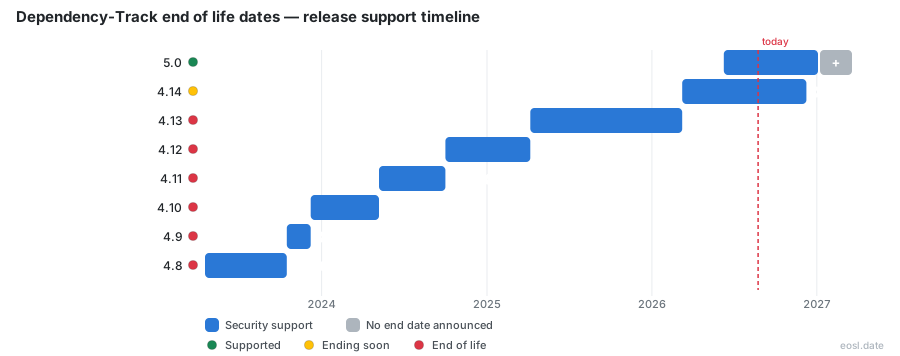
Currently Supported Dependency-Track Releases - Active EOS/EOSL Support (1)
| Release | Released | Security Support | Latest |
|---|---|---|---|
| 5.2 | (1 month and 1 week ago) | Active | 5.2.2 (3 days ago) |
Dependency-Track Releases Nearing End of Life - Support Ending Soon (1)
| Release | Released | Security Support | Latest |
|---|---|---|---|
| 4.14 | (8 months ago) | (in 2 weeks and 4 days) | 4.14.7 (3 days ago) |
Dependency-Track End of Life (EOL) Releases - No Longer Supported (9)
| Release | Released | Security Support | Latest |
|---|---|---|---|
| 5.1 | (2 months ago) | (1 month and 1 week ago) | 5.1.2 (1 month and 2 weeks ago) |
| 5.0 | (5 months ago) | (2 months ago) | 5.0.5 (2 months ago) |
| 4.13 | (1 year and 7 months ago) | (8 months ago) | 4.13.6 (1 year ago) |
| 4.12 | (2 years and 1 month ago) | (1 year and 7 months ago) | 4.12.7 (1 year and 8 months ago) |
| 4.11 | (2 years and 6 months ago) | (2 years and 1 month ago) | 4.11.7 (2 years and 3 months ago) |
| 4.10 | (2 years and 11 months ago) | (2 years and 6 months ago) | 4.10.1 (2 years and 11 months ago) |
| 4.9 | (3 years and 1 month ago) | (2 years and 11 months ago) | 4.9.1 (3 years ago) |
| 4.8 | (3 years and 7 months ago) | (3 years and 1 month ago) | 4.8.2 (3 years and 6 months ago) |
| 4.7 | (3 years and 11 months ago) | (3 years and 7 months ago) | 4.7.1 (3 years and 9 months ago) |
Planning an upgrade around Dependency-Track end of life starts with one fact: only the newest release lines still receive fixes, and the last 4.x line loses its coverage on 9 December 2026. Running a retired build of this software means no more security updates, so any new flaw stays open and the hidden risks pile up quietly. Here is how to read the dates, what to do about the 4.x series, and how to flag EoL libraries in your own inventory.
Dependency-Track End of Life Dates for Every Release
Maintainers do not publish a fixed calendar. Maintainers announce cut-off dates as new lines ship, and endoflife.date tracks them. As of late October 2026, the picture looks like this:
| Release | Released | Security fixes | Newest patch |
|---|---|---|---|
| 5.1 | 27 Aug 2026 | Active | 5.1.2 (5 Oct 2026) |
| 5.0 | 9 Jun 2026 | Ended 27 Aug 2026 | 5.0.5 (24 Aug 2026) |
| 4.14 | 9 Mar 2026 | Ends 9 Dec 2026 | 4.14.6 (25 Oct 2026) |
| 4.13 | 7 Apr 2025 | Ended 9 Mar 2026 | 4.13.6 (17 Nov 2025) |
| 4.12 | 1 Oct 2024 | Ended 7 Apr 2025 | 4.12.7 (12 Mar 2025) |
How End of Support Works for Each Dependency-Track Version
For Dependency-Track, a release line's security support window closes the day its successor is declared stable, or on a date set for the old line. Look at 5.0: it lost coverage on the same day 5.1 arrived. After that date, flaws found in the old line are fixed only in newer builds, so staying put means accepting known exposure.
Release Cycle and the Latest Version
There is no fixed release cycle, so the sensible rule is to run the latest version of the newest line. Treat any entry marked "Ended" as retired: a supported release is one whose security column still reads Active or shows a future date.
Moving Off v4: 4.14 and Its EoL Date
The 4.x series continues to get security and high-severity fixes on that line for roughly six months after 5.0 shipped, which is why the final cut-off falls in December. Because migration from v4 to v5 is not an in-place upgrade, start early. The new line runs on its own PostgreSQL cluster and pulls your data through an offline migrator, so book a maintenance window and rehearse first with the upgrade guides. Expect these breaking changes:
- PostgreSQL is the only database it accepts; H2, MySQL and Microsoft SQL Server are gone.
- Every notification template must be rewritten for the new Protobuf payloads.
- The REST API paginates by default and changes some response schemas.
- The bundled image and executable WAR are replaced by separate API server and frontend container images, so your image build files need edits.
Dependency-Track 5.0 and the Supported Release Line
The v5 line, built under the codename Hyades, is the newest line, and everything from 5.1 onward is where fixes land. Stateless API servers coordinate through the database alone, giving high availability that works across zones and in Kubernetes. A dedicated management port exposes Prometheus metrics and health probes. A new expression-based policy engine can audit or suppress findings before analysts see them, so a security team can enforce a rule across every portfolio.
This matters at enterprise scale. Under the EU Cyber Resilience Act, product makers must maintain a machine-readable bill of materials, with core obligations phasing in through December 2027. Such regulation turns inventory into a compliance duty, and one platform holding every product's data is the practical way to meet it. Regulators expect a supported build, so running a retired release undermines that duty. Early v5 adopters report more than 250,000 SBOMs in a single instance.
Detecting EoL Dependencies in Your SBOMs
The platform itself reports on vulnerabilities, but flagging abandoned libraries takes an add-on. This short tutorial follows a community tool that checks the software bill of materials behind your SBOM upload against endoflife.date data. It is experimental, so use a test instance first, and treat your dependencies as the thing being audited.
Install Dependency-Track and Import Your SBOM
If you do not have an instance, fetch the docker compose file and start the stack with docker compose up -d. Open the web UI on port 8080, add a project and upload a CycloneDX file. When processing finishes, the inventory of your components is ready to analyse.
Create an API Key and Run the Integration
Open Administration, then Access Management, then Teams, and generate an API key. Next download the integration binary from GitHub for Linux or Windows and run it with --apikey followed by your key. Matching relies on PURL, CPE and name heuristics, so some results may be incomplete.
Review EoL Detection Results
Search for "INT" in the interface to see flagged libraries, then read the program output for the matches. EoL detection of this kind depends on the quality of your data, so run a quick scan again after fixing identifiers and compare which items disappear.
Why EoL Software Puts Your Software Supply Chain at Risk
Retired libraries stop receiving patches, so unpatched vulnerabilities accumulate without any CVE ever being assigned to them in a way your scanner will see. That makes the software supply chain weaker than it looks on a dashboard. Organizations that only track known flaws miss this class of risk entirely, and that exposure grows every quarter that an abandoned library stays in a build. Pairing end of support data with your security findings gives software owners a defensible reason to prioritise upgrades.
End-of-Life Escalation in the SLSA Dependency Track
A different effort shares the name, so this section is not about the OWASP Dependency-Track retirement timeline. The SLSA Dependency Track is a draft specification for organisations that ingest third-party build dependencies, and it has nothing to do with the OWASP application. Its Future Considerations call for an end-of-life escalation path, a defined response once a retirement finding surfaces at the first level. SLSA cannot demand an attestation from every upstream author, so the track records how each of those dependencies entered your environment instead. It also borrows from the OpenSSF consumption framework, known as S2C2F, and leaves the organisational duties to the OpenSSF baseline.
Dependency Ingestion Provenance Levels
The track asks a platform to emit a signed provenance attestation for every artifact it admits. That attestation names the artifact by digest and records how its ingestion happened, so a verifier can reject a record it does not trust. Trust can come from a verified upstream attestation, a trusted distribution channel, or the ingestor's own admission process, and the platform writes the chosen mode into each provenance. The ingestion platform, usually an artifact repository manager plus scanners, signs that attestation from level two upward. The levels grow stricter, and the first one is where any retirement finding would be recorded:
| Level | Name | What the platform records |
|---|---|---|
| Dep L1 | Inventoried | A provenance per ingestion naming the dependency |
| Dep L2 | Controlled | Signed provenance, verified integrity, one ingestion path |
| Dep L3 | Screened | Blocked bypass, screened packages, isolated signing, audit trail |
At every level the platform must keep its attestation records complete, so a release can be traced back to the provenance of each direct and transitive dependency. A hostile package should never be able to touch the signing platform, which is why the highest level isolates each ingestion from the others.
Where an EOL Determination Fits
At the first level, the platform may record the end-of-life status of each dependency next to its vulnerability scan results. Whether an EOL determination is required then becomes a decision for the verifier's own policy. The same goes for a deny-list, a version-age rule or a license filter: the ingestion platform records every admission policy it applies, and an empty list of policies is itself a signal that a verifier can refuse. Back in this article's terms, that policy choice decides how a retired library gets handled. Dependencies that fail a policy are never admitted, so no provenance exists for them. If you run your own ingestion platform, pick a platform that can emit the evidence your target level needs: a platform that only logs fetches stops at level one, while a platform that blocks every side channel can reach level three. SLSA leaves the product choice open, so the same platform can also compare each package against retirement dates.
What OWASP Dependency-Track Does with EoL Data
The OWASP Foundation hosts it as a flagship project: an open source component analysis platform that ingests an SBOM per application, monitors components for new flaws and policy violations, and pushes alerts into the tools teams already use. It speaks CycloneDX, offers a REST API for automation and keeps all code on GitHub. Without the add-on above, it will not tell you that a library has been abandoned, which is why combining both sources is worth the effort. Run the OWASP platform for inventory, and let an EoL feed supply the retirement dates for your dependencies. Neither platform replaces the other, since each one covers a different part of the job.