Scala End of Life (EOL) Dates and End of Support (EOS) Dates
Scala end of life (EOL) and end of support (EOS) dates: 8 Scala versions have reached EOL, including Scala 3.8 (EOL date: Sep 03, 2026) — no longer receiving security updates or patches. Scala 3.10.1 is the current supported release — 7 versions in active support. Also see Dependency-Track lifecycle dates for related end-of-life information.
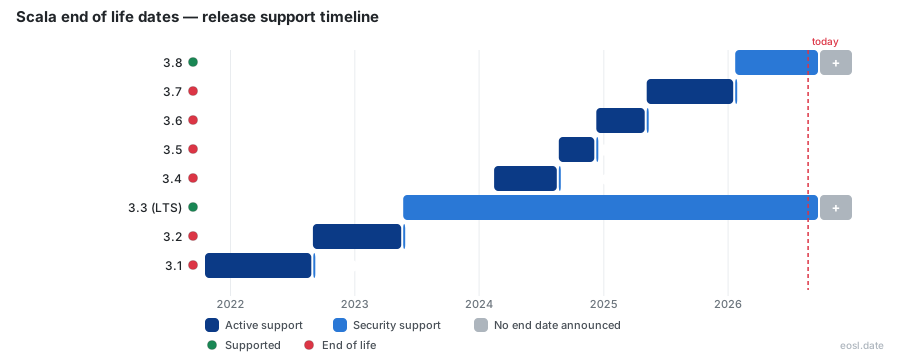
Currently Supported Scala Releases - Active EOS/EOSL Support (7)
| Release | Released | Maintenance Releases | Current Releases | Latest | LTS |
|---|---|---|---|---|---|
| 3.10 | (1 month and 1 week ago) | Active | Active | 3.10.1 (1 week and 3 days ago) | - |
| 3.9 (LTS) | (2 months ago) | Active | Active | 3.9.0 (2 months ago) | LTS |
| 3.3 (LTS) | (3 years and 5 months ago) | Active | Active | 3.3.9 (3 weeks and 3 days ago) | LTS |
| 2.13 | (7 years and 5 months ago) | Active | Active | 2.13.18 (1 year ago) | - |
| 2.12 | (10 years ago) | Active | (7 years and 5 months ago) | 2.12.21 (11 months ago) | - |
| 2.11 | (12 years and 7 months ago) | Active | (10 years ago) | 2.11.12 (9 years ago) | - |
| 2.10 | (13 years and 11 months ago) | Active | (12 years and 7 months ago) | 2.10.7 (9 years ago) | - |
Scala End of Life (EOL) Releases - No Longer Supported (8)
| Release | Released | Maintenance Releases | Current Releases | Latest | LTS |
|---|---|---|---|---|---|
| 3.8 | (9 months ago) | (2 months ago) | (2 months ago) | 3.8.4 (5 months ago) | - |
| 3.7 | (1 year and 6 months ago) | (9 months ago) | (9 months ago) | 3.7.4 (1 year ago) | - |
| 3.6 | (1 year and 11 months ago) | (1 year and 6 months ago) | (1 year and 6 months ago) | 3.6.4 (1 year and 8 months ago) | - |
| 3.5 | (2 years and 2 months ago) | (1 year and 11 months ago) | (1 year and 11 months ago) | 3.5.2 (2 years ago) | - |
| 3.4 | (2 years and 9 months ago) | (2 years and 2 months ago) | (2 years and 2 months ago) | 3.4.3 (2 years and 2 months ago) | - |
| 3.2 | (4 years and 2 months ago) | (3 years and 5 months ago) | (3 years and 5 months ago) | 3.2.2 (3 years and 9 months ago) | - |
| 3.1 | (5 years and 1 month ago) | (4 years and 2 months ago) | (4 years and 2 months ago) | 3.1.3 (4 years and 5 months ago) | - |
| 3.0 | (5 years and 6 months ago) | (5 years and 1 month ago) | (5 years and 1 month ago) | 3.0.2 (5 years and 2 months ago) | - |
Wondering when your release reaches Scala end of life? This JVM programming language splits its lifecycle in two: Scala 3 follows a published long term support policy with an LTS line and a Scala Next line, while Scala 2 is kept alive on a separate maintenance track. Below you will see which version still gets support, which one is already unsupported, and what developers should do about it.
Scala End of Life Status for Every Version
Scala has no single shutdown date. Each release line is one of the current releases, part of the long-lived maintenance releases, or a line that has reached end-of-life, meaning its compiler no longer receives fixes. Only the newest Scala 2 and Scala 3 versions are actively developed, and every older minor version of Scala 3 stops getting patches once the next one ships. Treat the language like any other software dependency: the version in your build file decides your exposure. The table below summarizes the picture as of late October 2026, using the dates published on endoflife.date.
| Release line | Released | Support status |
|---|---|---|
| Scala 3.10 (Scala Next) | 12 Oct 2026 | Current release, actively developed |
| Scala 3.9 (LTS) | 3 Sep 2026 | Supported, newest LTS line |
| Scala 3.8 | 22 Jan 2026 | Ended 3 Sep 2026 |
| Scala 3.3 (LTS) | 23 May 2023 | Supported, previous LTS line |
| Scala 2.13 | 7 Jun 2019 | Maintained indefinitely |
| Scala 2.12 | 28 Oct 2016 | Minimal maintenance |
| Scala 2.11 | 16 Apr 2014 | Ended in 2016 |
In short, a stable release other than an LTS line has a short life: Scala 3.8 lasted about eight months before it was replaced. Anything labelled "Ended" has reached end-of-life, so plan an upgrade rather than waiting for a patch that will never come.
Scala 3 Release Policy: LTS and Scala Next Explained
Since Scala 3.3, development is split into two distribution lines. This release policy exists because library authors and application teams want different things from a compiler: one group needs a stable Scala 3 version for a long time, the other wants new features quickly, and the Scala 3 community wanted a clear answer for both. Every release candidate is published for testing first, and if no regressions turn up for a week it becomes the stable version.
Scala LTS for Library Authors
Scala LTS is the preferred target for libraries. Bug fixes and usability improvements are backported into it, and those patches are guaranteed until at least a year after the next LTS line appears. A new LTS line cannot start for at least two years after the current one, so the guaranteed long-term support window runs past three years. Expect a new LTS patch every three to six months, which is also the release cadence of Scala 2.13. By that rule, the 3.9 LTS from September 2026 means 3.3 keeps getting patches until at least September 2027.
Scala Next for Application Projects
Scala Next is the default line for anything that is not a published library. Despite the name, nothing about it is unstable: the same testing and maintenance practices apply. The difference is that Scala Next carries language changes approved by the SIP committee, larger new features and occasional bug fixes that can affect source compatibility. Each iteration lasts six to twelve weeks, so a new minor version arrives roughly every two months, and the roadmap follows that schedule. Experimental features can ship in a patch, but only behind an explicit opt-in.
Scala 2 Maintenance: Which Releases Are Still Supported
Scala 2 is not obsolete: it is still a practical blend of object-oriented and functional programming on the JVM, and none of its supported versions has a fixed shutdown date. Scala 2.13 and Scala 2.12 both remain in use across large Java shops, where the Scala 2 codebase represents years of investment. Maintenance is handled mostly by the Scala team at VirtusLab together with the Scala Center, and it covers the compiler and the standard library. A healthy tooling and library ecosystem is a separate matter that depends on the maintainers of those projects.
Scala 2.13 Maintenance Continues Indefinitely
The Scala Center has no plan to retire 2.13. That means security vulnerabilities get fixed, compatibility with new JVM versions is kept up, interoperability with Scala 3 continues, and releases continue every three to six months, although that cadence may slow. Even Lightbend has not announced an EOL for the 2.13 series, so most teams can stay on Scala 2.13 comfortably. Running Scala 2.13 on a recent Java release works as long as you pick the minimum version from the JDK table below.
2.12 Maintenance Follows sbt 1
Scala 2.12 is the line that sbt 1.x builds on, so Scala 2.12 stays fundamental to the ecosystem for as long as sbt 1.x, which needs it, remains in wide use. For that reason there is no plan to end its life entirely, though only minimal fixes land there.
2.11 Is No Longer Maintained
Scala 2.11 reached its end in 2016. It is still downloadable and usable in some contexts, but it is no longer maintained, receives no security fixes and does not run on modern Java releases. Any Scala 2.11 project is a candidate for a Scala 2.12 or Scala 2.13 move before the Java runtime under it changes.
Scala 3 Semantic Versioning and Long Term Support Guarantees
Scala 3 follows semantic versioning in the major.minor.patch form, and every part of that number carries a specific promise. Those promises are what make the compatibility guarantees trustworthy when you decide how long a Scala 3 version is safe to keep, and they apply to every Scala 3 library you depend on.
Because minor and patch upgrades stay compatible, moving to a supported line once your version ends support is low-risk.
Patch, Minor and Major Versions
Patch versions, such as 3.3.3 to 3.3.4, focus on fixes and are both forward and backward compatible, so a library built with one patch releases cleanly with any other patch of the same minor. Minor versions, such as 3.4.3 to 3.5.0, add features and stay backwards compatible: code compiled with 3.2 keeps working in 3.5. The reverse does not hold. Major versions could in theory break compatibility, but there is no Scala 4 on the horizon.
Output and Binary Compatibility
Together, binary compatibility (generated bytecode) and TASTy compatibility (the metadata describing your source) form what is called output compatibility. Because of it, a library published to Maven Central can be used by any later compiler without cross-publishing, a major improvement over Scala 2, where each non-patch release was its own ecosystem.
Source Compatibility
Source compatibility means you can upgrade the compiler and still compile the same code. The compiler team aims for it but cannot promise it, since fixing a bug may break code that only compiled by accident. Scala Next trades a little of it for speed, so test your codebase before moving to a new minor.
JDK Compatibility and Supported Versions by Java Release
Scala is a Java language in practice: its primary platform is the Java Virtual Machine, so the JDK you run decides which Scala releases are usable. Compiled bytecode targets the JVM, and the JVM version sets the floor. A runtime update can quietly make an old version unsupported even though nothing in Scala itself changed. The minimum versions that run on each Java release are listed here.
| JDK | Minimum Scala versions |
|---|---|
| Java 27 | 3.10.0 |
| Java 25 (LTS) | 3.7.1, 3.3.6, 2.13.17 |
| Java 21 (LTS) | 3.4.0, 3.3.1, 2.13.11, 2.12.18 |
| Java 17 (LTS) | 3.0.0, 3.3.0, 2.13.6, 2.12.15 |
| Java 11 (LTS) | 3.0.0, 2.13.0, 2.12.4, 2.11.12 |
If your Java upgrade is the trigger, pick the row first and then choose the newest patch of the supported Scala line that fits.
Planning a Migration Before an EOL Date
Staying on a supported version beats scrambling after it ends. Moving from Scala 2.13 to Scala 3 is a change of epoch rather than a routine upgrade, since the two are not source compatible, though most of the Scala syntax stays the same. Because the compilers can mix outputs, a codebase can migrate module by module. Open source tooling, a Java-friendly runtime and the ecosystem of libraries listed on Scaladex make that gradual path realistic, and Scala CLI is the default runner from 3.5.0.
Migration Tools for Moving to Scala 3
If you are on 2.11, 2.12 or an ended Scala 3 minor, the safest targets are Scala 2.13 or the 3.3 LTS line from the table above. Moving to Scala 3 means reworking implicits into contextual abstractions and updating old syntax, such as the underscore wildcard import and the arrow alias syntax, but automated migration handles the mechanical part and developers review the rest. Both object-oriented and functional programming styles carry over, because this Java-based programming language keeps one model across versions. The effort is mostly in the build, the compiler flags, the new syntax and the Java libraries and software you depend on, and the compiler reports most problems as errors.
The Scala Center and Commercial Support
If an unsupported version cannot be retired soon, commercial support from vendors such as Lightbend and VirtusLab can extend its life for versions like 2.11 or 3.8. Community and open source maintenance of the programming language comes from the Scala Center, a not-for-profit funded through its advisory board, so check which versions your own vendor still covers.