Dropwizard End of Life (EOL) Dates and End of Support (EOS) Dates
Dropwizard end of life (EOL) and end of support (EOS) dates: 8 Dropwizard versions have reached EOL, including Dropwizard 3.0 (EOL date: Jan 31, 2026) — no longer receiving security updates or patches. Dropwizard 5.0.2 is the current supported release. Also see Dependency-Track end of support dates for related end-of-life information.
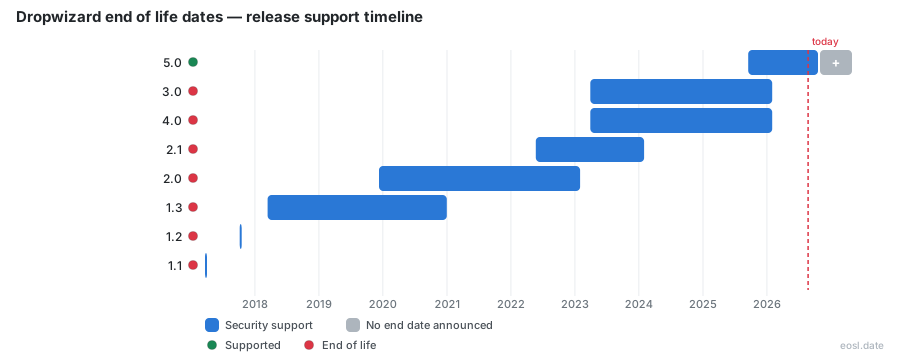
Currently Supported Dropwizard Releases - Active EOS/EOSL Support (1)
| Release | Released | Support | Latest |
|---|---|---|---|
| 5.0 | (1 year and 1 month ago) | Active | 5.0.2 (5 months ago) |
Dropwizard End of Life (EOL) Releases - No Longer Supported (8)
| Release | Released | Support | Latest |
|---|---|---|---|
| 3.0 | (3 years and 7 months ago) | (9 months ago) | 3.0.17 (9 months ago) |
| 4.0 | (3 years and 7 months ago) | (9 months ago) | 4.0.17 (9 months ago) |
| 2.1 | (4 years and 5 months ago) | (2 years and 9 months ago) | 2.1.12 (2 years and 9 months ago) |
| 2.0 | (6 years and 11 months ago) | (3 years and 9 months ago) | 2.0.35 (3 years and 9 months ago) |
| 1.3 | (8 years and 7 months ago) | (5 years and 10 months ago) | 1.3.29 (5 years and 10 months ago) |
| 1.2 | (9 years and 1 month ago) | — | 1.2.9 (8 years and 1 month ago) |
| 1.1 | (9 years and 7 months ago) | — | 1.1.8 (8 years and 4 months ago) |
| 1.0 | (10 years and 3 months ago) | — | 1.0.9 (9 years and 3 months ago) |
If you run this Java framework in production, Dropwizard end of life dates decide how long you get fixes, so you need the current picture before your next release. The maintainers announced the official end of life for 4.0.x on January 31, 2026, which means 5.0.x is now the only supported line and every earlier line is retired.
Dropwizard End of Life Dates for Every Version
Dropwizard is an ops-friendly, high-performance Java framework for building RESTful web services, and each release line gets a support window that ends on a published date. The table below lists the status of every line as tracked on the endoflife.date page, which compares the release date, the end of support and the latest patch.
| Release line | First released | Support ended | Latest patch release |
|---|---|---|---|
| 5.0.x | Sep 16, 2025 | Still supported | 5.0.2 (May 31, 2026) |
| 4.0.x | Mar 30, 2023 | Jan 31, 2026 | 4.0.17 (Jan 27, 2026) |
| 3.0.x | Mar 30, 2023 | Jan 31, 2026 | 3.0.17 (Jan 27, 2026) |
| 2.1.x | May 23, 2022 | Jan 31, 2024 | 2.1.12 (Jan 31, 2024) |
| 2.0.x | Dec 10, 2019 | Jan 31, 2023 | 2.0.35 (Jan 28, 2023) |
| 1.3.x | Mar 14, 2018 | Dec 31, 2020 | 1.3.29 (Jan 6, 2021) |
Lines 1.0, 1.1 and 1.2 are listed as unmaintained. Treat any version older than 5.0.x as retired, because no release will come for it.
Which Dropwizard Versions Are Still Supported
Only the 5.0.x line receives fixes today. The 5.0 release came out in September 2025, and the 5.0.2 patch release followed on May 31, 2026. If your build resolves any other version, it falls outside the supported set, so plan an upgrade rather than waiting for another patch.
The endoflife.date page puts it plainly: you should be running one of the supported release numbers in its rightmost column. In practice that means moving to the newest 5.0 patch, since patch releases ship the dependency fixes that keep the framework healthy.
Dropwizard 4.0.x EOL: Why Maintainers End Support
The 4.0.x EOL came from a GitHub discussion posted by a maintainer on November 16, 2025. Dropwizard 4.0.0 was released over 30 months earlier, on March 30, 2023, and the maintainers decided to end support for it on January 31, 2026. In the announcement they point out that 5.0.x is the currently stable version, targeting Jakarta EE 10 and Jetty 12.
They also argue that the migration effort from 4.0.x to 5.0.x is small enough to finish on short notice, so a firm deadline did not seem unreasonable. Questions go in the discussion thread, which has no replies yet.
Jetty 11.x Security Releases and the January 2026 Deadline
The trigger was an announcement about the limited availability of Jetty 11.x security releases starting January 1, 2026. Dropwizard 4.0.x depends on Jetty 11, so once Jetty stopped publishing regular fixes, the line could no longer receive trustworthy security updates. Ending support was the honest alternative to leaving users on an unpatched web server.
Dropwizard 2.1.x EOL and the Earlier Retire Decision
The 4.0.x deadline is not the first of its kind. When the project split into 3.0.x (using the javax namespace) and a Jakarta line, the maintainers announced they would retire 2.1.x on January 31, 2024. That is exactly two years before the 4.0.x date, a pattern the maintainers even joke about in the discussion.
The 2.1.x line was released on May 23, 2022, and its final patch, 2.1.12, shipped on the day support ended. The 2.0.x and 1.3.x lines retired the same way, each closing with a last patch release.
Support Policy: When Maintainers Retire a Release Line
Dropwizard does not have a clearly defined release and support policy. The general rule is that the currently stable and the previously stable major or minor versions are supported, and the project website holds more detail. That unwritten support policy explains the pairing in the table: 5.0.x was stable, 4.0.x was previous, and 3.0.x ran alongside it.
When a newer line has been stable for a while and a key dependency loses support, the maintainers end support for the older one. The official end of life is then posted as an announcement, usually with a date at the end of a month. Expect fixes to stop on that day, not weeks later.
Jakarta EE Transition Behind the EOL of javax Builds
All Dropwizard versions released before 4.0 used Java EE dependencies under the javax namespace. Version 4.0.x moved to Jakarta EE 9 components, so many imports switched to the jakarta namespace. Because some components still use javax, a blind search and replace can break other imports, and that is the first thing to check when you upgrade.
The result is a clean split: 3.0.x stays on javax, while 4.0.x and later use jakarta. Since both 3.0.x and 4.0.x reached EOL together on January 31, 2026, the javax builds are now retired as well.
Jakarta EE Compatibility Across Release Lines
Dropwizard tries to stay consistent with one specific EE version per line. Line 4.0.x stays on Jakarta EE 9, and the step to Jakarta EE 10 was left for a later series, which became 5.0.x. The upgrade notes explain that a bump of the EE version probably brings breaking changes, so the maintainers did not put it into a 4.1.x release.
Hibernate 6 Changes Before the Dropwizard End-of-Life Date
Hibernate 6 is the biggest hidden cost of leaving the retired 3.0.x and 4.0.x lines, because the EOL forces you to absorb it. One feature of the 4.0.x line is the move to Hibernate 6. Hibernate 5.6 offered compatible implementations for JPA 2.2 and Jakarta Persistence 3.0, but Hibernate 6.0 and 6.1 still match Jakarta Persistence 3.0, so Dropwizard upgraded to Hibernate 6.1. That brought three changes:
- The Criteria API is gone, so methods that took Criteria instances were removed.
- The restriction for Serializable keys was lifted, and parameters changed from Serializable to Object.
- The
AvailableSettings.USE_NEW_ID_GENERATOR_MAPPINGSproperty is no longer set.
If your application uses Hibernate directly rather than through Dropwizard, expect extra work and follow the Hibernate 6 migration guide. Hibernate 6.0 had already reached its own end-of-life, which is why 4.0.x shipped with 6.1.
Supported Features in 4.0.x Versus 3.0.x
Both lines reached EOL together, so the comparison only matters when you plan the move. Dropwizard 4.0.x includes every feature of 3.0.x, because the maintainers planned to keep the two versions mostly in sync. Since Jakarta EE library work now continues in the jakarta namespace, a few features exist only in 4.0.x, with the Hibernate 6 upgrade as the clearest example. Both lines are now retired, so none of this matters for new work, but it explains why a javax project could not simply bump a minor version.
Migrating to 5.0.x Before You Retire 4.0.x
Migrating from 4.0.x to 5.0.x is a smaller jump than the javax to jakarta move, because both lines share the same namespace. Start by reading the upgrade notes for 5.0.x, then bump your Maven or Gradle dependency, rebuild, and run your tests. The 5.0.x line targets Jakarta EE 10 and Jetty 12, so check any code that touches Jetty classes directly.
Plan the upgrade in a branch, deploy it to staging, and watch logging output for deprecation warnings before you promote it. Teams that wait for the next announcement pay more, because every skipped patch release adds dependency changes to review, and every release you skip makes the upgrade bigger.
Small steps keep you from a rushed upgrade at the EOL deadline, so schedule the upgrade as soon as the next release of your line appears, and treat each release as a rehearsal for the final upgrade. Each release of the framework publishes upgrade notes, so read them in order if you skip a line, and treat every Maven or Gradle upgrade as a chance to clear old deprecation warnings. A Maven build that already resolves the Jackson and Logback versions from the Dropwizard BOM needs the fewest edits, because the BOM carries the matching dependency versions for the whole release.
Upgrade Notes Checklist
- Read the 5.0.x upgrade notes and the 4.0.x upgrade notes for the jakarta changes.
- Replace the old Dropwizard BOM or parent version with the latest 5.0 patch.
- Rebuild and fix any compile error caused by a changed import or removed API.
- Run integration tests against Jetty 12 and your database dependency.
- Confirm the JDK your deployment uses is supported by the new line.
What's Changed in 5.0.x Patch Releases Since the EOL
The GitHub releases page for 5.0.2 lists a long "What's Changed" section, and almost all of it is dependency maintenance opened by the Renovate bot. One entry reads "Retire Dropwizard 3.0.x and 4.0.x", which is the change that formally closed both older lines. The rest shows what a supported release delivers that a retired line no longer gets: every patch release bumps a handful of libraries, and each dependency update lands on the 5.0.x branch so you do not have to chase it yourself. A release that carries only dependency work is still worth taking, because after EOL a stale dependency is how a known flaw survives in production.
| Dependency | Versions seen in the release | Role in the framework |
|---|---|---|
| Jetty dependency | 12.1.6, 12.1.7, 12.1.8 | Embedded web server |
| Logback dependency | 1.5.27, 1.5.28, 1.5.29 | Logging backend |
| Jackson dependency | 2.21.1, 2.21.2 | JSON binding |
| Hibernate dependency | 6.6.42 to 6.6.49 | Persistence layer |
| JUnit dependency | 5.14.3, 5.14.4 | Test framework |
| Maven dependency | 3.9.13, 3.9.14, 3.9.15 | Build tool |
Jetty 12 and Logging Dependency Updates
The Jetty dependency moved through 12.1.6, 12.1.7 and 12.1.8 across these patch releases, which keeps the web server current and explains why a Jetty fix never needs a Dropwizard minor release. The Logback dependency climbed from 1.5.27 to 1.5.29 and beyond, so logging fixes arrive without code changes on your side. The Logback monorepo update is a good example of a routine patch: no new API, only a safer logging library. These are fixes only a supported line receives; a team stuck on a retired line gets none of them.
Jackson, Hibernate and Database Dependency Updates
The Jackson dependency was updated to 2.21.1 and then 2.21.2 through the Jackson BOM, which matters because JSON parsing sits on the request path of every service. The Hibernate dependency stayed on the 6.6 series, with hibernate-core moving from 6.6.42 to 6.6.49 over the lifetime of the release, so Hibernate users get a steady stream of fixes inside one series. On the database side, the MySQL connector dependency rose to 9.6.0 and the Tomcat JDBC dependency to 11.0.20 and 11.0.21. Only the supported line receives these database fixes in each release, and a milestone on GitHub tracks the larger changes, which is one more reason to leave retired lines.
Maven, JUnit and Build Dependency Updates
Build tooling gets the same treatment. The Maven dependency for the wrapper moved from 3.9.13 to 3.9.15, the Maven compiler, Surefire and Shade plugins were bumped to 3.15.0, 3.5.5 and 3.6.2, and the JUnit dependency went to 5.14.3 and 5.14.4. The Byte Buddy dependency, httpcore5 and commons-codec 1.21.0 were refreshed too, plus the CodeQL action and the cache action in the GitHub workflows. None of this changes your code, but it shows that only a supported line gets this care, and that the Maven build of the framework itself is actively kept healthy, and that a project built with Maven can take the update with a one-line version bump. Teams that pin the JUnit dependency in their own pom should match the 5.14 line to avoid a mixed test classpath.
How GitHub Pull Requests Keep Supported Lines Current
Every entry in a patch release maps to a GitHub pull request, and the Renovate bot opens most of them. When Jackson, Logback or Jetty publishes a new version, the bot proposes a dependency update against the 5.0.x release branch, a maintainer reviews it on GitHub, and the next release picks it up. The same flow handles the Maven plugins, so a Maven build of the framework stays reproducible from one release to the next.
That process is the real meaning of support, and the end of life date is the day it stops for a line. A supported release line has a branch where this pipeline runs; a retired release line has none. When you see a pull request merged for the Jackson dependency or the Logback dependency, it only reaches your service if you are on the branch that still receives releases. For a team on Maven, the practical habit is simple: bump the Dropwizard version in the pom, let Maven resolve the matching Jackson and Logback versions, and read the GitHub release page to see which dependency moved.
It also gives you a cheap early warning. If the release list for your line has gone quiet for months while the newest line keeps shipping, support for your line is probably about to end. Check the GitHub page for the next release before you start a major feature built on an older line, and ask in a GitHub discussion if the plans are unclear. A maintainer usually answers there before any official end of life notice is posted.
Release Notes and the GitHub Release List for Supported Lines
The project's own release notes page says to check GitHub releases for the most up-to-date notes, and the old notes there stop at 2.0.0 from December 10, 2019. For anything newer, open the GitHub release list. Each release shows the tag, the commit, the date and a "What's Changed" list, and a "Version updates" heading groups dependency bumps on the older notes page.
For a supported line, the release list is the fastest way to confirm that a patch you want has already shipped.
Tracking EOL Dates With RSS, iCalendar and the API
You do not have to remember January 31 each year. The endoflife.date page offers an RSS feed, an iCalendar feed and a JSON API for Dropwizard. Subscribe to the calendar in your team tool and a dated reminder shows up before the next support window closes. The API is useful if you want a CI job to fail when your pinned Dropwizard version is past its end of support.
Risks of Running Versions Past EOL
A retired version keeps working, so the risk is quiet. You stop receiving security patches for Jetty, Jackson and the other libraries bundled with the framework. A known vulnerability in Jackson, Logback or Jetty then stays in your service until you move, and compliance reviews flag unsupported components. Maven dependency scanners and GitHub security alerts will keep reporting it, release after release, until you leave the retired line.
The gap shows in defaults too. Dropwizard 2.0.0 already disabled protocols less secure than TLS v1.2 by default, and later lines continue that direction, so a long-retired version may carry weaker defaults than your auditors expect.
Dropwizard 5.0.x as the Current Supported Stable Version
The 5.0.x line is the current stable version, first released on September 16, 2025, with the 5.0.0 release candidates ahead of it. It targets Jakarta EE 10, runs on Jetty 12, and the 5.0.0 documentation updates cover dependency upgrades and Java 17. As long as you track the newest patch, your service stays inside the support window.
Older EOL History for 1.x and 2.0 Release Lines
The oldest lines show the full lifecycle. The 1.3 line, released March 14, 2018, ended on December 31, 2020, and 2.0 ended on January 31, 2023. Lines 1.0 to 1.2 were retired before the endoflife.date tracker began recording support dates, so they simply read as unmaintained.
Major, Minor and Patch Numbering for Supported Releases
Dropwizard version numbers follow major, minor and patch levels. A new major version, such as 5.0, can carry breaking changes, a minor version adds compatible features, and a patch only fixes problems. The support policy mentions "major/minor" lines because the project supports a line, for example 5.0.x, rather than each individual patch.
Reading 5.0.2 as a Patch Release
The number 5.0.2 means the second patch of the 5.0 line. It contains fixes and dependency updates but no new API, so upgrading from 5.0.1 should be safe.
What to Do Before the Next Retire Announcement
Pin your Dropwizard version in one place, such as the Maven pom, subscribe to the endoflife.date feed, and test each new release in staging, including the Jackson and Logback changes it carries. Read each release page on GitHub, and keep the previous release tag handy so a rollback is one commit. When the maintainers announce the next end of life, you will already know which line you are on and how far you are from a supported release.