Red Hat OpenShift End of Life (EOL) Dates and End of Support (EOS) Dates
Red Hat OpenShift end of life (EOL) and end of support (EOS) dates: 18 Red Hat OpenShift versions have reached EOL, including Red Hat OpenShift 4.18 (EOL date: Aug 25, 2026) — no longer receiving security updates or patches. Red Hat OpenShift 4.19 reaches its End of Support date on Dec 17, 2026 — plan your upgrade path now. Red Hat OpenShift 5.0.1 is the current supported release, with support through Nov 30, 2028 — 3 versions in active support. Also see Elastic Beats EOSL dates for related end-of-life information.
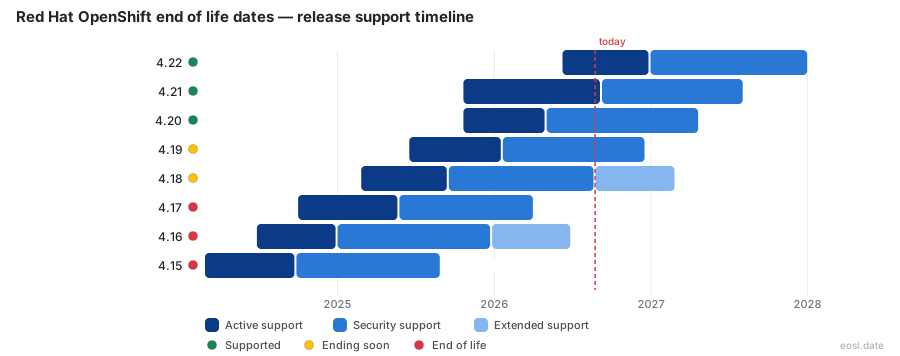
Currently Supported Red Hat OpenShift Releases - Active EOS/EOSL Support (3)
| Release | Released | Maintenance Support | Full Support | Extended Update Support | Latest |
|---|---|---|---|---|---|
| 5.0 | (2 weeks and 4 days ago) | (in 2 years) | (in 1 year) | Active | 5.0.1 (1 week and 5 days ago) |
| 4.22 | (5 months ago) | (in 1 year and 1 month) | (in 1 month and 1 week) | Active | 4.22.22 (2 weeks and 2 days ago) |
| 4.21 | (1 year and 1 month ago) | (in 8 months) | (2 months ago) | Active | 4.21.42 (1 week and 5 days ago) |
Red Hat OpenShift Releases Nearing End of Life - Support Ending Soon (2)
Red Hat OpenShift End of Life (EOL) Releases - No Longer Supported (18)
| Release | Released | Maintenance Support | Full Support | Extended Update Support | Latest |
|---|---|---|---|---|---|
| 4.18 | (1 year and 8 months ago) | (2 months ago) | (1 year and 2 months ago) | (in 3 months) | 4.18.60 (1 week and 5 days ago) |
| 4.17 | (2 years and 1 month ago) | (7 months ago) | (1 year and 5 months ago) | Active | 4.17.60 (1 week and 3 days ago) |
| 4.16 | (2 years and 4 months ago) | (10 months ago) | (1 year and 10 months ago) | (4 months ago) | 4.16.75 (1 week and 5 days ago) |
| 4.15 | (2 years and 8 months ago) | (1 year and 2 months ago) | (2 years and 1 month ago) | Active | 4.15.71 (1 week and 3 days ago) |
| 4.14 | (3 years ago) | (1 year and 6 months ago) | (2 years and 5 months ago) | (1 year ago) | 4.14.78 (1 week and 5 days ago) |
| 4.13 | (3 years and 6 months ago) | (2 years ago) | (2 years and 9 months ago) | Active | 4.13.73 (1 week and 3 days ago) |
| 4.12 | (3 years and 10 months ago) | (2 years and 4 months ago) | (3 years and 3 months ago) | (1 year and 10 months ago) | 4.12.103 (1 week and 5 days ago) |
| 4.11 | (4 years and 3 months ago) | (2 years and 9 months ago) | (3 years and 7 months ago) | Active | 4.11.59 (2 years and 7 months ago) |
| 4.10 | (4 years and 8 months ago) | (3 years and 2 months ago) | (4 years ago) | Active | 4.10.67 (3 years and 2 months ago) |
| 4.9 | (5 years and 1 month ago) | (3 years and 7 months ago) | (4 years and 5 months ago) | Active | 4.9.59 (3 years and 7 months ago) |
| 4.8 | (5 years and 3 months ago) | (3 years and 9 months ago) | (4 years and 9 months ago) | (3 years and 6 months ago) | 4.8.57 (3 years and 9 months ago) |
| 4.7 | (5 years and 8 months ago) | (4 years and 2 months ago) | (5 years ago) | Active | 4.7.60 (4 years ago) |
| 4.6 | (6 years ago) | (4 years ago) | (5 years and 7 months ago) | Active | 4.6.62 (4 years ago) |
| 4.5 | (6 years and 4 months ago) | (5 years and 3 months ago) | (5 years and 11 months ago) | Active | 4.5.41 (5 years and 4 months ago) |
| 4.4 | (6 years and 6 months ago) | (5 years and 8 months ago) | (6 years and 3 months ago) | Active | 4.4.33 (5 years and 9 months ago) |
| 4.3 | (6 years and 9 months ago) | (6 years ago) | (6 years and 5 months ago) | Active | 4.3.40 (6 years and 1 month ago) |
| 4.2 | (7 years ago) | (6 years and 4 months ago) | (6 years and 8 months ago) | Active | 4.2.36 (6 years and 4 months ago) |
| 4.1 | (7 years and 5 months ago) | (6 years and 6 months ago) | (7 years ago) | Active | 4.1.41 (6 years and 6 months ago) |
Your Red Hat OpenShift end of life date decides how long a cluster keeps receiving security fixes, so it pays to know it before an auditor or an outage asks. This guide shows the OpenShift EOL dates for every 4.x minor version, explains how Red Hat's support phases work, and gives you a plan for moving to a supported release in time.
Red Hat OpenShift end of life policy and support phases
Red Hat publishes a fixed life cycle for Red Hat OpenShift Container Platform (OCP), its Kubernetes-based container platform for hybrid cloud, so customers and partners can plan deployments. Red Hat OpenShift uses semantic versioning, so 4.19.16 means major 4, minor 19 and patch 16. A new minor release arrives roughly every four months, and Red Hat supports at least four of them at any moment. The clock starts at general availability (GA) and keeps running whatever your upgrade schedule looks like. Every Red Hat OpenShift support lifecycle moves through the same support phases, and each support phase has its own scope of fixes. The OpenShift life cycle ends when the last phase you are entitled to runs out.
Full support window
Full support begins at GA and lasts six months, or 90 days after the superseding minor release, whichever is later. In this phase Red Hat ships security advisories (RHSA) for critical, important and moderate CVE fixes rated 7.0 or higher on the CVSS scale, plus urgent bug fix updates. You also receive enhancements, so this is the only phase where new capability lands.
Maintenance support window
Maintenance support follows full support and ends 18 months after GA. Critical and important security errata still arrive from Red Hat, but other bug fix and enhancement advisories come at Red Hat's discretion and should not be expected. When it closes, software and documentation stay downloadable, yet technical support only helps you upgrade. That closing date is the standard OpenShift end of support point for odd releases, and only an extended update support add-on can push an even release past it.
OpenShift EOL dates and release date version matrix
The table below lists each recent release with its Kubernetes version, GA date and the date each phase stops. The maintenance support column is the EOL for clusters without an EUS add-on, so use it to see which OpenShift versions are still covered. Treat it as a planning aid and confirm it against the Red Hat OpenShift Container Platform life cycle policy, because dates can shift.
| OpenShift version | Kubernetes | GA | Full support ends | Maintenance ends (EOL) | EUS Term 1 ends |
|---|---|---|---|---|---|
| 4.22 (EUS) | 1.35 | Jun 9, 2026 | Dec 31, 2026 | Dec 31, 2027 | Jun 30, 2028 |
| 4.21 | 1.34 | Feb 3, 2026 | Sep 9, 2026 | Aug 3, 2027 | — |
| 4.20 (EUS) | 1.33 | Oct 21, 2025 | May 3, 2026 | Apr 21, 2027 | Oct 21, 2027 |
| 4.19 | 1.32 | Jun 17, 2025 | Jan 21, 2026 | Dec 17, 2026 | — |
| 4.18 (EUS) | 1.31 | Feb 25, 2025 | Sep 17, 2025 | Aug 25, 2026 | Feb 25, 2027 |
| 4.17 | 1.30 | Oct 1, 2024 | May 25, 2025 | Apr 1, 2026 | — |
| 4.16 (EUS) | 1.29 | Jun 27, 2024 | Jan 1, 2025 | Dec 27, 2025 | Jun 27, 2026 |
As of late October 2026, 4.17 and 4.16 are past their standard EOL, 4.18 survives only through its EUS term until February 25, 2027, and 4.19 loses maintenance on December 17, 2026. Version 4.22 is the newest OpenShift Container Platform release and the safest OCP target for a new production cluster.
OpenShift release cycle and extended update support
Red Hat marks even-numbered minor releases (4.16, 4.18, 4.20, 4.22) as Extended Update Support releases. Odd releases follow the standard 18 months path and nothing more. Extended update support also lets you move between even releases with fewer node reboots, which is why many teams stay on even versions, and the optional extended update support add-on stretches their coverage further. The OpenShift release cycle therefore gives you two lanes: a short one for odd versions and a long one for even versions with an add-on.
Term 1 and Term 2 add-ons
The EUS add-on comes in two long-life offerings. Term 1 is an optional add-on that adds six months after maintenance, reaching 24 months from GA; Premium subscriptions include it and Standard ones can buy it. Term 2 is a second add-on that adds twelve more months for platform-aligned operators, reaching 36 months in total, and it only applies on top of Term 1. Both add-on terms provide backports of critical, important and moderate CVE fixes plus urgent bug fix work, which suits mission-critical workloads that cannot move often. Some even releases, such as 4.12 and 4.14, also received a Term 3. Each long-life add-on inherits the service level agreement (SLA) of your base subscription, and Term 2 support is only as good as the entitlement you hold, so buy it before the date arrives, not after.
OpenShift support lifecycle on Azure and other managed services
The platform ships as self-managed software on Red Hat Enterprise Linux and RHEL CoreOS, and as a managed service through Azure Red Hat OpenShift, ROSA on AWS and a Red Hat OpenShift offering for IBM Cloud. Community users run OKD, and developers run MicroShift or a local cluster at the edge. A managed service handles the containerization plumbing for you, while Red Hat Enterprise Linux still sits under each node. Managed offerings follow their own support policy built on top of the Red Hat schedule, so check the provider's calendar as well as Red Hat's. In a hybrid cloud, each environment can carry a different EOL, and each cluster operator you install has its own support dates too.
Azure Red Hat OpenShift version availability
Azure Red Hat OpenShift supports a minor version once its update appears in the fast channel, and Microsoft lists installable releases on its own release calendar. You can also run az aro get-versions --location [region] to see what you can create today. For Azure Red Hat OpenShift, the stable-channel end of life for 4.20 is April 21, 2027, and its EUS Term 1 date is October 21, 2027.
Update channels
An update channel states which minor version your cluster is heading toward. Azure Red Hat OpenShift supports the fast channel, the stable channel and the eus channel only. A cluster that follows the candidate channel can land in a limited support state.
Policy exceptions and mandatory updates
The Azure Red Hat OpenShift site reliability engineers may add, remove or delay a patch version or minor release without notice when a serious bug or vulnerability appears. In extreme cases you get 72 hours to apply the newest z-stream, after which a critical patch can be pushed to your cluster automatically. Red Hat's own self-managed security fixes work differently, since you apply them yourself.
What happens at OpenShift end of support
Once a version reaches end of life, no patches or fixes follow, and you are on self-support. Red Hat support may still help you upgrade, and extended update support is the only way to delay that point, but a cluster on an unsupported release can fall into limited support and, on Azure, outside the SLA. The practical risks are concrete:
- unpatched vulnerability exposure, because new security fixes stop arriving for the container platform;
- failed compliance checks, since many frameworks require a vendor-supported platform and a good security rating and a supported container platform;
- operators and container images that refuse to install against an old release;
- help desk answers that start and end with "upgrade first".
IT teams that track assets in an asset management tool should add each cluster's EOL date as a field, so an alert fires well before the deadline. Treat the end-of-life date as the last day to be upgraded, not the day to start.
OpenShift version upgrade paths and Kubernetes mapping
Minor upgrades are sequential. You move 4.18 to 4.19 to 4.20 and cannot skip a minor version, although you can jump several z-stream builds within one minor. Update to the latest patch of your current minor before you take the next step. Use oc adm upgrade to list the targets your channel offers, and read Red Hat's security and platform notes for each release first.
Kubernetes version for each OpenShift minor version
Each OpenShift minor ships one Kubernetes minor, and the offset has been constant through the 4 series:
$$\text{Kubernetes minor} = x + 13 \quad \text{for OpenShift } 4.x$$
So 4.18 runs Kubernetes 1.31, 4.20 runs 1.33 and 4.22 runs 1.35. Run oc version to confirm the Kubernetes version on a live cluster, because API removals follow it, not the OpenShift number.
EUS-to-EUS upgrade
An EUS-to-EUS move, such as 4.18 to 4.20, still updates the control plane through the odd release, but you pause the worker MachineConfigPools so worker nodes reboot once.
oc patch mcp/worker --type merge -p '{"spec":{"paused":true}}'
oc adm upgrade channel eus-4.20
oc adm upgrade --to-latest
OpenShift life cycle planning checklist
Start planning about six months before an OCP EOL, test in staging three months before, and upgrade production one to two months before. Keep that OCP cadence per cluster and the dates above stop being emergencies. Skipping the plan is how teams end up forced into a rushed migration.
Pre-upgrade checklist
- Compare your current OpenShift Container Platform version with the matrix and note the EOL and the current support phase.
- Confirm every ClusterOperator reports healthy and no MachineConfigPool is degraded.
- Review removed API usage in workloads before the new Kubernetes release lands.
- Check that installed operators support the target version, as well as drivers that depend on the kernel.
- Take an etcd backup, and record which support phase the target release is in, and verify that PodDisruptionBudgets will not block node drains.
Teams running Windows containers or OpenShift virtualization should also verify guest and node support for the target release in the Red Hat product documentation, and confirm that Red Hat support covers your subscription tier.