GitLab Runner End of Life (EOL) Dates and End of Support (EOS) Dates
GitLab Runner end of life (EOL) and end of support (EOS) dates: 16 GitLab Runner versions have reached EOL, including GitLab Runner 19.3 (EOL date: Nov 19, 2026) — no longer receiving security updates or patches. GitLab Runner 19.4 reaches its End of Support date on Dec 17, 2026 — plan your upgrade path now. Also see Elastic Beats EOSL dates for related end-of-life information.
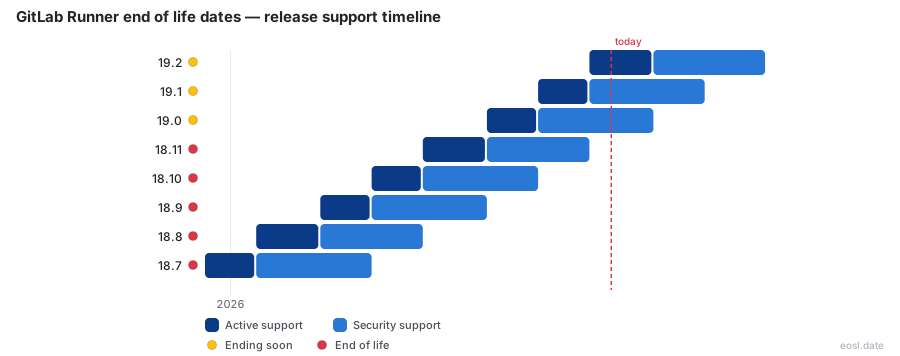
GitLab Runner Releases Nearing End of Life - Support Ending Soon (3)
| Release | Released | Maintenance Support | Active Support | Latest |
|---|---|---|---|---|
| 19.4 | (2 months ago) | (in 3 weeks and 5 days) | (1 month and 6 days ago) | 19.4.4 (2 weeks and 2 days ago) |
| 19.5 | (1 month and 6 days ago) | (in 2 months) | (2 days ago) | 19.5.3 (2 weeks and 2 days ago) |
| 19.6 | (2 days ago) | (in 2 months) | (in 3 weeks and 5 days) | 19.6.0 (4 days ago) |
GitLab Runner End of Life (EOL) Releases - No Longer Supported (16)
| Release | Released | Maintenance Support | Active Support | Latest |
|---|---|---|---|---|
| 19.3 | (3 months ago) | (2 days ago) | (2 months ago) | 19.3.6 (2 weeks and 2 days ago) |
| 19.2 | (4 months ago) | (1 month and 6 days ago) | (3 months ago) | 19.2.6 (2 months ago) |
| 19.1 | (5 months ago) | (2 months ago) | (4 months ago) | 19.1.5 (2 months ago) |
| 19.0 | (6 months ago) | (3 months ago) | (5 months ago) | 19.0.3 (3 months ago) |
| 18.11 | (7 months ago) | (4 months ago) | (6 months ago) | 18.11.4 (4 months ago) |
| 18.10 | (8 months ago) | (5 months ago) | (7 months ago) | 18.10.1 (7 months ago) |
| 18.9 | (9 months ago) | (6 months ago) | (8 months ago) | 18.9.0 (9 months ago) |
| 18.8 | (10 months ago) | (7 months ago) | (9 months ago) | 18.8.0 (10 months ago) |
| 18.7 | (11 months ago) | (8 months ago) | (10 months ago) | 18.7.2 (10 months ago) |
| 18.6 | (1 year ago) | (9 months ago) | (11 months ago) | 18.6.6 (11 months ago) |
| 18.5 | (1 year and 1 month ago) | (10 months ago) | (1 year ago) | 18.5.0 (1 year and 1 month ago) |
| 18.4 | (1 year and 2 months ago) | (11 months ago) | (1 year and 1 month ago) | 18.4.0 (1 year and 2 months ago) |
| 18.3 | (1 year and 3 months ago) | (1 year ago) | (1 year and 2 months ago) | 18.3.1 (1 year and 2 months ago) |
| 18.2 | (1 year and 4 months ago) | (1 year and 1 month ago) | (1 year and 3 months ago) | 18.2.2 (1 year and 3 months ago) |
| 18.1 | (1 year and 5 months ago) | (1 year and 2 months ago) | (1 year and 4 months ago) | 18.1.3 (1 year and 3 months ago) |
| 18.0 | (1 year and 6 months ago) | (1 year and 3 months ago) | (1 year and 5 months ago) | 18.0.5 (1 year and 3 months ago) |
Your GitLab Runner end of life date decides when the open-source agent that runs your CI/CD jobs from .gitlab-ci.yml stops getting fixes. Whether jobs run in Docker, Kubernetes or over SSH, an unsupported runner leaves your DevOps pipeline, continuous integration builds and deployment steps on a platform nobody patches. This guide covers each support policy rule and the dates behind it, so your repository keeps shipping.
GitLab Runner Versions: Semantic Versioning and Release Cycle
GitLab Runner uses semantic versioning (major.minor.patch), the same version scheme as GitLab.com, so the release cycle matches. A minor release arrives monthly on the third Thursday, a major version arrives yearly in May, and each release date is announced in the release notes. Breaking changes and API removals wait for a major version, and for compatibility you should keep a runner within one major version of your instance.
| Version type | Cadence | What changes |
|---|---|---|
| Major | Yearly, in May | Breaking changes, deprecations and removals |
| Minor | Monthly, third Thursday | New features, backward-compatible API |
| Patch | Twice monthly | Bug fixes only |
Major Release, Minor Release and Patch Release Cadence
A major release may remove features deprecated earlier, a minor release adds features without breaking anything, and a patch release only corrects behavior. Every patch is scheduled around the monthly minor release, so the cadence stays predictable.
Supported Versions Under the Maintenance Policy
The maintenance policy covers the current stable release and the two previous minor versions, so three supported versions exist at any time. On 27 October 2026 that means:
- 19.5: active support until 19 November 2026, maintenance until 21 January 2027
- 19.4: maintained versions status until 17 December 2026
- 19.3: supported until 19 November 2026, the day 19.6 is due
Runner 19.2 already lost coverage on 15 October 2026. Run gitlab-runner --version on each host and compare; the latest patch of a supported minor version is your target. A lifecycle exception is rare, so never plan around one.
Security Fixes, Bug Fixes and Backport Rules
Bug fixes go only to the current stable release, while security fixes reach the previous two monthly releases. Backporting is costly, so GitLab does it sparingly. An outdated runner still works, but any security vulnerability found next month stays open, raising risk, cost and compliance exposure for customers who depend on your builds.
Container Images and End of Publishing Dates
GitLab follows the support lifecycle of the base container behind each image: Ubuntu, Alpine and Red Hat Universal Base Image. It stops publishing an image in a minor release once the upstream vendor stops updating it, so an end of publishing date rarely lines up with a major release. Since 17.7 only the latest Alpine is published, and Ubuntu moves to the newest LTS release once an end-of-publishing date passes.
| Base container | Vendor EOL date | GitLab EOL date |
|---|---|---|
| Ubuntu 20.04 | 2025-05-31 | 2025-06-19 |
| Ubuntu 24.04 | 2027-04-30 | 2027-05-20 |
| Alpine 3.21 | 2026-11-01 | 2026-11-22 |
Base Distributions and Helper Images
The runner image and its helper images inherit the operating system of their base distributions. A Linux package install follows your host instead, so check that lifecycle policy separately. Once a base distribution passes its end date, GitLab stops publishing images built on it, and you must move to a supported tag.
Windows Version Support in the Runner Support Lifecycle
For Windows, runner support follows Microsoft's servicing channels. Long-Term Servicing Channel releases get five years of mainstream support, then an extended period of five more where GitLab helps as far as practical; Semi-Annual Channel releases get 18 months. Because the Docker executor needs containers matching the host, Windows Server choices matter.
| Windows Server | Mainstream support ends | Extended support ends |
|---|---|---|
| 2019 | January 2024 | January 2029 |
| 2022 | October 2026 | October 2031 |
| 2025 | October 2029 | October 2034 |
Mainstream Support and Extended Support
Windows Server 2022 leaves mainstream support this month, and GitLab can end extended support with an announcement on a major release. Watch the deprecations page and subscribe to the RSS feed for breaking removals; the GitLab Runner support policy page lists current dates.
Upgrade Plan Before GitLab Runner End of Life
Build an upgrade plan around the dates above:
- List every runner version, image and operating system in use.
- Mark anything already past its end of life.
- Follow the upgrade paths guide, then run testing on a staging runner.
- Roll out to production before the next monthly release.