Elastic Beats End of Life (EOL) Dates and End of Support (EOS) Dates
Elastic Beats end of life (EOL) and end of support (EOS) dates: 9 Elastic Beats versions have reached EOL, including Elastic Beats 9.3 (EOL date: Aug 04, 2026) — no longer receiving security updates or patches. Elastic Beats 9.5.6 is the current supported release — 3 versions in active support. Also see RabbitMQ end of support dates for related end-of-life information.
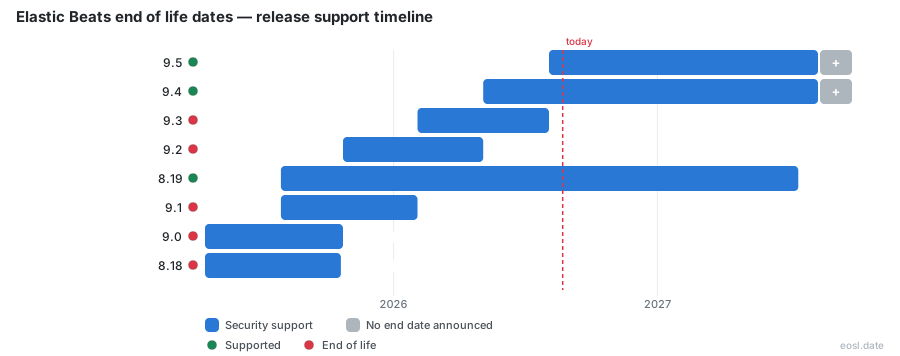
Currently Supported Elastic Beats Releases - Active EOS/EOSL Support (3)
Elastic Beats End of Life (EOL) Releases - No Longer Supported (9)
| Release | Released | Support | Latest |
|---|---|---|---|
| 9.3 | (9 months ago) | (3 months ago) | 9.3.8 (4 months ago) |
| 9.2 | (1 year ago) | (6 months ago) | 9.2.8 (7 months ago) |
| 9.1 | (1 year and 3 months ago) | (9 months ago) | 9.1.10 (10 months ago) |
| 9.0 | (1 year and 7 months ago) | (1 year ago) | 9.0.8 (1 year and 1 month ago) |
| 8.18 | (1 year and 7 months ago) | (1 year and 1 month ago) | 8.18.8 (1 year and 1 month ago) |
| 8.17 | (1 year and 11 months ago) | (1 year and 3 months ago) | 8.17.10 (1 year and 3 months ago) |
| 8.16 | (2 years ago) | (1 year and 7 months ago) | 8.16.6 (1 year and 7 months ago) |
| 7 | (7 years and 7 months ago) | (10 months ago) | 7.17.29 (1 year and 4 months ago) |
| 6 | (9 years ago) | (4 years and 9 months ago) | 6.8.23 (4 years and 10 months ago) |
Planning around Elastic Beats end of life starts with knowing that these lightweight shippers follow the same version policy as the rest of the platform, so every release series has a fixed date after which fixes and help stop. This guide shows the dates, the rules behind them and how to check your data pipeline against your subscription terms.
Beats Lifecycle: Maintenance Term and Support Term
Every release moves through two windows. The maintenance term is the period when the vendor ships bug fixes, performance work and patches for newly found security vulnerabilities, each delivered as a maintenance release. The support term runs for six months after that, so customers can still open cases with the support services team even though no new fixes arrive.
A major series keeps maintenance for the longer of 30 months from general availability or 18 months after the next major version appears. Take a made-up series released on 3 March 2020 whose successor lands on 1 June 2022: the 30-month mark falls on 3 September 2022 and the 18-month mark on 1 December 2023, so maintenance lasts until 1 December 2023 and support until 1 June 2024. This policy uses semantic versioning, so the first number signals a major change.
Major Release and Minor Release Rules
Within a maintained major release, the two newest minor release lines receive fixes, plus the final minor of the previous major. Older minors are not patched, and Elasticsearch, Kibana and Logstash all follow this rule, so staying on the latest minor is the safest habit across all supported versions.
Elastic Beats End of Life Dates by Release Series
The table lists the release date and the end-of-life dates for each series, as published in October 2026. Because Beats ship with Elasticsearch on the same schedule, the Elasticsearch versions you run set the pace for every shipper. Elastic can move a date later, so confirm against the official page before committing to a migration.
| Release series | Release date | End of maintenance | End of support | Status |
|---|---|---|---|---|
| 9.x | 15 Apr 2025 | 15 Oct 2027 or later | Not yet set | Supported |
| 8.x | 10 Feb 2022 | 15 Jan 2027 | 15 Jul 2027 | Ends soon |
| 7.17.x | 10 Apr 2019 | 15 Apr 2025 | 15 Jan 2026 | Ended |
| 6.x | 14 Nov 2017 | 10 Feb 2022 | Past | Ended |
Each row is unsupported once its final column reads Ended, and the latest version in a closed series, such as 7.17.29, gets no further releases. Only the newest minor lines of 9.x and the last 8.x versions still receive fixes, and the 8.x cutoff falls about eight months after the October 2026 update. Elasticsearch 7 reached the same point in January 2026, so Elasticsearch clusters on that series are already unsupported versions.
End of Support for Functionbeat and Software Product Retirement
A retired product is different from a routine version expiry. When the vendor announces software product retirement, no new major releases follow, but maintenance and help continue for at least 12 months after the notice. Functionbeat is the clear example: it reaches end of support 12 months after 8.5, and Elastic Serverless Forwarder replaces it. Subscribe to the RSS feed to catch each retired software notice as it is published.
Checking EOL Status for Filebeat and Metricbeat
All shippers share one clock: Filebeat, Metricbeat, Packetbeat, Winlogbeat, Auditbeat and Heartbeat inherit the dates in the table. Run each binary with its version flag, match the number to a supported release, and note any host still on 7.x. A supported release is one that appears in the table as supported, not one that merely still runs.
- Filebeat and Metricbeat: confirm the minor line is among the newest supported versions, and that Elasticsearch accepts it.
- Packetbeat, Winlogbeat, Auditbeat and Heartbeat: check them separately, since they are often installed on different hosts.
Support Policy and Support Matrix for Elasticsearch and the Elastic Stack
Your shippers must also fit the support matrix, the page listing eligible platform and software combinations. Beats versions from 8.0 do not support a 32-bit operating system, and Elastic drops older operating systems from the matrix six months after the vendor's own end date, so supported systems shrink over time. Elastic Agent adds aarch64 on Linux from 7.16.
The same support policy covers the whole Elastic Stack, also called the ELK Stack, so Elasticsearch, Logstash and Kibana move together. Check Linux, Windows, Docker, Kubernetes, JVM and cloud compatibility before choosing a target version. On Linux, a CentOS or Debian release that has reached its own end is dropped from newer 7.17.x builds, Docker images need a recent engine, and Elasticsearch itself has a separate Linux and Docker row.
Upgrade Planning Before End of Maintenance Arrives
Begin an upgrade well before the end of maintenance, because security fixes stop on that cutoff and an unpatched host can fail a compliance review. Elastic does not offer long-term support releases, so the practical plan is to move Elasticsearch and every shipper to the newest 9.x minor and then keep pace with each patch. Upgrade Elasticsearch first, then Kibana and Logstash, then the Beats, since a shipper newer than its Elasticsearch target is not supported.