Teleport End of Life (EOL) Dates and End of Support (EOS) Dates
Teleport end of life (EOL) and end of support (EOS) dates: 16 has reached EOL — EOL date: Oct 31, 2025. This version no longer receives security updates, patches, or support. Teleport 18.11.10 is the current supported release — 2 versions in active support. Also see Elastic Beats EOSL dates for related end-of-life information.
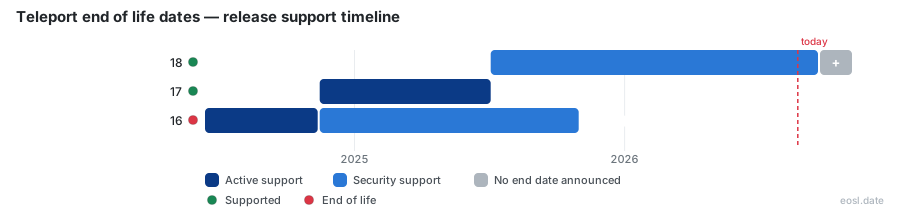
Currently Supported Teleport Releases - Active EOS/EOSL Support (2)
Teleport End of Life (EOL) Releases - No Longer Supported (1)
| Release | Released | Security Support | Active Support | Latest |
|---|---|---|---|---|
| 16 | (2 years and 5 months ago) | (1 year ago) | (2 years ago) | 16.5.18 (1 year and 1 month ago) |
Planning around Teleport end of life comes down to one rule: only the two newest major versions get fixes. This guide shows which Teleport version is supported today, when older releases lose support, and how to upgrade before a security issue forces your hand on your servers and clusters.
Teleport End of Life Dates by Major Version
Teleport ships one major version each year, and each one is supported for 24 months. The table combines the endoflife.date lifecycle data with Teleport's own policy, so you can see where your cluster stands at a glance.
| Major version | Released | Active support | Security support | Status |
|---|---|---|---|---|
| Teleport 18 | 04 Jul 2025 | Yes | Yes | Current Version |
| Teleport 17 | 15 Nov 2024 | Ended 04 Jul 2025 | Yes | Stable Version |
| Teleport 16 | 13 Jun 2024 | Ended 15 Nov 2024 | Ended 31 Oct 2025 | No longer supported |
The newest patch builds listed in mid-September 2026 were 18.11.1 and 17.7.29. Treat the table as a snapshot and confirm it against the supported releases page in the documentation before you plan a change window.
Teleport 16 Is Out of Support
Teleport 16 has reached end of life and is no longer supported. Its active window closed on 15 November 2024 and its security window on 31 October 2025, so a cluster still on it gets no fixes of any kind. Move it up one major version at a time.
Stable Version: Teleport 17
Teleport 17 is the Stable Version. It receives only security patches and bug fixes, and new features are never backported to it. That makes it a calm choice if you favor predictability over features, but plan its exit, because it drops out of support when the next major version arrives.
Current Version: Teleport 18
Teleport 18 is the Current Version, the only major version that still gets new features alongside fixes. Teleport Cloud tenants default to it, and it is where the latest capabilities landed, including MCP server access and AI session summaries.
Teleport Release Process and Semantic Versioning
Teleport adheres to semantic versioning, and a new major release arrives once a year, in August. In November 2025 the company changed its release process: three supported majors became two, and each major's support window grew to 24 months. The Current Version gets features; the Stable Version gets fixes only.
Upgrades did not change. You still cannot skip a major release, so a cluster two versions behind needs two upgrade steps.
Active Support and Security Support
Each major version passes through two phases. During active support it receives fixes and, for the newest, features. Afterwards security support continues with critical fixes only, which is why Teleport 17 still shows security coverage after its active window ended. When both phases are over, the version is simply unsupported.
No Longer Supported: Risks of Running Old Releases
An unsupported release stops receiving every fix for each new vulnerability. Teleport sits in a sensitive spot: it brokers access to servers, databases and clusters, and it issues short-lived certificates from its own certificate authority. An unpatched flaw there can weaken your security posture and the compliance evidence behind it.
Security Patches and Bug Fixes
Supported versions get regular patch releases. Teleport 18.10.0 on GitHub, for example, bundled fixes for role validation, Kubernetes RBAC and application access. Builds arrive through the package managers Teleport maintains, including apt, yum and helm, so staying patched is routine, provided your version is still supported.
A Recent CVE Response
The Teleport Cloud status page shows what an incident looks like. In October 2026 the team tracked a CVE, shipped builds with a patched Go version (18.11.6 and 17.7.31, then 18.11.7 and 17.7.32) and asked self-hosted customers to update every service. Only the two supported majors received those builds.
Upgrade Procedure for Every Teleport Version
The upgrade procedure is the same however you run Teleport. Back up the cluster first, then work through the pieces in order:
- Upgrade the control plane (auth and proxy services).
- Upgrade your agents.
- Upgrade client tools such as
tshandtctl. - Repeat for the next major version, since skipping is not supported.
The component compatibility rules explain the order: agents and tools on a newer release cannot connect to an older control plane, but older ones can connect to a newer one.
Teleport Cloud and Managed Updates
On Teleport Cloud, tenants follow the Current Version by default, and your account manager can switch you to the Stable Version. Customers enrolled in managed updates need no extra action when versions transition; everyone else must upgrade agents and clients after the tenant moves.
Self-Hosted Clusters and Documentation
If you are self-hosted, you choose the version of your clusters and agents. The documentation lists the current supported releases, and you should expect one month each year, around August, when a major upgrade comes due.
Teleport Releases and Downloads on GitHub
Every build is listed under the project's GitHub releases, and the open-source Teleport Community edition and Teleport Enterprise share the same version numbers, so you can check any build against the end-of-life table. Only 18.x and 17.x builds are still supported; each entry has a description of changes and a download section.
- Download only a build from a supported major version, and confirm the version number before you download.
- Skip any pre-release candidate on production systems; they are not production ready.
- Read the breaking changes before upgrading applications that rely on old behavior, such as the Kubernetes ephemeral-container RBAC change in 18.10.0.
Why Teleport Support Matters for Access and Infrastructure
Teleport is an identity-based access platform that replaces VPNs and static credentials with a proxy in front of SSH, Kubernetes, databases and web applications. Every access decision, authentication step and identity check passes through one product, so its patch level matters across your infrastructure.
The features that rely on a supported release include role-based access control, the audit log, session recording, access request workflows and zero trust access. Roughly 500 organizations use Teleport, which is reason enough to keep it inside the support window for every Teleport Enterprise or Community deployment you run.