Quasar End of Life (EOL) Dates and End of Support (EOS) Dates
Quasar end of life (EOL) and end of support (EOS) dates: 1 has reached EOL — EOL date: Jun 30, 2023. This version no longer receives security updates, patches, or support. Quasar 2.35.3 is the current supported release. Also see AdonisJS end of life dates for related end-of-life information.
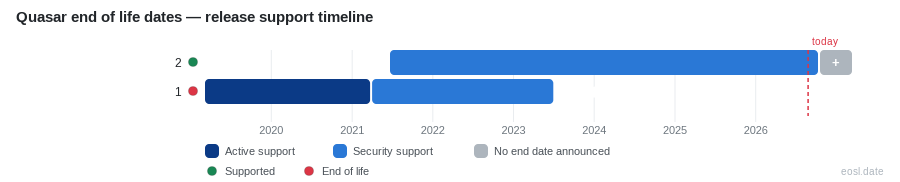
Currently Supported Quasar Releases - Active EOS/EOSL Support (1)
| Release | Released | LTS support | Active Support | Latest |
|---|---|---|---|---|
| 2 | (5 years and 4 months ago) | Active | Active | 2.35.3 (2 days ago) |
Quasar End of Life (EOL) Releases - No Longer Supported (1)
| Release | Released | LTS support | Active Support | Latest |
|---|---|---|---|---|
| 1 | (7 years and 8 months ago) | (3 years and 4 months ago) | (5 years and 7 months ago) | 1.22.10 (3 years and 6 months ago) |
If your team ships a product on this Vue.js framework, Quasar end of life is the date that decides how long you can count on fixes before you have to move. This guide lays out where every Quasar version stands today, what the project's own roadmap promises, and what to do while you still have time.
Quasar End of Life: Where Each Version Stands Today
Quasar is an open-source Vue-based tool for building single page apps, SSR apps, PWAs, browser extensions, mobile apps and Electron apps from one codebase. Its status is published in two places: the project's own plans and the endoflife.date listing, last updated on 20 October 2026. Both agree on the headline: the 1.x line is out of service, the 2.x line is fully maintained, and 3.x is only planned.
Quasar v2 Support Status
Released on 21 June 2021, the 2.x line is the active one and the one to build on. Its row in the schedule shows Active status, and both end dates read not planned yet, so no EOL date has been announced for it. The latest stable version at the time of writing is 2.35.2, published on 19 October 2026. Run quasar -v in your project to see which version you actually have.
Quasar v1 EOL Date and What It Means
The first generation arrived on 7 March 2019. Active support ended on 1 April 2021, and LTS support ended on 30 June 2023, with 1.22.10 (5 May 2023) as the final version. Today that line is unsupported: nobody is backporting fixes to it, so a Vue app on it carries every flaw found since mid-2023. Treat it as a migration job, not routine upkeep.
Supported Release Lines Compared
| Line | Released | Active | LTS | Latest release |
|---|---|---|---|---|
| 2.x | 21 Jun 2021 | Yes | Yes | 2.35.2 (19 Oct 2026) |
| 1.x | 7 Mar 2019 | Ended 1 Apr 2021 | Ended 30 Jun 2023 | 1.22.10 (5 May 2023) |
| 3.x | TBD | TBD | TBD | None |
Quasar Support Policy and Release Schedule
The support policy is short. Every major version is typically covered for at least 12 months, and coverage closes 12 months after the successor ships. Because 3.x has not been released, the clock on 2.x has not started. Once a successor appears, expect a one-year runway at minimum before upkeep of 2.x stops.
Long-Term Support Window: How Quasar LTS Works
Think of long-term support as two phases. During the first, a line gets new features and bug fixes. When active support ends, the same line enters LTS, where only fixes continue. When LTS support ends, nothing else ships. The date lands one year after the next major release, so you can plan the move the day a successor is announced.
App-Vite and App-Webpack Support Schedule
The build tooling follows its own timeline, separate from the UI package. In the schedule table:
- @quasar/app-vite v3 is active, released 11 June 2026.
- @quasar/app-vite v2 is in maintenance, with both end dates set to 11 June 2027.
- @quasar/app-webpack v4 is deprecated, so new projects should start on Vite.
- @quasar/extras v1 is inactive, with LTS ending 31 December 2026; v2 is active.
Anything marked TBD has no committed date, so check the table before each release cycle.
Quasar CLI and Package Versions
The Quasar CLI is on v5 and marked active, as are @quasar/icongenie v7 and the new MCP package. These npm packages move independently, so a project can sit on a maintained Vue 3 build tool while its UI package lags. Run an npm audit across each dependency and each version, not just quasar itself.
What Happens After a Quasar EOL
Once a line passes its Quasar EOL, you get no bug fixes, no new releases, and no answers on the issue tracker for that line. Your app keeps running, which is exactly why teams ignore the date. The risk builds up quietly in production, because every dependency your code touches keeps moving without it.
Security Patches on an Unsupported Version
The headline risk is that security patches stop. Newly disclosed vulnerabilities in the UI package or its plugins go unfixed, and a scanner will flag a CVE with no remediation path. Any later CVE published against the old line stays open for good, which makes it a standing finding in compliance-driven reviews and a hard sell to a security team.
Development Activity and Community Sentiment
Day-to-day development on a line also dries up: no new pull requests are merged for it and the Vue community moves on to the current version. Vue plugins, tutorials and Stack Overflow answers drift toward the supported API, so a stranded project loses outside help along with the patches.
Node.js Release Timeline and Quasar Compatibility
Your toolchain has its own clock, and Quasar builds run on Node.js. Node.js is the JavaScript runtime that powers the CLI, the dev server and every production build, so its schedule matters as much as the framework's. Node.js ships a new major roughly every six months, and each even-numbered line passes through Current, Active LTS and Maintenance LTS before it ends.
Node.js End-of-Life Dates Behind Quasar Builds
Node.js 20 reached end-of-life on 30 April 2026, Node.js 22 reaches it on 30 April 2027, and Node.js 24 on 30 April 2028. The roadmap says current Quasar packages target Node 22 and Baseline Widely Available browsers, with legacy compatibility code removed, so an old Node.js runtime can become the first thing that breaks a build. Pair your Vue 3 stack with a supported Node.js release, and keep an eye on the Node.js release timeline and your own version whenever you plan an upgrade.
Quasar v3 and the End-of-Life Roadmap
The plan lists one open entry for Q1 2027: planning for the next generation, with a promise to ask the community for input on decisions. Until a release exists, it should not change your plans. When it lands, the LTS rule above starts the countdown for 2.x.
Recent Quasar Milestones
The page marks several milestones as done in 2026: a new build package, an SSG mode, an accessibility overhaul of the UI components, faster builds through a new Vite plugin, and IconGenie v7. The shipped work covers SSR, PWA, Electron and mobile apps, which suggests the framework is still under active development rather than wound down.
Planning the New Major Version
A new major version is where breaking updates concentrate. Read the announcement when it appears, test your largest screens first, and decide whether to migrate right away or stay put through the LTS window. You can send feature requests through the project's Discord, which is how the team says it gathers input.
Community Questions About Quasar EOL Risk
In January 2026 a long-term user and sponsor opened a public discussion noting a gradual decline in development activity and a plan that had not been updated in about a year. Several replies voiced the same worry about the project. Doubts like these are what make an EOL date feel urgent, even though 2.x remains covered under the stated policy: the open question is whether the team behind it can sustain the work.
Open Source Funding and Sponsors
Most of the discussion came back to money. The roadmap itself asks for donations, noting that more income lets more of the team work on the project full time, and it urges companies using Quasar commercially to sponsor it monthly. For an open source effort, sustainability depends on that, so a business building on it has a practical reason to contribute.
What the Maintainers Said About Support
On 17 March 2026 the lead maintainer replied that Quasar is here to stay, that v3 was being planned, and that the team needed funding to reach its goals. That is a commitment, not a dated schedule, so weigh it as context rather than a guarantee. Web developers on commercial projects should keep an exit path documented.
Upgrade Guide for Quasar Versions Nearing EOL
An upgrade guide for Quasar is mostly a question of order: update the CLI or build package for your version, read the notes for your jump, then fix what breaks. Plan to move one major line at a time rather than skipping, since each hop has its own removals.
Breaking Changes Between Major Versions
Within one line, the project's historic notes promise no breaking changes, so staying current on the latest minor is safe and recommended. Across a major boundary, expect removed APIs, new build requirements and component changes. Moving from 1.x to 2.x is the move that matters before EOL, and it is a real migration with removed APIs rather than a bump, so budget time for it.
Upgrade Before the Quasar LTS Window Closes
If you are on the 1.x line, move to 2.x now, since it is already past LTS. If you are on 2.x, update the CLI and your Vite or webpack package, then bump Quasar itself. Delete node_modules and the lockfile and reinstall if packages go missing after an update.
Migrating Off Quasar After EOL
Some teams will conclude the framework no longer fits and move to another Vue UI library. Others on an out-of-support version buy third-party extended coverage instead of rewriting, an option vendors now offer for runtimes after official end of support. Whichever you choose, set the decision date before your current line's LTS ends, not after.