Electron End of Life (EOL) Dates and End of Support (EOS) Dates
Electron end of life (EOL) and end of support (EOS) dates: 41 Electron versions have reached EOL, including Electron 42 (EOL date: Oct 20, 2026) — no longer receiving security updates or patches. Electron 43 reaches its End of Support date on Jan 05, 2027 — plan your upgrade path now. Also see AdonisJS EOSL information for related end-of-life information.
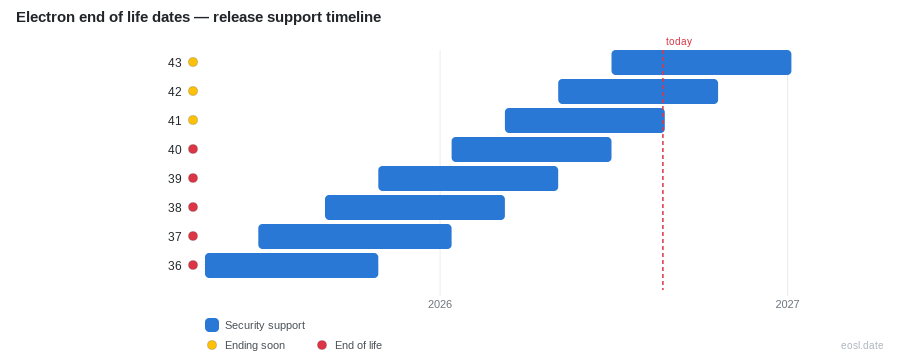
Electron Releases Nearing End of Life - Support Ending Soon (3)
Electron End of Life (EOL) Releases - No Longer Supported (41)
| Release | Chrome Version | Node Version | Released | Supported | Latest |
|---|---|---|---|---|---|
| 42 | M148 | 24 | (6 months ago) | (4 weeks ago) | 42.11.18 (3 weeks and 6 days ago) |
| 41 | M146 | 24 | (8 months ago) | (2 months ago) | 41.10.7 (2 months ago) |
| 40 | M144 | 24 | (10 months ago) | (4 months ago) | 40.10.6 (4 months ago) |
| 39 | M142 | 22 | (1 year ago) | (6 months ago) | 39.8.10 (6 months ago) |
| 38 | M140 | 22 | (1 year and 2 months ago) | (8 months ago) | 38.8.6 (8 months ago) |
| 37 | M138 | 22 | (1 year and 4 months ago) | (10 months ago) | 37.10.3 (11 months ago) |
| 36 | M136 | 22 | (1 year and 6 months ago) | (1 year ago) | 36.9.5 (1 year and 1 month ago) |
| 35 | M134 | 22 | (1 year and 8 months ago) | (1 year and 2 months ago) | 35.7.5 (1 year and 2 months ago) |
| 34 | M132 | 20 | (1 year and 10 months ago) | (1 year and 4 months ago) | 34.5.8 (1 year and 5 months ago) |
| 33 | M130 | 20 | (2 years and 1 month ago) | (1 year and 6 months ago) | 33.4.11 (1 year and 6 months ago) |
| 32 | M128 | 20 | (2 years and 2 months ago) | (1 year and 8 months ago) | 32.3.3 (1 year and 8 months ago) |
| 31 | M126 | 20 | (2 years and 5 months ago) | (1 year and 10 months ago) | 31.7.7 (1 year and 10 months ago) |
| 30 | M124 | 20 | (2 years and 7 months ago) | (2 years and 1 month ago) | 30.5.1 (2 years and 2 months ago) |
| 29 | M122 | 20 | (2 years and 8 months ago) | (2 years and 2 months ago) | 29.4.6 (2 years and 3 months ago) |
| 28 | M120 | 18 | (2 years and 11 months ago) | (2 years and 5 months ago) | 28.3.3 (2 years and 5 months ago) |
| 27 | M118 | 18 | (3 years and 1 month ago) | (2 years and 7 months ago) | 27.3.11 (2 years and 7 months ago) |
| 26 | M116 | 18 | (3 years and 3 months ago) | (2 years and 8 months ago) | 26.6.10 (2 years and 8 months ago) |
| 25 | M114 | 18 | (3 years and 5 months ago) | (2 years and 11 months ago) | 25.9.8 (2 years and 11 months ago) |
| 24 | M112 | 18 | (3 years and 7 months ago) | (3 years and 1 month ago) | 24.8.8 (3 years and 1 month ago) |
| 23 | M110 | 18 | (3 years and 9 months ago) | (3 years and 3 months ago) | 23.3.13 (3 years and 3 months ago) |
| 22 | M108 | 16 | (3 years and 11 months ago) | (3 years and 1 month ago) | 22.3.27 (3 years and 1 month ago) |
| 21 | M106 | 16 | (4 years and 1 month ago) | (3 years and 7 months ago) | 21.4.4 (3 years and 7 months ago) |
| 20 | M104 | 16 | (4 years and 3 months ago) | (3 years and 9 months ago) | 20.3.12 (3 years and 9 months ago) |
| 19 | M102 | 16 | (4 years and 5 months ago) | (3 years and 11 months ago) | 19.1.9 (3 years and 11 months ago) |
| 18 | M100 | 16 | (4 years and 7 months ago) | (4 years and 1 month ago) | 18.3.15 (4 years and 1 month ago) |
| 17 | M98 | 16 | (4 years and 9 months ago) | (4 years and 3 months ago) | 17.4.11 (4 years and 3 months ago) |
| 16 | M96 | 16 | (5 years ago) | (4 years and 5 months ago) | 16.2.8 (4 years and 5 months ago) |
| 15 | M94 | 16 | (5 years and 1 month ago) | (4 years and 5 months ago) | 15.5.7 (4 years and 5 months ago) |
| 14 | M93 | 14 | (5 years and 2 months ago) | (4 years and 7 months ago) | 14.2.9 (4 years and 7 months ago) |
| 13 | M91 | 14 | (5 years and 5 months ago) | (4 years and 9 months ago) | 13.6.9 (4 years and 9 months ago) |
| 12 | M89 | 14 | (5 years and 8 months ago) | (5 years ago) | 12.2.3 (5 years ago) |
| 11 | M87 | 12 | (6 years ago) | (5 years and 2 months ago) | 11.5.0 (5 years and 2 months ago) |
| 10 | M85 | 12 | (6 years and 2 months ago) | (5 years and 5 months ago) | 10.4.7 (5 years and 5 months ago) |
| 9 | M83 | 12 | (6 years and 5 months ago) | (5 years and 8 months ago) | 9.4.4 (5 years and 8 months ago) |
| 8 | M80 | 12 | (6 years and 9 months ago) | (5 years and 11 months ago) | 8.5.5 (5 years and 11 months ago) |
| 7 | M78 | 12 | (7 years ago) | (6 years and 2 months ago) | 7.3.3 (6 years and 2 months ago) |
| 6 | M76 | 12 | (7 years and 3 months ago) | (6 years and 5 months ago) | 6.1.12 (6 years and 5 months ago) |
| 5 | M73 | 12 | (7 years and 6 months ago) | (6 years and 9 months ago) | 5.0.13 (6 years and 11 months ago) |
| 4 | M69 | 10 | (7 years and 10 months ago) | (7 years ago) | 4.2.12 (7 years and 1 month ago) |
| 3 | M66 | 10 | (8 years and 1 month ago) | (7 years and 3 months ago) | 3.1.13 (7 years and 3 months ago) |
| 2 | M61 | 8 | (8 years and 6 months ago) | (7 years and 6 months ago) | 2.0.18 (7 years and 8 months ago) |
If you ship a desktop application on this open-source framework, Electron end of life decides how long your codebase keeps getting fixes. The framework lets you build cross-platform desktop applications with JavaScript, HTML and CSS for Windows, macOS and Linux, and each major release has its own set of end-of-life dates. This guide shows you which software versions are still covered, how the release schedule works, and when to upgrade.
Supported Releases and Electron End of Life Dates
Only the latest three stable major versions are supported at any moment. The table below lists the most recent release lines as of late October 2026, with the browser engine each one bundles, its launch date and its end-of-life date.
| Version | Chromium | Stable release | End-of-life date | Status |
|---|---|---|---|---|
| 45 | M156 | Oct 20, 2026 | Apr 27, 2027 | Active |
| 44 | M152 | Aug 24, 2026 | Mar 2, 2027 | Active |
| 43 | M150 | Jun 29, 2026 | Jan 5, 2027 | Active |
| 42 | M148 | May 5, 2026 | Oct 20, 2026 | Ended, unsupported |
| 41 | M146 | Mar 10, 2026 | Aug 24, 2026 | Ended, unsupported |
| 40 | M144 | Jan 15, 2026 | Jul 1, 2026 | Ended, unsupported |
| 39 | M142 | Oct 27, 2025 | May 5, 2026 | Ended, unsupported |
| 38 | M140 | Sep 2, 2025 | Mar 10, 2026 | Ended, unsupported |
| 37 | M138 | Jun 23, 2025 | Jan 15, 2026 | Ended, unsupported |
| 36 | M136 | Apr 28, 2025 | Oct 27, 2025 | Ended, unsupported |
Release lines 43 through 45 are the supported releases today. If you are still on 42 or older, you are running a software build that no longer gets patches. Dates for upcoming releases are tentative, so recheck the official page before you commit to a deadline.
Electron Version Support Policy and Support Cycle
The version support policy is simple: the OpenJS Foundation project supports the three newest stable releases and only the newest minor release of each. A security fix lands in the current minor of each supported line, and older minors get nothing. The newest line receives every fix backported from development, the one before it gets most of them, and the oldest supported line gets security patches only. Because the support cycle follows the upstream browser, dates can move when Chromium's own schedule shifts.
Chromium version support and the main process
Every app bundles its own copy of the browser engine, so your Chromium version is fixed when you ship. Your main process and renderer processes both run on that bundled engine, whether you write plain JavaScript or TypeScript. Releases target every other Chromium major release, and a new engine usually reaches the framework within one or two weeks of Chrome's own launch.
Node.js version support
The main branch moves to even-numbered Node.js versions as they enter Active LTS, and those lines then get minor and patch bumps. A Node.js patch ships in a patch release; a minor bump means a minor release.
Breaking changes and API removal
When an API changes in a way that breaks existing behavior, the old behavior is kept for at least two major versions where possible. That backwards compatibility buys you time, but check the official migration notes before every jump.
Electron Release Schedule and Release Cadence
Since Electron 16, the release cadence has been an eight-week cycle that follows Chrome's four-week rhythm. A single release cycle runs about four weeks of alpha and four weeks of beta, so a major takes roughly 8 weeks to go from its first preview build to stable before the next one begins. Early previews are the least reliable; the cutoff to beta happens when the underlying Chromium version reaches Chrome's early-access channel. The cadence exists to match Chromium Extended Stable.
The release dates for the first alpha, first beta and stable build are the firm milestones, and the team aims for weekly prerelease builds along the way, with nightly builds for anyone testing early. Each end-of-life date is then derived from when the third-newest line is pushed out. The timeline for every release branch is published on the official schedule page, where unconfirmed future dates carry a tentative marker, and every tagged build lives in the project's GitHub repository. Many teams also watch GitHub issues for upgrade reminders. In practice, a new major arrives about every two months, and each line stays supported for roughly six months after its stable date.
What End-of-Support Means: Security Fixes and Warnings
When a line reaches end-of-support, the team ships one final release and then stops. That last build adds a runtime warning telling you an unsupported Electron version is in use, and the line is marked deprecated on npm. After that, security fixes for the bundled Chromium never reach your app unless you upgrade, which matters most when your app opens remote content.
Real products depend on this timeline. Visual Studio Code and GitHub Desktop both ship on this stack, and projects such as Logseq and ZAP each opened a GitHub issue once their pinned line neared its end. Store rules matter too, because the Microsoft Store requires browser-based apps to stay within two major versions of the latest engine. An exception shows how seriously dates are treated: support for version 22 was temporarily extended to October 10, 2023, to cover the end of Windows 7, 8 and 8.1. Maintenance on this lifecycle is why you should treat every end-of-life date as a deadline for your own release plan.
Electron Releases: Upgrading to the Next Major Version
Plan an upgrade at least one cycle before your line ends. Move one major version at a time, on Windows, macOS and Linux alike, read the breaking changes for each, update dependencies that use native modules, and test on every operating system you ship to. Treat the framework like any other software dependency: skipping several majors at once makes it much harder to find which change broke your app.
Some teams use end of support as a moment to reconsider the whole stack. Critics point to large binaries and memory use, since even a medium-sized app can produce a binary of about 60 MB, and some developers move to Tauri, a toolkit with a Rust core that builds much smaller native apps. Tauri needs Rust installed and a rewritten backend, while keeping your JavaScript frontend and one codebase of web code, so for most apps staying current with Electron releases is cheaper than switching to Tauri. Track the upgrade as a GitHub milestone so the deadline stays visible.