AdonisJS End of Life (EOL) Dates and End of Support (EOS) Dates
AdonisJS end of life (EOL) and end of support (EOS) dates: 5 has reached EOL — EOL date: Feb 20, 2023. This version no longer receives security updates, patches, or support. AdonisJS 7.7.0 is the current supported release — 2 versions in active support. Also see Next.js end of support life for related end-of-life information.
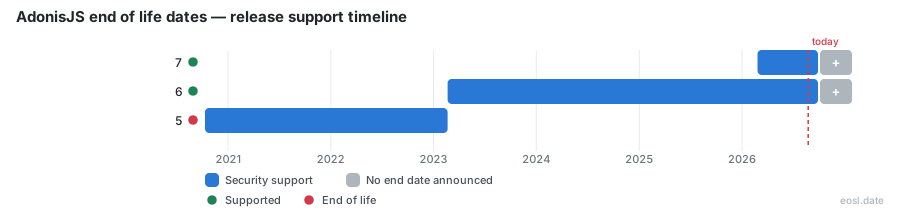
Currently Supported AdonisJS Releases - Active EOS/EOSL Support (2)
AdonisJS End of Life (EOL) Releases - No Longer Supported (1)
| Release | Released | Security Support | Latest |
|---|---|---|---|
| 5 | (6 years and 1 month ago) | (3 years and 9 months ago) | 5.9.0 (4 years ago) |
Planning around AdonisJS end of life starts with one question: which major versions of this web framework still get fixes? Today v7 and v6 are supported and v5 ended on 20 February 2023, but the maintainers have not published a formal schedule, so you have to read the signals yourself.
AdonisJS End of Life Status for Every Major Version
The tracker endoflife.date, last updated on 6 October 2026, lists the supported release numbers below. Use the latest version column to confirm that your lockfile is on the newest patch of your line.
| Major version | Released | Security support | Latest version |
|---|---|---|---|
| 7 | 25 Feb 2026 | Yes | 7.6.0 (5 Oct 2026) |
| 6 | 20 Feb 2023 | Yes | 6.20.0 (5 Feb 2026) |
| 5 | 11 Oct 2020 | Ended 20 Feb 2023 | 5.9.0 (22 Nov 2022) |
There is a catch. The same page notes that no official policy exists, and the release history suggests only the latest release actually receives fixes. Treat the "Yes" next to the older line as a courtesy, not a promise.
AdonisJS v5 EOL: What Retired Means for Old Apps
Version 5 shipped its last release, 5.9.0, in November 2022, and the tracker marks its support as ended in February 2023. An app in production on v5 should be considered deprecated in practice: no patches arrive, and its dependencies drift further from current Node.js releases every month.
AdonisJS v6 Support and Release History
The official blog traces AdonisJS v6 from its announcement through the "future plans" posts, and the v6 docs remain online for teams that cannot move yet. Version 6.20.0 arrived in February 2026, so maintenance releases continue, but only as long as the team keeps backporting. Keep your documentation bookmarks and tooling pinned, then set a calendar date to leave.
AdonisJS v7 Release and Supported Release Status
The v7 post went live on 25 February 2026, after a January note that the line was feature-complete and in final validation. It is the one supported release you can treat as safe for new work, and the latest release is 7.6.0. A new website and rewritten docs launched alongside it. The upgrade is described as incremental, with a stronger TypeScript foundation for JavaScript developers and a hard floor of Node.js 24.
Semantic Versioning and the Missing EOL Policy
The project follows semantic versioning, so a major number signals breaking changes, but a version number alone says nothing about how long an old line stays alive. A request on GitHub in April 2026 asked the team for dated end-of-life rules, and none had appeared when we checked. The 2025 roadmap post and the project's wider ecosystem updates on the blog are the closest thing to a forecast.
Security Fixes Shipped in the Latest Major Release
When you decide how long to stay on an old line, weigh the security fixes in v7. The announcement lists four CVE identifiers, and several describe flaws that existed in v6 code. Read the security notes before you postpone a move.
Path traversal and mass assignment fixes
One fix closes a path traversal problem in file uploads. Another stops mass assignment in Lucid: in v6, fill, merge and create accepted keys that matched internal ORM properties, so a crafted request body could corrupt model state. V7 ignores any key starting with a dollar sign.
Prototype pollution and denial of service CVE entries
Multipart parsing received two hardening changes. Reserved field names could trigger prototype pollution, and an unbounded buffer allowed a denial of service through uploads whose content matched no known signature. Both affect your server only where you accept multipart requests.
Upgrade Guide: AdonisJS 6 to AdonisJS 7
The jump is small by major-version standards, which makes waiting harder to justify.
How to migrate with the official steps
Start with the written walkthrough, because migrating from v6 is billed as an incremental upgrade and you can migrate one app at a time. For a new project, run npm init adonisjs@latest my-app and compare its config with yours.
Node.js 24 and the new compiler
You need Node.js 24, the LTS version since October 2025, because the new ts-exec compiler for TypeScript replaces ts-node and relies on its features. Check your CI images and hosting server runtime first, then your npm packages.
Breaking changes to check first
The list of breaking changes is short, but run your testing pipeline early, since the new schema classes and generated barrel imports touch many files.
Starter Kits and Official Packages Outside the EOL Window
What you lose by staying on a retired line shows up first in the kits. V7 ships four reworked starter kits (Hypermedia, API, React and Vue), and each starter kit includes authentication with working login and signup, and the TypeScript-first API kit serves JSON from a server without a front end. A September 2026 post updated all five official kits with dark mode and typed forms. More than 45 official packages were refreshed, and Persona and Permission joined as paid extras. Older packages on a retired line will not get those updates.
Planning Around the EOL: Type Safety, Inertia and Vite
Staying inside the maintained window means moving these front-end pieces together with the core. The headline v7 theme is end-to-end type safety: a type-safe URL builder, transformers and an API client that share TypeScript types between back end and front end, covering every API route your pages call. Inertia benefits most. Type-safe links and forms in Inertia pages, shared data moving into middleware, and the Inertia adapter's support for Inertia v3 all landed in the 2026 releases. The React and Vue kits rely on Inertia for their single-page flow. Server-rendered or single-page, pair it with Vite 8 support, added in August 2026, and your front end follows the same upgrade path. If your Inertia setup is old, plan the Inertia and Vite bump alongside the framework change, and note that each Inertia package ships its own version number. Teams that skip it will read Inertia release notes against an unsupported base.
Encryption, Observability and Bug Fixes in v7
Beyond security, v7 brings smaller bug fixes and a better developer experience. A new encryption module supports key rotation, so you can retire a secret without breaking stored data, and adds deterministic encryption for lookups. Observability arrives through zero-config OpenTelemetry, while a multi-limiter lets one call enforce several rate limits, such as per IP and per email on a login API endpoint. Apps stuck on older majors will never receive any of this, and each change reduces custom code you must keep alive yourself, so the encryption work alone justifies a look.
Lucid and Database Changes Before the Next EOL
The ORM on a retired line gets no further fixes, so verify these points before you move. Lucid, the ORM, changes in ways that matter to your database layer. Besides the mass assignment fix, smart migrations infer a create or alter call from the name you pass to the make:migration command. Test every database query touching Lucid models, and compare Lucid relationships on a staging server with a copy of your database, including any API that returns model data.
AdonisJS Lifecycle Phases Versus an EOL Date
Searches for this topic often land on pages about the application lifecycle, which describes what happens inside a running app, not a version's own maintenance lifecycle, which the table above covers. Still, knowing it helps you upgrade safely, because service providers and Ace commands hook into these phases.
Boot phase and warmup phase
The boot phase prepares the container, and the warmup phase registers routes, listeners and named middleware. Tooling such as the codegen command stops after warmup.
Termination phase and graceful shutdown
The termination phase runs on a shutdown signal, giving providers time for graceful shutdown: closing connections and flushing logs.
Your EOL Checklist for AdonisJS Projects
- Inventory: list every app and its major version.
- Prioritize: move v5 first, then v6 apps handling uploads.
- Verify: confirm Node.js 24 on your hosts.
- Watch: follow the GitHub thread for a policy.
Whatever your support status, a calendar reminder each quarter keeps the next release from surprising you, and a documented plan makes the framework easier to defend in an audit.