Plone End of Life (EOL) Dates and End of Support (EOS) Dates
Plone end of life (EOL) and end of support (EOS) dates: 4 Plone versions have reached EOL, including Plone 5.2 (EOL date: Oct 31, 2024) — no longer receiving security updates or patches. Plone 6.2.3 is the current supported release, with support through Jun 30, 2028 — 3 versions in active support. Also see Ansible-core lifecycle dates for related end-of-life information.
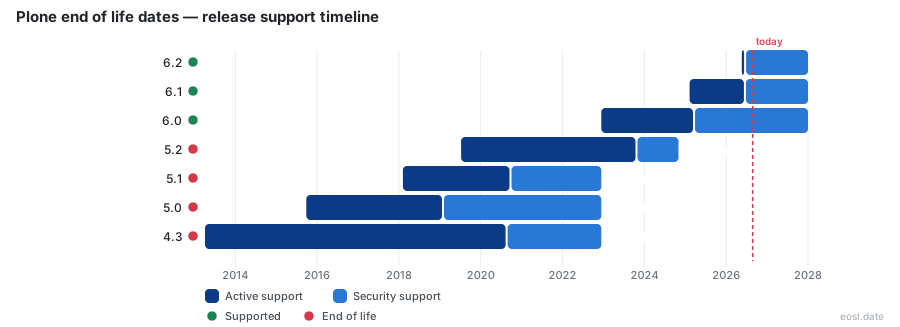
Currently Supported Plone Releases - Active EOS/EOSL Support (3)
| Release | Python Versions | Released | Security Support | Maintenance Support | Latest |
|---|---|---|---|---|---|
| 6.2 | 3.10-3.14 | (6 months ago) | (in 1 year and 7 months) | Active | 6.2.3 (1 week and 5 days ago) |
| 6.1 | 3.10-3.13 | (1 year and 9 months ago) | (in 1 year and 1 month) | (4 months ago) | 6.1.6 (1 week and 5 days ago) |
| 6.0 | 3.9-3.13 | (3 years and 11 months ago) | (in 1 year and 1 month) | (1 year and 7 months ago) | 6.0.16 (1 week and 5 days ago) |
Plone End of Life (EOL) Releases - No Longer Supported (4)
| Release | Python Versions | Released | Security Support | Maintenance Support | Latest |
|---|---|---|---|---|---|
| 5.2 | 2.7, 3.8 | (7 years and 4 months ago) | (2 years ago) | (3 years ago) | 5.2.15 (2 years and 3 months ago) |
| 5.1 | 2.7 | (8 years and 9 months ago) | (3 years and 11 months ago) | (6 years and 1 month ago) | 5.1.7 (6 years and 1 month ago) |
| 5.0 | 2.7 | (11 years and 1 month ago) | (3 years and 11 months ago) | (7 years and 9 months ago) | 5.0.10 (7 years and 9 months ago) |
| 4.3 | 2.7 | (13 years and 7 months ago) | (3 years and 11 months ago) | (6 years and 2 months ago) | 4.3.20 (6 years and 2 months ago) |
Plone end of life is not a single date: every release series of this open source content management system has its own cutoff, and the nearest one for most sites is 31 December 2027, when security support for Plone 6.0 and 6.1 is scheduled to stop. Below you get every date, a plain explanation of the rules behind them and a way to choose a version that gives you stability without surprises.
Plone End of Life Dates for Each Release Series
Plone separates two kinds of coverage. Maintenance support brings bug fixes and small new features, while security support brings security patches only. The table follows the Plone Foundation's published schedule and matches the independent endoflife.date tracker, which was last updated on 3 October 2026.
| Series | Python versions | Initial release | End of maintenance | End of security support |
|---|---|---|---|---|
| 4.3 | 2.7 | 2013-04-06 | 2020-08-28 | 2022-12-12 |
| 5.2 | 2.7, 3.8 | 2019-07-10 | 2023-10-31 | 2024-10-31 |
| 6.0 | 3.9-3.13 | 2022-12-12 | 2025-03-27 | 2027-12-31 |
| 6.1 | 3.10-3.13 | 2025-02-07 | 2026-06-25 | 2027-12-31 |
| 6.2 | 3.10-3.14 | 2026-05-19 | Until 6.3 or 7.0 ships | 2028-06-30 |
Plone 6.0 and 6.1 Security Support
Plone 6.0 arrived on 12 December 2022 with Python 3.9 to 3.13 support, and its latest patch is 6.0.15. Plone 6.1 followed on 7 February 2025 and also runs on Python 3.13 and stopped receiving maintenance after 6.2.0 was released. Both lines keep getting security fixes until 31 December 2027, exactly five years after 6.0.0. If your priority is stability, 6.0 with Volto 16 holds the same security date.
Plone 6.2 Maintenance Support Window
Plone 6.2 was released on 19 May 2026 and runs on Python 3.10 through 3.14, with 6.2.2 as the newest release at the time of writing. It stays in maintenance support until 6.3.0 or 7.0.0 is final. The written policy gives it security support until Plone 7.0.0 is out, and the schedule table shows 30 June 2028. A 6.3 line is in development, listed with 30 June 2029.
Unsupported Plone Versions and End of Support
Plone calls anything older than the lines above unsupported: no patches and no hotfixes from the core team. Plone 4.3, 5.0 and 5.1 lost security support on 12 December 2022, and Plone 5.2 followed on 31 October 2024, a year after its end of maintenance. Those releases depended on Python 2.7 or an early Python 3, and 4.3 predates the Dexterity-only world, with Archetypes content types still in use. Staying there means unpatched vulnerabilities, so plan an upgrade rather than a workaround. Plone solution providers sell extended support on request if a migration cannot happen yet.
Plone Release Policy and Version Numbers
The release policy is built on semantic versioning, so the number tells you how risky a change is. The key rules:
- Each major version receives five years of security support from its release date.
- Every minor version inside that major version shares the same security end date.
- The first minor release (
x.0) gets two years of maintenance support; later ones drop maintenance when the next minor or major version is final. - Fixes for vulnerabilities ship as a patch release (6.0.8) or a sub release (6.0.8.1), at the discretion of the Release Team and Security Team.
Updated in January 2024, this policy replaced the older habit of dropping every minor version except the last one. It also treats the release schedule as a promise rather than a forecast.
Semantic Versioning for Plone Releases
Plone follows MAJOR.MINOR.PATCH, often shortened to semver. A major version may break add-ons, for example when Archetypes was removed. A minor version can change how data sits in the ZODB, so you cannot go back without a backup. A patch release is backward compatible and reversible. Beta and release candidate builds are pre-release states.
How Each Support State Works
- Development: new features, with alpha, beta and release candidate builds.
- Maintenance support: patches, bug fixes and small features in patch versions.
- Security support: fixes for vulnerabilities in individual packages only.
Plone Release Schedule and Roadmap After Plone 6
The roadmap for 2025 to 2032 keeps Plone 6 as the stable foundation through 2027 and aims at a Plone 7 release in 2027. Plone 7 is then maintained from 2028 to 2031, and Plone 8 is expected around 2032 with five years of security support. A prototype of Plone 7, codenamed Seven, has been available since late 2025. Plone 6.3 is planned to bring refinements and AI features before that.
Progress is steered by the Plone Steering Circle, which reviews the plan quarterly, while the Plone community takes part through improvement proposals and a yearly sprint. Read the roadmap again after each Plone Conference, because it is revised then. The stated priorities are accessibility, security and a modern interface for a headless setup built on React.
Volto as the Default Frontend
Volto is the React frontend that ships with Plone 6, and its support follows the same lifecycle rules. The recommended pairing today is the 6.2 line with Volto 19, and the Plone roadmap treats it as the long-term default.
Choosing a Plone Version While Maintenance Support Lasts
Match the version to your risk tolerance, and keep an eye on the roadmap and community announcements for this open source CMS:
- Run Plone 6.0 with Volto 16 when you want a steady setup and can live without new features until the end of 2027.
- Run Plone 6.2 when you start a new site or want the newest features and the longest security window.
- Check that your Python runtime, add-ons and hosting stack support the target release before you move.
Leave at least a quarter of lead time. A site's upgrade from 5.2 touches its extensions, the Python migration and theme, so moving in one jump takes longer than staying current with patch releases.
What Plone Is and Why Security Support Matters
Plone is a free and open source Python CMS built on the Zope application server and its object database, and the wider Zope ecosystem supplies much of its tooling. The Plone Foundation owns the trademarks, while the project began in 1999 and shipped its first release in 2001. Organizations such as the FBI, the United Nations and the European Environment Agency use it, partly because of its record on security and accessibility, and a large global community keeps the project moving. Running software that no longer gets patches on a site like that is the real risk behind any end-of-life date.