Ansible-core End of Life (EOL) Dates and End of Support (EOS) Dates
Ansible-core end of life (EOL) and end of support (EOS) dates: 10 Ansible-core versions have reached EOL, including Ansible-core 2.18 (EOL date: May 31, 2026) — no longer receiving security updates or patches. Ansible-core 2.19 reaches its End of Support date on Nov 30, 2026 — plan your upgrade path now. Ansible-core 2.22.0 is the current supported release, with support through May 31, 2028 — 3 versions in active support. Also see Django EOSL information for related end-of-life information.
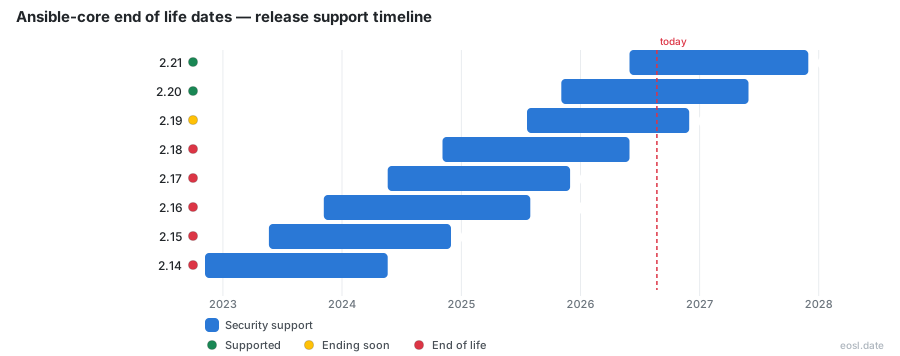
Currently Supported Ansible-core Releases - Active EOS/EOSL Support (3)
| Release | Powershell Versions Managed Node | Python Versions Control Node | Python Versions Managed Node | Released | Supported | Latest |
|---|---|---|---|---|---|---|
| 2.22 | 5.1 - 7 | 3.13 - 3.15 | 3.9 - 3.15 | (2 weeks and 5 days ago) | (in 1 year and 6 months) | 2.22.0 (2 weeks and 5 days ago) |
| 2.21 | 5.1 - 7 | 3.12 - 3.14 | 3.9 - 3.14 | (5 months ago) | (in 1 year) | 2.21.6 (2 weeks and 5 days ago) |
| 2.20 | 5.1 | 3.12 - 3.14 | 3.9 - 3.14 | (1 year ago) | (in 6 months) | 2.20.11 (2 weeks and 5 days ago) |
Ansible-core Releases Nearing End of Life - Support Ending Soon (1)
| Release | Powershell Versions Managed Node | Python Versions Control Node | Python Versions Managed Node | Released | Supported | Latest |
|---|---|---|---|---|---|---|
| 2.19 | 5.1 | 3.11 - 3.13 | 3.8 - 3.13 | (1 year and 4 months ago) | (in 1 week and 2 days) | 2.19.15 (2 weeks and 5 days ago) |
Ansible-core End of Life (EOL) Releases - No Longer Supported (10)
| Release | Powershell Versions Managed Node | Python Versions Control Node | Python Versions Managed Node | Released | Supported | Latest |
|---|---|---|---|---|---|---|
| 2.18 | 5.1 | 3.11 - 3.13 | 3.8 - 3.13 | (2 years ago) | (5 months ago) | 2.18.20 (2 weeks and 5 days ago) |
| 2.17 | 5.1 | 3.10 - 3.12 | 3.7 - 3.12 | (2 years and 6 months ago) | (11 months ago) | 2.17.14 (1 year and 2 months ago) |
| 2.16 | 5.1 | 3.10 - 3.12 | 2.7 / 3.6 - 3.12 | (3 years ago) | (1 year and 3 months ago) | 2.16.20 (2 weeks and 5 days ago) |
| 2.15 | 3 - 5.1 | 3.9 - 3.11 | 2.7 / 3.5 - 3.11 | (3 years and 5 months ago) | (1 year and 11 months ago) | 2.15.13 (2 years ago) |
| 2.14 | 3 - 5.1 | 3.9 - 3.11 | 2.7 / 3.5 - 3.11 | (4 years ago) | (2 years and 6 months ago) | 2.14.18 (2 years ago) |
| 2.13 | 3 - 5.1 | 3.8 - 3.10 | 2.7 / 3.5 - 3.10 | (4 years and 5 months ago) | (3 years ago) | 2.13.13 (3 years and 1 month ago) |
| 2.12 | 3 - 5.1 | 3.8 - 3.10 | 2.6 - 2.7 / 3.5 - 3.10 | (5 years ago) | (3 years and 5 months ago) | 2.12.10 (4 years and 1 month ago) |
| 2.11 | 3 - 5.1 | 2.7 / 3.5 - 3.9 | 2.6 - 2.7 / 3.5 - 3.9 | (5 years and 6 months ago) | (4 years ago) | 2.11.12 (4 years and 5 months ago) |
| 2.10 | 3 - 5.1 | 2.7 / 3.5 - 3.9 | 2.6 - 2.7 / 3.5 - 3.9 | (6 years and 3 months ago) | (4 years and 5 months ago) | 2.10.17 (4 years and 9 months ago) |
| 2.9 | 3 - 5.1 | 2.7 / 3.5 - 3.8 | 2.6 - 2.7 / 3.5 - 3.8 | (7 years ago) | (4 years and 5 months ago) | 2.9.27 (5 years and 1 month ago) |
Ansible-core End of Life dates tell you when Red Hat and the open-source community stop shipping fixes for a version of the automation framework behind your infrastructure as code. Use this guide to find your configuration management engine's cutoff, see what the community bundle built on top of it adds, and plan before security patches stop. Dates reflect endoflife.date as of 8 October 2026.
Ansible-core End of Life Dates by Release
Every supported release of ansible core receives roughly eighteen months of fixes. The latest release, 2.21.5, shipped on 5 October 2026, and branch 2.19 reaches EOL on 30 November 2026. Anything on 2.18 or older is already unsupported, so move those control hosts first.
| ansible-core | Released | Support ends | Latest patch |
|---|---|---|---|
| 2.21 | 31 May 2026 | 30 Nov 2027 | 2.21.5 |
| 2.20 | 3 Nov 2025 | 31 May 2027 | 2.20.10 |
| 2.19 | 21 Jul 2025 | 30 Nov 2026 | 2.19.14 |
| 2.18 | 4 Nov 2024 | Ended 31 May 2026 | 2.18.19 |
| 2.17 | 20 May 2024 | Ended 30 Nov 2025 | 2.17.14 |
| 2.16 | 6 Nov 2023 | Ended 31 Jul 2025 | 2.16.19 |
| 2.15 | 22 May 2023 | Ended 30 Nov 2024 | 2.15.13 |
How the Life Cycle and Support Policy Work
Upstream uses a graduated maintenance structure that extends to three major releases: the newest gets every fix, while older branches keep only the most important ones. A new major release lands about every six months, with patch updates between them, and the release numbers in the table identify what you run. Versions 2.10 and 2.11 were once called ansible-base. The ansible-core roadmap lists what is coming, and a stable branch is cut for each version.
Ansible Community Package and ansible-core Versions
The community package adds collections and modules for provisioning and application-deployment on top of ansible core, and it is distributed through PyPI. It gets about two major releases a year plus a minor version every four weeks, but only the newest line is maintained: version 14 (2 June 2026) is supported, while 13 and older have ended.
Check Your Ansible Core Version
Run ansible --version and compare the output with the supported versions above.
Supported Versions Compatibility Matrix
| Version | Control node Python | Managed node Python | Managed node PowerShell |
|---|---|---|---|
| 2.21 | 3.12 - 3.14 | 3.9 - 3.14 | 5.1 - 7 |
| 2.20 | 3.12 - 3.14 | 3.9 - 3.14 | 5.1 |
| 2.19 | 3.11 - 3.13 | 3.8 - 3.13 | 5.1 |
| 2.18 | 3.11 - 3.13 | 3.8 - 3.13 | 5.1 |
| 2.17 | 3.10 - 3.12 | 3.7 - 3.12 | 5.1 |
Control Node vs Managed Node Python Versions
Your controller needs a newer interpreter than the hosts it manages: 2.21 wants Python 3.12 to 3.14 on the controller, while targets can run 3.9. Windows targets need PowerShell 5.1, and Unix-like hosts only need a compatible interpreter.
Maintenance Support Phases in Ansible Automation Platform
Red Hat Ansible Automation Platform bundles its own default core and publishes life cycle phases for it. The Ansible Automation Platform subscription gives teams on-premise packages and hosted automation services, and Red Hat advises customers to move to the newest Ansible Automation Platform version promptly. Subscription customers move through three production phases, with an optional Extended Life-cycle Support add-on afterward. The default core is supported for the whole lifetime of its platform version, so a platform on 2.16 keeps that core after upstream has dropped it.
| Phase | Security fixes (by severity) | Bug fixes | Feature fixes / enhancements |
|---|---|---|---|
| Full support | Critical, important, moderate | Yes | Select |
| Maintenance Support 1 | Critical and important | Critical only | No new features |
| Maintenance Support 2 | Critical only | None | No new features |
Operating System and Execution Environment Requirements
Each platform version pins a supported operating system, PostgreSQL release and OpenShift range for the operator. Customers may bring their own database, or Kubernetes on EKS, AKS or GKE for container groups, with commercially reasonable support. Execution environment images carry versioned and version-less tags, so read the documentation for your platform version.
| Ansible Automation Platform version | Default core | RPM install OS | Containerized OS |
|---|---|---|---|
| 2.6 | 2.16 | RHEL 9 | RHEL 9, RHEL 10 |
| 2.5 | 2.16 | RHEL 8, RHEL 9 | RHEL 9, RHEL 10 |
Running EOL Ansible Versions in CI
Many collections still test against old branches. The ansible-community repository on GitHub keeps CI working for them:
- stable-2.9: the Fedora 31 image no longer runs on GitHub Actions; use the repository's container images instead.
- stable-2.10: Fedora 31 and 32 images fail, so the same container images apply.
- stable-2.11: the Ubuntu 20.04 image fails, so use the cherry-picked fixes.
Ansible Core Version Upgrade Checklist
- Compare your ansible core release with the dates above and flag every automation job that depends on it.
- Move one release at a time and read the porting notes.
- Rebuild your execution environment on the target version.
- Retest your automation content and Red Hat automation collections against it.
- Check each Ansible Automation Platform release you run for its default core before deciding on a date.