pgAdmin End of Life (EOL) Dates and End of Support (EOS) Dates
pgAdmin end of life (EOL) and end of support (EOS) dates: 8 pgAdmin versions have reached EOL, including pgAdmin 8 (EOL date: Feb 06, 2025) — no longer receiving security updates or patches. pgAdmin 9.19 is the current supported release. Also see Ansible-core EOSL information for related end-of-life information.
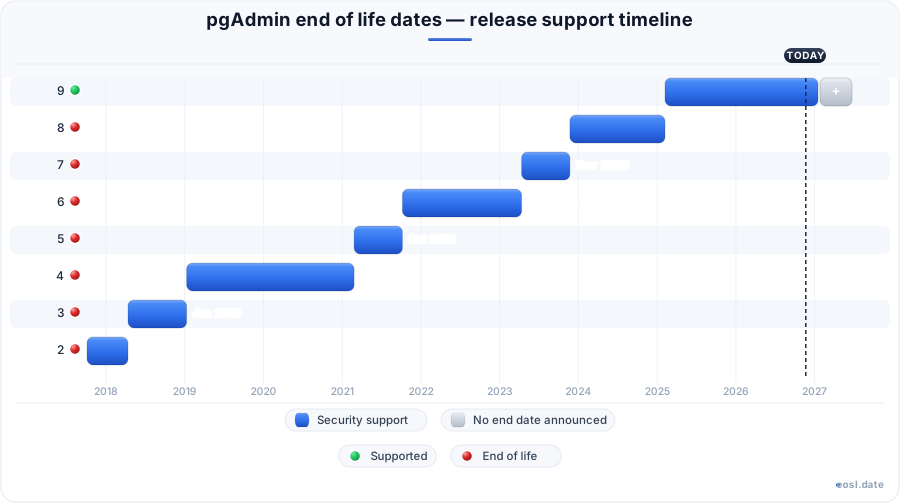
Currently Supported pgAdmin Releases - Active EOS/EOSL Support (1)
| Release | Released | Supported | Latest |
|---|---|---|---|
| 9 | (1 year and 9 months ago) | Active | 9.19 (2 weeks and 4 days ago) |
pgAdmin End of Life (EOL) Releases - No Longer Supported (8)
| Release | Released | Supported | Latest |
|---|---|---|---|
| 8 | (2 years and 11 months ago) | (1 year and 9 months ago) | 8.14 (1 year and 11 months ago) |
| 7 | (3 years and 7 months ago) | (2 years and 11 months ago) | 7.8 (3 years and 1 month ago) |
| 6 | (5 years and 1 month ago) | (3 years and 7 months ago) | 6.21 (3 years and 8 months ago) |
| 5 | (5 years and 8 months ago) | (5 years and 1 month ago) | 5.7 (5 years and 2 months ago) |
| 4 | (7 years and 10 months ago) | (5 years and 8 months ago) | 4.30 (5 years and 9 months ago) |
| 3 | (8 years and 7 months ago) | (7 years and 10 months ago) | 3.6 (7 years and 11 months ago) |
| 2 | (9 years and 1 month ago) | (8 years and 7 months ago) | 2.1 (8 years and 10 months ago) |
| 1 | (10 years and 1 month ago) | (9 years and 1 month ago) | 1.6 (9 years and 4 months ago) |
The pgAdmin End of Life question gets a different answer from the relational database it manages: this open-source tool, built by volunteers with no paid support, has no per-version schedule at all. Only the newest build is supported, so what you really need to track is the end-of-life date of each PostgreSQL release you run in production, plus how the support window of the software itself works. Both are covered below, with the dates.
pgAdmin Release Lifecycle and Rolling Release Policy
pgAdmin follows a rolling release policy: only the latest release is supported at any time. There are no back-branches and no long-term stable versions, so a security fix or one of the new features lands in the next release and is never backported to an older one. The version number uses a major.minor format; a normal release raises the minor number, while a change big enough to alter how the application feels to use may raise the major number instead.
The team aims to publish a build roughly every six weeks, with the schedule shifting around major holidays such as Christmas, New Year and Diwali. Out-of-cycle releases appear whenever a security problem cannot wait.
Latest Release Only: No Fixed End of Life
That makes the end of life for an old build a moving target: a version is no longer supported the moment a newer one ships, and anything but the newest counts as unsupported. Bugs reported against older builds are fixed in the next release, so users who want a fix must upgrade rather than wait.
PostgreSQL Support Policy and the Five-Year Window
The PostgreSQL Global Development Group publishes a new major version about once a year and supports each one for a five-year window after its first release. The window closes with a final minor release, after which the version is end-of-life and receives nothing more. Between majors, every supported branch gets a minor release with bug fixes and security fixes at least every three months, and a critical bug can trigger an earlier one. That support policy and versioning policy drive every date in this article, and the project's release policy has no long-term tier for anyone.
How Major Version and Minor Release Numbering Works
Since PostgreSQL 10, a major version is marked by the first number alone, such as 14 to 15, and a minor release raises the second part, such as 10.0 to 10.1. Earlier branches used two numbers for a major, such as 9.5 to 9.6. Every supported release also carries a support status, shown in the table below.
PostgreSQL EOL Dates and the Release Roadmap
This is where each recent branch stands on October 27, 2026, using the dates the PostgreSQL project publishes. Each EOL date falls five years after the first release, and the release roadmap lists the minor releases still to come for supported versions.
| Version | Latest minor | Release date | Final release | Support status |
|---|---|---|---|---|
| 18 | 18.6 | September 25, 2025 | November 14, 2030 | Supported |
| 17 | 17.11 | September 26, 2024 | November 8, 2029 | Supported |
| 16 | 16.15 | September 14, 2023 | November 9, 2028 | Supported |
| 15 | 15.19 | October 13, 2022 | November 11, 2027 | Supported |
| 14 | 14.24 | September 30, 2021 | November 12, 2026 | Supported until final release |
| 13 | 13.23 | September 24, 2020 | November 13, 2025 | Unsupported |
| 12 | 12.22 | October 3, 2019 | November 21, 2024 | Unsupported |
PostgreSQL 14 Support Ends November 12, 2026
PostgreSQL 14 shipped on September 30, 2021, so its five-year window closes on November 12, 2026, about two weeks from now. That PostgreSQL end of life date matters because community patches stop for the branch once its last minor release is out, and installations still on it should move to PostgreSQL 15 or higher.
Why PostgreSQL 13 and 12 Are Already Unsupported
PostgreSQL 13 reached the end of its window on November 13, 2025 with 13.23, and PostgreSQL 12 ended on November 21, 2024 with 12.22. Neither branch gets fixes any longer, and cloud providers have started to force upgrades off them or charge extra to keep them running.
Security Patches Stop When a Version Is No Longer Supported
pgAdmin itself only receives fixes in its newest release, but the PostgreSQL servers you manage with it lose security patches once their branch is retired, and any vulnerability found afterward stays unpatched. The exposure is real because the same flaws regularly hit every supported branch at once, so an EOL branch is left open the next time one appears. Compatibility also erodes: managed services, newer extensions and client drivers stop testing against it, and compliance audits increasingly flag unsupported software.
Recent CVE Fixes Reached Every Branch
The 2025 advisories show the pattern. The psql SQL injection flaw CVE-2025-1094 (CVSS 8.1) was fixed in 14.16, and a batch of August 2025 pg_dump and optimizer flaws was fixed in 14.19. After the final release, a flaw like these has no fix path for that branch.
Upgrade Options for Unsupported PostgreSQL Versions
Retiring a branch is a decision about the PostgreSQL servers you manage with pgAdmin, and the PostgreSQL community's older branches leave three realistic paths:
- Upgrade to a supported major version, which is the best long-term fix but needs migration planning and extension testing.
- Pay a managed provider for extended support while the EOL version keeps running.
- Buy commercial patching from a third-party vendor and stay put.
A major upgrade cannot keep the data directory backward compatible, so you need a dump/reload or pg_upgrade, and the release notes of each major version you skip deserve a read. A minor upgrade is simpler: stop the database server, install the new binaries and restart, always on the latest available minor release of your major version. Before November, audit your network for installations still on PostgreSQL 14 and plan their patches.
pgAdmin End of Life Support: Mailing List and Issue Tracker
If a question about retired builds is still unanswered, check the documentation first. The pgadmin-support mailing list handles end user support, while confirmed bugs belong on the issue tracker; include the version you run, whether you use desktop mode or server mode, your operating system and any log output, with logging turned up. Security problems go to a private address, and past security advisories list the affected versions and the releases that fixed them.