dbt Core End of Life (EOL) Dates and End of Support (EOS) Dates
dbt Core end of life (EOL) and end of support (EOS) dates: 11 dbt Core versions have reached EOL, including dbt Core 1.10 (EOL date: Jun 16, 2026) — no longer receiving security updates or patches. dbt Core 1.11 reaches its End of Support date on Dec 19, 2026 — plan your upgrade path now. dbt Core 2.0.11 is the current supported release, with support through Sep 14, 2027 — 2 versions in active support. Also see Ansible-core end of support dates for related end-of-life information.
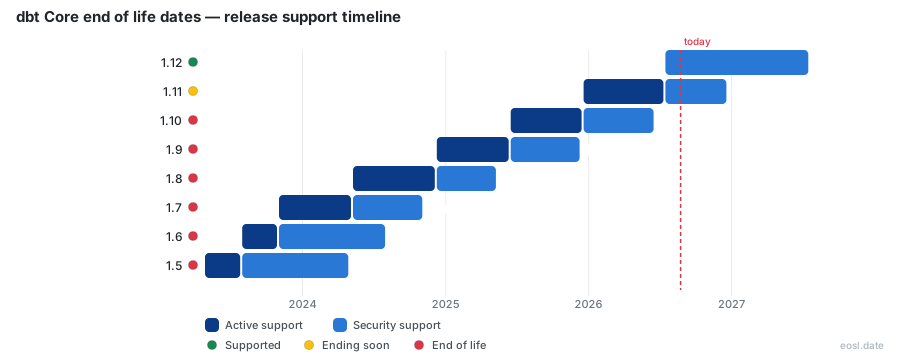
Currently Supported dbt Core Releases - Active EOS/EOSL Support (2)
dbt Core Releases Nearing End of Life - Support Ending Soon (1)
| Release | Released | Critical Support | Active Support | Latest |
|---|---|---|---|---|
| 1.11 | (11 months ago) | (in 3 weeks and 6 days) | (4 months ago) | 1.11.17 (2 weeks and 2 days ago) |
dbt Core End of Life (EOL) Releases - No Longer Supported (11)
| Release | Released | Critical Support | Active Support | Latest |
|---|---|---|---|---|
| 1.10 | (1 year and 5 months ago) | (5 months ago) | (11 months ago) | 1.10.23 (3 months ago) |
| 1.9 | (1 year and 11 months ago) | (11 months ago) | (1 year and 5 months ago) | 1.9.11 (3 months ago) |
| 1.8 | (2 years and 6 months ago) | (1 year and 6 months ago) | (1 year and 11 months ago) | 1.8.10 (3 months ago) |
| 1.7 | (3 years ago) | (2 years ago) | (2 years and 6 months ago) | 1.7.20 (3 months ago) |
| 1.6 | (3 years and 3 months ago) | (2 years and 3 months ago) | (3 years ago) | 1.6.19 (3 months ago) |
| 1.5 | (3 years and 6 months ago) | (2 years and 6 months ago) | (3 years and 3 months ago) | 1.5.12 (3 months ago) |
| 1.4 | (3 years and 9 months ago) | (2 years and 9 months ago) | (3 years and 6 months ago) | 1.4.10 (3 months ago) |
| 1.3 | (4 years and 1 month ago) | (3 years and 1 month ago) | (3 years and 9 months ago) | 1.3.8 (3 months ago) |
| 1.2 | (4 years and 3 months ago) | (3 years and 3 months ago) | (4 years and 1 month ago) | 1.2.7 (3 months ago) |
| 1.1 | (4 years and 6 months ago) | (3 years and 6 months ago) | (4 years and 3 months ago) | 1.1.6 (3 months ago) |
| 1.0 | (4 years and 11 months ago) | (3 years and 11 months ago) | (4 years and 6 months ago) | 1.0.9 (3 years and 10 months ago) |
Wondering about dbt Core end of life? Every 1.x release gets about a year of help from dbt Labs, and now that dbt v2 is generally available, the oldest releases are already out of the picture. Below you'll find the dates, what each phase covers, and what the dbt OSS naming change means for your open source setup.
dbt Core End of Life: The Short Answer
Each dbt-core minor version stops getting fixes a year after it ships. The next cliff is December 19, 2026, when 1.11 drops to the end of its critical-only fixes. Today the supported version list is 1.11, 1.12 and the 2.x line. The Python-based 1.x series is winding down while the Rust-based dbt v2 becomes the main release line.
How dbt Core Support Works
dbt Core support runs in two stages that together make up the support period for a release. dbt Labs keeps the version maintained through both.
Active Support Phase
During active support, which begins at release and lasts until the next minor version ships, you get bug fixes and security fixes, including repairs for regressions. Changes are narrowly scoped so nothing surprising lands in a version you've already pinned.
Critical Support Phase
When a newer release arrives, the old one moves to critical support for the rest of its one-year window. Only critical security and installation fixes ship now. After the window closes, the version hits that date and gets no further fixes, so any flaw found later stays open.
End-of-Life Dates for Each dbt Core Version
The dates here come from the endoflife.date tracker and the official versions page. The release history shows a new minor version roughly every three months, and every build is published to PyPI and tagged on GitHub. Anything past its critical date belongs with the unsupported versions. The hosted platform adds its own deprecation date on top, covered further down.
| Version | Released | Fixes end | Status today |
|---|---|---|---|
| 2.0 | Sep 14, 2026 | Sep 14, 2027 | Current release |
| 1.12 | Jul 16, 2026 | Jul 16, 2027 | Critical phase |
| 1.11 | Dec 19, 2025 | Dec 19, 2026 | Critical phase, ending soon |
| 1.10 | Jun 16, 2025 | Jun 16, 2026 | End-of-life |
| 1.9 | Dec 9, 2024 | Dec 9, 2025 | Ended |
| 1.8 | May 9, 2024 | May 9, 2025 | Ended |
| 1.7 | Nov 2, 2023 | Nov 2, 2024 | Ended |
Checking Your Installed Version
From the command line, run dbt --version. The output lists your core version plus each installed warehouse connector, such as dbt-snowflake, and tells you whether you're behind.
Deprecated Versions in the dbt Platform
In the hosted dbt platform, a version is deprecated once dbt Labs stops offering it there. On January 31, 2027, versions 1.3 through 1.7 are removed from availability, and environments still on them need to move. If you manage an enterprise account, audit every environment's version now.
dbt Platform Release Tracks
The simplest route is release tracks. They update a platform environment automatically and give early access to new features, and they are required on the Developer and Starter plans. Older dbt Cloud accounts are migrated to the v1 latest track.
Upgrading Off dbt v1
Any dbt v1 project can upgrade by moving first to 1.11 or 1.12 as a stepping stone, or by jumping straight to dbt v2 using the migration guide. Read each release's notes on the way, and pin dbt-core to a tested range, because deprecated behavior stops working at the next major version.
Adapter Plugin Compatibility
dbt releases dbt-core and its adapter plugins on separate schedules, so the numbers rarely match. They stay compatible through a shared interface, which means you can bump the latest release of your connector without a lockstep change to the warehouse integration. Metadata files still deserve a check after any jump.
Semantic Versioning and the dbt Core v1 Series
The project follows semantic versioning, usually shortened to semver. In practice this scheme tells you what to expect from a number: major versions can break things, minor versions add features and stay backwards compatible, and patch releases only repair problems.
Breaking Changes in Minor Versions
Breaking changes in a minor release are rare and come in two kinds: changes to the Python interface that adapter plugins use, and changes to metadata interfaces such as artifacts and logging, which are flagged by a version bump in the file itself. Projects that share artifacts between orchestrations should move those together.
Release Channels and Patch Releases
For dbt v2, release channels let you pick stability: latest is the known-good build, canary is newer but still being tested, and dev may fail tests. A patch release, such as 2.0.8 on October 14, 2026, contains fixes only, and the GitHub releases page for the dbt-core repository lists each one.
What Deprecation Means for dbt Core 1.x
For a release line, it means the maintainers stop investing in it. The dbt v1 series ends with 1.13, now a pre-release beta, which will be the final minor version, so dbt-core 1.x is effectively in maintenance mode: repairs, not new features.
Long-Term Patches After the Final Release
Version 1.13 will keep receiving critical security and installation fixes well past the usual twelve months. dbt Labs expects three to five years and promises ample notice before a final end date, though no hard cutoff exists yet.
dbt OSS and the dbt v2 Rebrand
With general availability, a rebrand split the new generation into two distribution options on one shared engine. The full package is simply called dbt, and its fully Apache-licensed subset is dbt OSS. The dbt Core name no longer applies to anything in the v2 era, even though the code is the same.
Will dbt Labs Maintain dbt Core v1
Yes. dbt Labs says the 1.x license stays unchanged, and it continues to fix the series. Its commercial products sit alongside rather than replace that commitment.
Two Distributions of dbt v2
The full dbt distribution, formerly the dbt Fusion engine, adds capabilities like SQL comprehension and a VS Code extension that dbt OSS lacks. Both install locally, and most teams are advised to choose the full dbt distribution.
Apache 2.0 License and Free Use
dbt OSS is covered by the Apache 2.0 license. The full dbt build uses a separate product agreement over proprietary code, yet it is free to use internally with no user cap. The one boundary: you can't sell it to third parties as a hosted service without letting them reach the platform.
Is dbt Core Dead? dbt Fusion and Maintenance Mode Worries
When dbt Fusion was announced in May 2025, critics, including the team behind SQLMesh, argued that dbt Labs' revenue pressure and product roadmap pointed toward starving the older project. That fear was reasonable at the time; later license moves have softened it.
Source Available Versus Open Source
The original Fusion license, ELv2, was source available but not approved as open source, much like Elastic's earlier change that pushed Amazon to fork Elasticsearch into OpenSearch. Since June 2026 that code has been relicensed under Apache 2.0, which keeps the open-source path alive for everyone.
What Your Data Team Can Do
Stay on 1.11 or 1.12 and plan the move to dbt v2 or dbt OSS before your version's last date. Every analytics engineer on your data teams should know which release each project runs. Analytics engineering workflows and day-to-day data transformation code change little, and the community tracks each release on GitHub.
Licensing Questions Around dbt Core EOL
Hitting that date doesn't change a license: old 1.x code stays Apache 2.0 forever, and you may keep running it free of charge, just without updates.
Does One Engine Replace dbt OSS
No. A single engine powers both distributions, and dbt Labs states that its open source offering isn't being replaced by the proprietary distribution.
Planning Around Deprecation Dates
Turn the calendar into a checklist:
- Run the version check in every environment and record the result.
- Flag platform environments on 1.7 or older before January 31, 2027.
- Pencil in December 19, 2026 for anything still on 1.11.
- Pin a range with
require-dbt-versionin your project file.
Choosing a Target Version
Pick 1.12 if you want the most conservative supported version, or dbt v2 if you want features that 1.x won't receive. Either way, move before the clock runs out, not after.