Phoenix Framework End of Life (EOL) Dates and End of Support (EOS) Dates
Phoenix Framework end of life (EOL) and end of support (EOS) dates: 5 Phoenix Framework versions have reached EOL, including Phoenix Framework 1.4 (EOL date: Aug 05, 2025) — no longer receiving security updates or patches. Phoenix Framework 1.8.17 is the current supported release — 4 versions in active support. Also see Bootstrap EOSL dates for related end-of-life information.
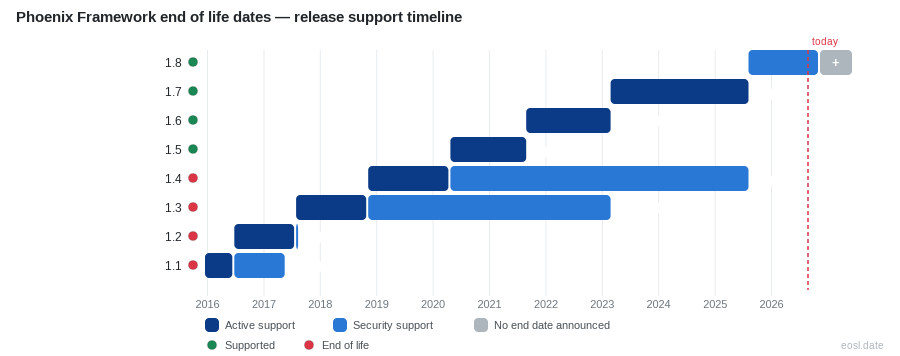
Currently Supported Phoenix Framework Releases - Active EOS/EOSL Support (4)
| Release | Released | Security Support | Bug Fixes | Latest |
|---|---|---|---|---|
| 1.8 | (1 year and 3 months ago) | Active | Active | 1.8.17 (4 days ago) |
| 1.7 | (3 years and 9 months ago) | Active | (1 year and 3 months ago) | 1.7.25 (4 days ago) |
| 1.6 | (5 years and 2 months ago) | Active | (3 years and 9 months ago) | 1.6.18 (4 days ago) |
| 1.5 | (6 years and 7 months ago) | Active | (5 years and 2 months ago) | 1.5.16 (4 days ago) |
Phoenix Framework End of Life (EOL) Releases - No Longer Supported (5)
| Release | Released | Security Support | Bug Fixes | Latest |
|---|---|---|---|---|
| 1.4 | (8 years ago) | (1 year and 3 months ago) | (6 years and 7 months ago) | 1.4.18 (4 years and 1 month ago) |
| 1.3 | (9 years and 3 months ago) | (3 years and 9 months ago) | (8 years ago) | 1.3.5 (4 years and 1 month ago) |
| 1.2 | (10 years and 5 months ago) | (9 years and 3 months ago) | (9 years and 3 months ago) | 1.2.5 (9 years and 3 months ago) |
| 1.1 | (10 years and 11 months ago) | (9 years and 6 months ago) | (10 years and 5 months ago) | 1.1.9 (9 years and 6 months ago) |
| 1.0 | (11 years and 2 months ago) | (9 years and 8 months ago) | (10 years and 11 months ago) | 1.0.6 (9 years and 8 months ago) |
If you run a real-time web framework in production, you need to know where your release stands. The Phoenix Framework end of life picture is simple: only the newest Elixir release gets bug fixes, and security patches cover the latest four minor branches. This guide shows which versions are still supported, which have aged out, and how to plan your next upgrade, whether you maintain one app or many applications. Most developers in the Phoenix community face this choice sooner than they expect.
Phoenix Framework End of Life: Where Each Version Stands
Phoenix is a real-time web framework built on Elixir, and it ships frequent patch updates inside each minor line. Right now 1.8 is the latest version, while 1.5, 1.6 and 1.7 remain supported for security fixes only. Branch 1.4 and everything older has already lost support. Even if your app works fine today, an unsupported release keeps running in production with every new vulnerability left unpatched. Newer additions such as Phoenix LiveView sit on top of this base, so a stale framework limits what LiveView you can adopt, too.
Phoenix Support Dates and Release Table
The table below lists each release, its start date and when bug fixes and security support ended for that framework line. These support dates reflect the public lifecycle data as last updated on 21 October 2026.
| Framework version | Released | Bug fixes | Security support | Latest patch release |
|---|---|---|---|---|
| 1.8 | 5 Aug 2025 | Active | Active | 1.8.16 (20 Oct 2026) |
| 1.7 | 24 Feb 2023 | Ended 5 Aug 2025 | Active | 1.7.24 (7 Jul 2026) |
| 1.6 | 26 Aug 2021 | Ended 24 Feb 2023 | Active | 1.6.17 (7 Jul 2026) |
| 1.5 | 22 Apr 2020 | Ended 26 Aug 2021 | Active | 1.5.15 (7 Jul 2026) |
| 1.4 | 7 Nov 2018 | Ended 22 Apr 2020 | Ended 5 Aug 2025 | 1.4.18 (10 Oct 2022) |
| 1.3 | 28 Jul 2017 | Ended 7 Nov 2018 | Ended 24 Feb 2023 | 1.3.5 (10 Oct 2022) |
Read the timeline from the end date columns: a version with Ended under security support is fully out of the maintenance window.
Phoenix Support Policy and Lifecycle Rules
The support policy is rolling rather than date-based. Because Phoenix is open source, the maintainers do not announce a fixed retirement day for each release. The lifecycle policy works from the newest minor branch backward, and each new minor release moves the oldest branch out of the security window. That differs from Microsoft, whose .NET Framework follows a fixed policy with a published end date, and from the Microsoft .NET releases that alternate long-term support with shorter tracks. Microsoft publishes every end date years ahead, and Microsoft tooling reports it automatically, so you can read the support window off a calendar. With Phoenix you work it out from the release pace of the framework, and that is true for all versions of it.
Bug Fixes and Security Patches by Branch
Bug fixes land only on the latest minor branch. Security patches go to the last four minor branches, so vulnerabilities and CVEs found in 1.5 through 1.8 still get fixed. Only the latest patch release of each branch counts as supported, so the framework maintainers expect you to stay current inside your branch.
Release Cadence and Changelog Before End of Life
A new minor release arrives roughly every 18 to 24 months. When a 1.9 release appears, branch 1.5 would drop out of security support under the four-branch rule. Read the changelog first, because breaking changes between a major version or minor line decide how hard the move will be.
What EOL Means for Your Phoenix App
Here is what happens after end of life: the maintainers stop shipping fixes, so each newly discovered flaw stays open in your application. The risk grows with exposed features such as channels, PubSub and WebSocket connections running on the Erlang VM, plus authentication and other backend code. Many teams also hit a compliance problem, since an audit or scanning tool will flag an end-of-life dependency as unsupported software. Your dependencies can age out too, and performance or deployment tooling may stop supporting an old release. The EOL dates above are the framework deadline to plan around, not a date to meet at the last minute. A front-end change in LiveView can add pressure as well.
Upgrade Options Before End of Support
You have three options when a branch nears end of support: upgrade to the latest version, move up one minor line, or stay put and accept the risk. Upgrading is cheapest while your app is close to the current release, because the Phoenix documentation and changelog cover each step. A quick reference habit helps: check your installed version in mix.lock against the table, then run mix deps.update phoenix in a test branch. Keep your update schedule tied to the project's security notices on Hex.
Migrate One Minor Version at a Time
Plan the migration as small hops. Move 1.5 to 1.6, then onward, running your tests after each step. Fixing deprecation warnings early makes the final jump to 1.8 far less painful, and it keeps your API and security updates flowing, which matters for any framework your business depends on.