Hibernate ORM End of Life (EOL) Dates and End of Support (EOS) Dates
Hibernate ORM end of life (EOL) and end of support (EOS) dates: 15 Hibernate ORM versions have reached EOL, including Hibernate ORM 7.3 (EOL date: Jun 07, 2026) — no longer receiving security updates or patches. Hibernate ORM 7.4.17 is the current supported release. Also see Bootstrap EOSL dates for related end-of-life information.
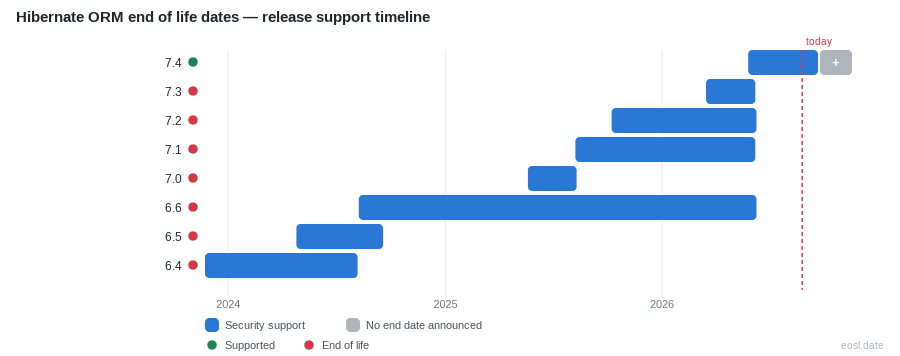
Currently Supported Hibernate ORM Releases - Active EOS/EOSL Support (1)
| Release | Supported Jakarta Eeversions | Supported Java Versions | Released | Stable support | Limited support | Latest |
|---|---|---|---|---|---|---|
| 7.4 | 11 | 17, 21, 25 or 26 | (5 months ago) | Active | Active | 7.4.17 (5 days ago) |
Hibernate ORM End of Life (EOL) Releases - No Longer Supported (15)
| Release | Supported Jakarta Eeversions | Supported Java Versions | Released | Stable support | Limited support | Latest |
|---|---|---|---|---|---|---|
| 7.3 | 11 | 17, 21, 25 or 26 | (8 months ago) | (5 months ago) | — | 7.3.13 (3 months ago) |
| 7.2 | 11 | 17, 21 or 25 | (1 year and 1 month ago) | (5 months ago) | Active | 7.2.26 (5 days ago) |
| 7.1 | 11 | 17, 21 or 25 | (1 year and 3 months ago) | (5 months ago) | — | 7.1.36 (2 months ago) |
| 7.0 | 11 | 17, 21 or 23 | (1 year and 6 months ago) | (1 year and 3 months ago) | — | 7.0.10 (1 year and 3 months ago) |
| 6.6 | 10 | 11, 17, 21 or 25 | (2 years and 3 months ago) | (5 months ago) | Active | 6.6.59 (1 month and 6 days ago) |
| 6.5 | 10 | 11, 17, 21, 22 or 23 | (2 years and 6 months ago) | (2 years and 2 months ago) | — | 6.5.3 (2 years and 2 months ago) |
| 6.4 | 10 | 11, 17 or 21 | (3 years ago) | (2 years and 3 months ago) | — | 6.4.10 (2 years and 3 months ago) |
| 6.3 | 10 | 11, 17, 20 or 21 | (3 years and 2 months ago) | (3 years ago) | — | 6.3.2 (3 years ago) |
| 6.2 | 10 | 11, 17, 20 or 21 | (3 years and 7 months ago) | (6 months ago) | — | 6.2.52 (6 months ago) |
| 6.1 | 10 | 11, 17 or 18 | (4 years and 5 months ago) | (3 years and 7 months ago) | — | 6.1.7 (3 years and 9 months ago) |
| 6.0 | 10 | 11, 17 or 18 | (4 years and 7 months ago) | (4 years and 5 months ago) | — | 6.0.2 (4 years and 5 months ago) |
| 5.6 | 8 | 8, 11, 17 or 18 | (5 years and 1 month ago) | (3 years and 9 months ago) | — | 5.6.15 (3 years and 9 months ago) |
| 5.5 | 8 | 8, 11 or 17 | (5 years and 5 months ago) | (4 years and 11 months ago) | — | 5.5.9 (4 years and 11 months ago) |
| 5.4 | 8 | 8, 11 or 17 | (7 years and 11 months ago) | (4 years and 10 months ago) | — | 5.4.33 (4 years and 10 months ago) |
| 5.3 | 8 | 8, 11 or 17 | (8 years and 6 months ago) | (10 months ago) | — | 5.3.39 (4 months ago) |
If you run Hibernate ORM end of life checks on your Java stack, you want one answer fast: which series still get fixes, and which are on their own. Hibernate is an open-source ORM and framework that maps a domain model in the Java programming language to a relational database, and every database layer built on it depends on a maintained series.
What Hibernate ORM End of Life Means for Security Vulnerabilities
A series that has reached its end-of-life is no longer maintained, so it receives no bug fixes and no security patches. Pull requests against it are rejected, bug reproducers using it get lower priority, and security vulnerabilities stay open. The code keeps running; the support around it is gone.
Hibernate Stable Support, Limited Support and Supported Series
Each series sits at one support level. Under stable support, usually only the newest series, you get improvements, bug fixes and security fixes. Under limited support (labelled limited-support on the project site), a series only gets updates requested by Red Hat customers, with no guarantee beyond that. Everything else is end-of-life. Only the stable and limited-support lines count as supported series, and the development line is not meant for production.
Hibernate ORM Releases: Latest Stable and Older Series
The table below lists the latest stable line, the lines in limited support and a few older series, with the newest Final build of each as of 27 October 2026. Each release gets a release announcement, and the release page lists every Final release with its Maven artifacts, download links and API docs; the API reference changes with each release too.
| Series | Status | Latest release |
|---|---|---|
| 8.0 | Development | 8.0.0.Beta3 |
| 7.4 | Latest stable | 7.4.14.Final |
| 7.2 | Limited support | 7.2.25.Final |
| 6.6 | Limited support | 6.6.59.Final |
| 7.3 | End-of-life | 7.3.13.Final |
| 7.1 | End-of-life | 7.1.36.Final |
| 5.0 | End-of-life | 5.0.12.Final |
Hibernate ORM 5.0 and Other Legacy Hibernate Series
Hibernate ORM 5.0 is retired: it last shipped in January 2017 under the LGPL (LGPL v2.1 for every 5.0 build, the same LGPL terms as 4.x), and legacy Hibernate lines from 5.x back to 1.0 are all done. The 5.6 line dropped Javassist, 5.4 added JDK 11 support and EntityGraph improvements, and the 6.x lines moved on to hbm.xml transformation and Apache License terms from 7.0.
Hibernate Semantic Versioning and Maintenance Policy
Hibernate follows semantic versioning: a major and minor pair such as 6.6 is a series, and maintenance applies per series, not per patch. The project's maintenance policy decides which series stay supported, so check it before assuming a fix will reach your version.
Hibernate Compatibility Matrix for Java and Jakarta Persistence
Pick your target release from the compatibility matrix. Series 7.4 runs on Java 17, 21, 25 or 26 with Jakarta Persistence 3.2 and Jakarta EE 11, while 6.6 uses Jakarta Persistence 3.1 and Jakarta EE 10; the old Java EE and JPA 2.1 era belongs to 5.0. Ecosystem pairings differ too: Quarkus, WildFly, Red Hat EAP 8.1, Hibernate Reactive, the MongoDB extension and Jakarta Data 1.0 each track specific series.
Hibernate Search and Spring Boot Versions
Hibernate Search 8.4 pairs with 7.4 and Spring Boot 4.1, while 6.6 pairs with Search 7.2 and Spring Boot 3.4 to 3.5.
Risks of Running Legacy Hibernate in Production
Legacy Java apps pinned to retired series such as 5.0, 7.1 or 7.3 keep running without patches, and in enterprise Java shops in finance, insurance, healthcare and government that dependency is easy to forget. Production risk grows quietly: applications keep working while enterprise exposure builds, and subtle bugs in an unmaintained ORM are hard to diagnose.
Unpatched Vulnerabilities and Compliance Audit Pressure
- Unpatched vulnerabilities such as SQL injection, session hijacking and cache poisoning stay open.
- Compliance frameworks like PCI-DSS, SOC 2 and HIPAA expect vendor-supported components, so an audit can fail.
What's New and Hibernate Upgrade Documentation
Start your upgrade with the What's New guide and the documentation for your target series. Every What's New page and release announcement names the Final build, links the Maven artifacts and the download. Read the release announcement before you download anything, confirm the Maven artifacts match your build, and keep the API javadoc and the JPA API notes open while you compare the old and new API surface. In your build file, check the Maven coordinates and Maven repository first, then use the GitHub releases and the issue tracker to see what each Final release changes before you commit to an upgrade to a newer series.
Hibernate Migration Guide to a Newer Series
Follow the migration guide for each series rather than jumping blindly; every migration guide lists breaking changes, and each migration step should be tested on its own. A migration guide for 6.x differs from the migration guide for 7.x, so plan the migration as a chain of small migration steps. Replatforming to Spring Data or a full rewrite can take years, so modernize in steps and avoid a premature rewrite; the modernization can proceed after the security gap is closed.
Commercial Support After Hibernate End-of-Life
Commercial support is the other route. Vendors sell drop-in support for old lines: security patch delivery, patch-level documentation, changelogs and engineers on call, which extends an application's lifespan without a rewrite. The project itself points to commercial end-of-life support for retired series.
Tracking Hibernate End-of-Life Dates Automatically
Dates move, so subscribe instead of checking by hand. The endoflife.date page for Hibernate lists 7.3 and 7.1 as ended and 7.4 as current, and it offers a JSON version of its data through an API (the API returns the same JSON as the web page), an RSS feed, an iCalendar feed for your calendar, product identifiers (CPE and PURL) for scanners, and a talk page for corrections.