Ruby on Rails End of Life (EOL) Dates and End of Support (EOS) Dates
Ruby on Rails end of life (EOL) and end of support (EOS) dates: 10 Ruby on Rails versions have reached EOL, including Ruby on Rails 8.0 (EOL date: Nov 07, 2026) — no longer receiving security updates or patches. Ruby on Rails 8.1.4.1 is the current supported release, with support through Oct 10, 2027. Also see Bootstrap end of support life for related end-of-life information.
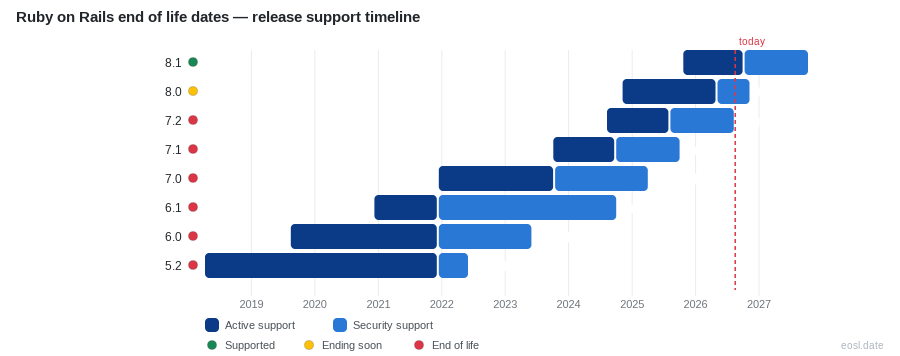
Currently Supported Ruby on Rails Releases - Active EOS/EOSL Support (1)
| Release | Released | Security Support | Active Support | Latest |
|---|---|---|---|---|
| 8.1 | (1 year and 1 month ago) | (in 10 months) | (1 month and 2 weeks ago) | 8.1.4.1 (3 weeks ago) |
Ruby on Rails End of Life (EOL) Releases - No Longer Supported (10)
| Release | Released | Security Support | Active Support | Latest |
|---|---|---|---|---|
| 8.0 | (2 years ago) | (2 weeks and 3 days ago) | (6 months ago) | 8.0.5.2 (3 weeks ago) |
| 7.2 | (2 years and 3 months ago) | (3 months ago) | (1 year and 3 months ago) | 7.2.4 (2 months ago) |
| 7.1 | (3 years and 1 month ago) | (1 year and 1 month ago) | (2 years and 1 month ago) | 7.1.6 (1 year ago) |
| 7.0 | (4 years and 11 months ago) | (1 year and 7 months ago) | (3 years and 1 month ago) | 7.0.10 (1 year ago) |
| 6.1 | (5 years and 11 months ago) | (2 years and 1 month ago) | (4 years and 11 months ago) | 6.1.7.10 (2 years and 1 month ago) |
| 6.0 | (7 years and 3 months ago) | (3 years and 5 months ago) | (4 years and 11 months ago) | 6.0.6.1 (3 years and 10 months ago) |
| 5.2 | (8 years and 7 months ago) | (4 years and 5 months ago) | (4 years and 11 months ago) | 5.2.8.1 (4 years and 4 months ago) |
| 5.1 | (9 years and 6 months ago) | (7 years and 2 months ago) | (8 years and 7 months ago) | 5.1.7 (7 years and 7 months ago) |
| 5.0 | (10 years and 4 months ago) | (8 years and 7 months ago) | (8 years and 7 months ago) | 5.0.7.2 (7 years and 8 months ago) |
| 4.2 | (11 years and 11 months ago) | (9 years and 6 months ago) | (10 years and 4 months ago) | 4.2.11.3 (6 years and 6 months ago) |
Wondering where Ruby on Rails end of life leaves your app? Rails is an open source web application framework built on Ruby, and every version eventually loses support. Once a version line is retired you get no more fixes, and the Ruby on Rails EOL date decides when your applications lose protection, so knowing which Rails versions are still covered tells you how urgent your next upgrade is.
Ruby on Rails End of Life Dates and Currently Supported Versions
As of late October 2026, the Rails core team supports only the 8.x series. These Rails EOL dates come from the official support schedule, and each version stops receiving bug fixes before it stops receiving security fixes.
| Version | Bug fixes end | Security support ends |
|---|---|---|
| Rails 8.1 | October 10, 2026 | October 10, 2027 |
| Rails 8.0 | May 7, 2026 | November 7, 2026 |
| Rails 7.2 | August 9, 2025 | August 9, 2026 |
| Rails 7.1 | October 1, 2024 | October 1, 2025 |
| Rails 7.0 | October 15, 2023 | April 1, 2025 |
Older lines such as Rails 6.1, Rails 6.0 and Rails 5.2 ended years ago. Only the newest line keeps full security support beyond this year, so the currently supported versions list is short.
Extended Support for Rails 8.0
That series received extended support of six months because Rails 8.1 shipped more than half a year later. Even so, its support period closes soon.
Ruby on Rails Maintenance Policy Explained
The maintenance policy splits every minor release into new features, bug fixes and security issues. Since 7.2, each release gets one year of Active Support for fixes and two years in total, so supported releases follow a predictable support cycle.
Bug Fixes and New Features
New features land every six months, and bug fixes continue for one year after the first release.
Security Fixes Support
Security fixes run for two years, after which the series reaches Rails end-of-life.
Unsupported Release Series
A retired series is yours to maintain. The team may publish backports to git, but it ships no new gem versions.
Rails 7.0 and 7.1 End of Support
The Rails 7.0 end of life arrived on April 1, 2025, and 7.1 followed in October 2025. Rails 7.0.10 and 7.1.6 were the final releases, so each is retired. Teams on either line now get no security patches, and Ruby on Rails end-of-life status applies to both. Rails 7.2 followed in August 2026.
Dual EOL: When Ruby and Rails Both Expire
A dual EOL hits when your Ruby runtime and your framework are both retired. Ruby 3.1 reached EOL in March 2025 and Ruby 3.2 followed on March 31, 2026. Ruby 3.3 stays supported until March 2027 and Ruby 3.4 until March 2028, while Ruby 2.7 and Ruby 3.0 are long gone.
Ruby 3.x Timeline for Your Stack
Ruby publishes a new release each December, with roughly three years of support. Check this timeline against your stack and your dependencies, and treat an old Ruby on Rails 7.0 app on Ruby 3.1 as the worst pairing. Library authors also drop old versions, so compatibility problems arrive early.
Security Risks of Running Unsupported Rails
Every EOL release carries growing risk, and each missed security patch widens it. Unpatched vulnerabilities pile up, and attackers favor known security vulnerabilities such as remote code execution or SQL injection. The March 2026 security releases (7.2.3.1, 8.0.4.1 and 8.1.2.1) fixed ten flaws, including CVE-2026-33195, a path traversal in Active Storage, and CVE-2026-33167, an XSS bug in debug exceptions. Another CVE, CVE-2026-33168, touched tag helpers. An EOL app gets none of these fixes, and its exposure to any vulnerability grows, whether the flaw sits in a public-facing server or an internal tool.
Compliance suffers too. Regulations such as HIPAA, PCI DSS, SOC2 and FedRAMP expect supported software, and an audit can flag it. Enterprises also face downtime when old versions clash with new servers and browsers.
Upgrade Plan Before Your Rails Version Reaches EOL
Start the upgrade early. Read the changelog for each release you cross, and open the Action Pack changelog, Active Record changelog and Active Storage changelog first. Every changelog lists deprecations, and a changelog entry usually names the fix. A migration goes smoothly when the changelog notes every breaking change, so keep the changelog open, since the changelog is your map of EOL changes beside your test suite, then migrate one minor release at a time and review every gem on RubyGems. Fresh updates reduce software risk.
Commercial Support After the End of Life
If you cannot move yet, legacy teams can buy commercial support. HeroDevs sells never-ending support (NES) that keeps patches flowing, a kind of never-ending support that buys time for a careful migration.