Bootstrap End of Life (EOL) Dates and End of Support (EOS) Dates
Bootstrap end of life (EOL) and end of support (EOS) dates: 3 Bootstrap versions have reached EOL, including Bootstrap 4 (LTS) (EOL date: Jan 01, 2023) — no longer receiving security updates or patches. Bootstrap 5.3.8 LTS is the current supported release. Also see ROS 2 end of support life for related end-of-life information.
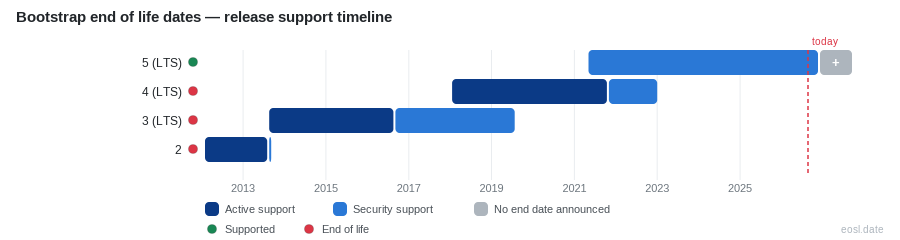
Currently Supported Bootstrap Releases - Active EOS/EOSL Support (1)
| Release | Released | Critical Support | Active Support | Commercial Support | Latest | LTS |
|---|---|---|---|---|---|---|
| 5 (LTS) | (5 years and 6 months ago) | Active | Active | Active | 5.3.8 (1 year and 2 months ago) | LTS |
Bootstrap End of Life (EOL) Releases - No Longer Supported (3)
| Release | Released | Critical Support | Active Support | Commercial Support | Latest | LTS |
|---|---|---|---|---|---|---|
| 4 (LTS) | (8 years and 9 months ago) | (3 years and 10 months ago) | (5 years ago) | Active | 4.6.2 (4 years and 3 months ago) | LTS |
| 3 (LTS) | (13 years and 2 months ago) | (7 years and 3 months ago) | (10 years and 2 months ago) | Active | 3.4.1 (7 years and 8 months ago) | LTS |
| 2 | (14 years and 9 months ago) | (13 years and 2 months ago) | (13 years and 2 months ago) | Active | 2.3.2 (13 years and 3 months ago) | - |
Wondering whether your front-end framework is still safe to ship? Bootstrap end of life arrived for Bootstrap 3 in 2019 and for Bootstrap 4 in 2023, so only Bootstrap 5 still gets fixes from the project. Below you'll find the exact dates, the retirement date of each major version, and what web developers can do about it.
Bootstrap End of Life Dates for Every Major Version
Each major version moves through active development, long-term care and finally retirement. This table shows where every release sits today.
| Version | Released | Active support ended | End of life | Last release |
|---|---|---|---|---|
| Bootstrap 5 | May 5, 2021 | Still supported | Not announced | 5.3.8 (Aug 25, 2025) |
| Bootstrap 4 | Jan 18, 2018 | Nov 1, 2021 | Jan 1, 2023 | 4.6.2 (Jul 19, 2022) |
| Bootstrap 3 | Aug 19, 2013 | Sep 5, 2016 | Jul 24, 2019 | 3.4.1 (Feb 13, 2019) |
| Bootstrap 2 | Jan 31, 2012 | Aug 19, 2013 | Aug 19, 2013 | 2.3.2 (Jul 26, 2013) |
Version 5.3.8 as the Current Release
Bootstrap 5 is supported and has no announced end of life date, so it is the only line still receiving fixes. The latest release is Bootstrap 5.3.8, published August 25, 2025, and it is the build to target. Its changes over older lines, such as vanilla JavaScript instead of jQuery, CSS custom properties (CSS variables), an offcanvas component, the utility API, dark mode, accessibility work toward WCAG and no Internet Explorer support, explain why moving over takes effort.
Bootstrap 4 and Its 4.6.2 Final Release
Bootstrap 4 reached end of life on January 1, 2023, and Bootstrap 4.6.2 was its last build, closing the line in July 2022. It had moved the grid system to flexbox and switched from Less to Sass, so any Sass theme pinned to 4.6.2 will never see another change.
Bootstrap 3.4.1 and Bootstrap 2 Retirement
Bootstrap 3.4.1 shipped in February 2019 as the last Bootstrap 3 build, and it is the version most scanners flag today. Bootstrap 3 also leaned hardest on jQuery, so every Bootstrap 3 site inherits that library's own issues. Bootstrap 2 was retired the day Bootstrap 3 launched, so the oldest line sits furthest outside any patch window. Every live HTML page on legacy markup relies on code with no owner.
How the Bootstrap Support Policy Works
The release working group manages every lifecycle in phases. During active support, a version gets features and fixes. A major version then becomes LTS, a branch that takes only bug and security updates. After that comes maintenance, also called critical support, where the code is frozen except for urgent items. Once that phase ends, support from the project stops entirely.
- Active: features, fixes and docs
- LTS: bug fixes and security updates only
- Maintenance: critical fixes only
- End of life: nothing further
The code stays on npm, GitHub, a CDN and other package managers, which is why old builds keep getting downloads. HeroDevs is the partner the Bootstrap site points to for retired versions, so HeroDevs coverage is the most widely recognized route. Commercial support for retired versions is sold by outside vendors, since the open source project no longer provides it.
What End of Life Status Means for Your Bootstrap Site
An end of life status does not break anything today. A Bootstrap 3.4.1 site keeps rendering while its XSS issues stay open, and that stability is the trap: a production site looks maintained while nobody applies a patch. Each new risk becomes technical debt for your applications, since the framework underneath every page is frozen and your teams inherit the gap across shared applications. The software is no longer maintained, and a dependency such as jQuery ages with it, so the exposure compounds across all its dependencies.
Bootstrap Vulnerabilities in Unsupported Versions
Bootstrap is mostly CSS and JavaScript components, so its vulnerabilities are mostly XSS (cross-site scripting) problems in components that render user content in the browser. They matter on unsupported versions because nobody ships a fix. Open vulnerabilities on Bootstrap 3.4.1 and Bootstrap 4.6.2 are the ones audits report most, and each new advisory adds to the list of vulnerabilities without a patch.
CVE Advisories Affecting Bootstrap 3 and 4
- CVE-2024-6531: XSS through the carousel href on Bootstrap 4.0.0 through 4.6.2, which is why Bootstrap 4.6.2 still appears in scan reports.
- CVE-2018-14040: the collapse
data-parentattribute, fixed in 4.1.2 and 3.4.0 but unpatched on Bootstrap 2. - CVE-2025-1647: XSS in a tooltip and popovers on Bootstrap 3.
- A button plugin XSS and prototype pollution issues have been reported against version 3.
A modal that renders unsanitized markup is exposed the same way. The project considers some of these out of scope, yet scanners from Snyk and others still flag them, usually with a CVSS score near 6, and OpenCVE alerts help you follow new ones.
Security Patches and Security Fixes That Never Shipped
No security patches or security fixes come from the Bootstrap team for 2, 3 or 4, so any new patch releases must come from a vendor, and new vulnerabilities stay open until then. An internal audit will list each open advisory.
Why Bootstrap End-of-Life Migrations Are Hard
"Just upgrade" is easy advice and expensive work. Bootstrap 4 changed the markup, JavaScript plugins and preprocessor, so moving from 3 is closer to a rewrite than a bump. Many breaking changes apply, and every page needs testing. For an enterprise app with hundreds of templates, that engineering effort can take a quarter.
Upgrade to Bootstrap 5 and Drop jQuery
Moving from 3 or 4 is the only path back onto a supported release, so upgrade if you can. A full migration means swapping jQuery plugins for vanilla JavaScript, renaming classes, reworking components, and rebuilding any custom layout that is responsive across breakpoints, which ends the end of life exposure.
Migrate in Stages Instead of One Rewrite
You can migrate one template at a time, running the old build beside Bootstrap 5 with scoped styles, and retire old classes as each page moves. That keeps the end of life deadline from forcing a big-bang release.
Extended Support Options Past Bootstrap 4
If a move is not possible this quarter, vendor coverage fills the gap. These long-term support programs patch only the retired versions, starting from the final release of each line, and the paperwork they provide helps with compliance requirements and your compliance audits.
HeroDevs NES and OpenLogic LTS Compared
HeroDevs sells never-ending support (NES) with continuous monitoring and a 14-day SLA for fixes. HeroDevs NES is the continuation of the earlier LTS periods, and NES for Bootstrap 3 and 4 starts from each final release. HeroDevs also publishes a patched 4.6.2 build for CVE-2024-6531, and the same never-ending support model covers other NES products. OpenLogic offers its own LTS through December 2030, covering medium and high severity CVEs and fixes for browser and jQuery changes, with no limit on tickets.
TuxCare and Bootstrap-Sass Support
TuxCare sells similar coverage for 3.4.1 under its endless lifecycle name. The bootstrap-sass port used in Ruby and Rails projects follows the same retirement dates as Bootstrap 3, so bootstrap-sass has no maintainer either. A Sass project on bootstrap-sass can buy NES from HeroDevs, and HeroDevs publishes a bootstrap-sass package for it, which keeps your support options open.
Planning Around Bootstrap Versions That Are No Longer Maintained
Start with an inventory of every version you run, then plan each one against the dates above: Bootstrap 3 ended in July 2019 and Bootstrap 2 in 2013, so both need an upgrade or extended support decision, while Bootstrap 4 followed in January 2023. Choose to upgrade, move off Bootstrap, or buy coverage, and rank your public-facing applications first. If customers or a regulatory body expect supported software, tell your stakeholders and teams early and record the choice.