OPNsense End of Life (EOL) Dates and End of Support (EOS) Dates
OPNsense end of life (EOL) and end of support (EOS) dates: 23 OPNsense versions have reached EOL, including OPNsense 26.1 Witty Woodpecker (EOL date: Jul 15, 2026) — no longer receiving security updates or patches. OPNsense 26.7.9 is the current supported release. Also see Cachet lifecycle dates for related end-of-life information.
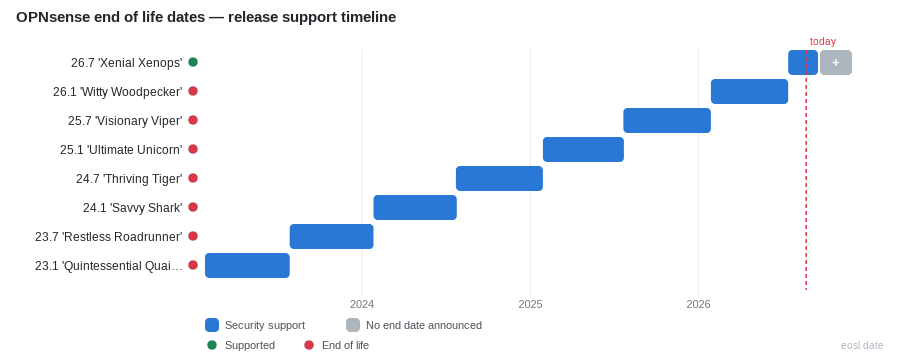
Currently Supported OPNsense Releases - Active EOS/EOSL Support (1)
| Release | Released | Security Support | Latest |
|---|---|---|---|
| 26.7 'Xenial Xenops' | (4 months ago) | Active | 26.7.9 (6 days ago) |
OPNsense End of Life (EOL) Releases - No Longer Supported (23)
| Release | Released | Security Support | Latest |
|---|---|---|---|
| 26.1 'Witty Woodpecker' | (9 months ago) | (4 months ago) | 26.1.11 (4 months ago) |
| 25.7 'Visionary Viper' | (1 year and 3 months ago) | (9 months ago) | 25.7.11 (10 months ago) |
| 25.1 'Ultimate Unicorn' | (1 year and 9 months ago) | (1 year and 3 months ago) | 25.1.12 (1 year and 3 months ago) |
| 24.7 'Thriving Tiger' | (2 years and 3 months ago) | (1 year and 9 months ago) | 24.7.12 (1 year and 10 months ago) |
| 24.1 'Savvy Shark' | (2 years and 9 months ago) | (2 years and 3 months ago) | 24.1.10 (2 years and 4 months ago) |
| 23.7 'Restless Roadrunner' | (3 years and 3 months ago) | (2 years and 9 months ago) | 23.7.12 (2 years and 10 months ago) |
| 23.1 'Quintessential Quail' | (3 years and 9 months ago) | (3 years and 3 months ago) | 23.1.11 (3 years and 4 months ago) |
| 22.7 'Powerful Panther' | (4 years and 3 months ago) | (3 years and 9 months ago) | 22.7.11 (3 years and 10 months ago) |
| 22.1 'Observant Owl' | (4 years and 9 months ago) | (4 years and 3 months ago) | 22.1.10 (4 years and 4 months ago) |
| 21.7 'Noble Nightingale' | (5 years and 3 months ago) | (4 years and 9 months ago) | 21.7.8 (4 years and 9 months ago) |
| 21.1 'Marvelous Meerkat' | (5 years and 9 months ago) | (5 years and 3 months ago) | 21.1.9 (5 years and 3 months ago) |
| 20.7 'Legendary Lion' | (6 years and 3 months ago) | (5 years and 9 months ago) | 20.7.8 (5 years and 9 months ago) |
| 20.1 'Keen Kingfisher' | (6 years and 9 months ago) | (6 years and 3 months ago) | 20.1.9 (6 years and 3 months ago) |
| 19.7 'Jazzy Jaguar' | (7 years and 4 months ago) | (6 years and 9 months ago) | 19.7.10 (6 years and 9 months ago) |
| 19.1 'Inspiring Iguana' | (7 years and 9 months ago) | (7 years and 4 months ago) | 19.1.10 (7 years and 4 months ago) |
| 18.7 'Happy Hippo' | (8 years and 3 months ago) | (7 years and 9 months ago) | 18.7.10 (7 years and 10 months ago) |
| 18.1 'Groovy Gecko' | (8 years and 9 months ago) | (8 years and 3 months ago) | 18.1.13 (8 years and 3 months ago) |
| 17.7 'Free Fox' | (9 years and 3 months ago) | (8 years and 9 months ago) | 17.7.12 (8 years and 10 months ago) |
| 17.1 'Eclectic Eagle' | (9 years and 9 months ago) | (9 years and 3 months ago) | 17.1.11 (9 years and 3 months ago) |
| 16.7 'Dancing Dolphin' | (10 years and 3 months ago) | (9 years and 9 months ago) | 16.7.14 (9 years and 9 months ago) |
| 16.1 'Crafty Coyote' | (10 years and 9 months ago) | (10 years and 3 months ago) | 16.1.20 (10 years and 3 months ago) |
| 15.7 'Brave Badger' | (11 years and 4 months ago) | (10 years and 9 months ago) | 15.7.25 (10 years and 9 months ago) |
| 15.1 'Ascending Albatross' | (11 years and 10 months ago) | (11 years and 4 months ago) | 15.1.12 (11 years and 5 months ago) |
If you run a firewall on OPNsense, the question behind OPNsense end of life is simple: which series still gets security fixes today? Only the newest series, 26.7, is supported, and every older series stops receiving patches once the next major release arrives. This guide lists each release with its support dates, explains how the open source team schedules them, and shows how to plan an upgrade before your router falls behind on network security.
OPNsense End of Life Dates for Every Release
The table below shows each major series with its release date, the day its security updates stopped, and its final patch version. The dates match the published history and the tracker at endoflife.date, so you can compare them with the version shown in your own firewall dashboard.
| Series and animal name | Released | Security support ended | Final patch version |
|---|---|---|---|
| 26.7 Xenial Xenops | 15 Jul 2026 | Still supported | 26.7.7 (13 Oct 2026) |
| 26.1 Witty Woodpecker | 28 Jan 2026 | 15 Jul 2026 | 26.1.11 (1 Jul 2026) |
| 25.7 Visionary Viper | 22 Jul 2025 | 28 Jan 2026 | 25.7.11 (15 Jan 2026) |
| 25.1 Ultimate Unicorn | 28 Jan 2025 | 23 Jul 2025 | 25.1.12 (21 Jul 2025) |
| 24.7 Thriving Tiger | 23 Jul 2024 | 28 Jan 2025 | 24.7.12 (14 Jan 2025) |
| 24.1 Savvy Shark | 26 Jan 2024 | 25 Jul 2024 | 24.1.10 (11 Jul 2024) |
| 23.7 Restless Roadrunner | 28 Jul 2023 | 26 Jan 2024 | 23.7.12 (16 Jan 2024) |
| 23.1 Quintessential Quail | 25 Jan 2023 | 28 Jul 2023 | 23.1.11 (27 Jun 2023) |
Look at the pattern in the last two columns: support for a series ends on the day the next one ships. The 26.1 series stopped on the very day 26.7 appeared. Nothing here is a long-term support promise, and the version trackers mark every series LTS: No. Versio.io also counts 338 of 426 tracked versions as affected by a CVE, which is a good reason to stay current on any firewall that faces the internet. The code is published under the BSD 2-Clause license.
How the OPNsense Release Strategy Works
The team ships two major release versions a year, one in January and one in July, on firm release dates. Between them, a maintenance update arrives roughly every two weeks with bug fixes and fresh third-party patches, and developers keep each stable release in step with upstream software. That rhythm is the whole lifecycle: a new series, a few months of small updates, then a hand-off to the next series. The project community treats the hardening of the firewall as a continuous job, not a one-off event, and this open-source platform expects production users to move with the schedule instead of freezing on one build, because a frozen build stops receiving fixes the day the next series ships.
Calendar Versioning and the Code Name Pattern
The version number is calendar versioning: year, then month. In 26.7.7, 26 is 2026, 7 is the month of release, and the last 7 is the seventh update to that series. Each series also carries a code name made of an adjective and an animal that share a first letter, such as Xenial Xenops or Witty Woodpecker.
No Fixed End-of-Life Schedule
OPNsense does not publish an advance calendar of cut-off dates. It follows a latest-only model in which earlier series stay installable but are no longer recommended, so the practical rule is to expect support to end when the next major version is released.
Latest Version: Which OPNsense Releases Are Supported
The latest version is 26.7.7, published on 13 October 2026 as part of the 26.7 series. That makes 26.7 the only supported release. Each fortnightly maintenance release ships the newest FreeBSD advisories and other security fixes, plus small bug fixes, and a hotfix follows only when a defect slips through. The same tracker counts 101 unstable versions among all tracked OPNsense releases, which are the release candidate and development builds you should keep off a production firewall gateway. Between series, the changelog is the one place that tells you whether a hotfix is needed on your box.
OPNsense Roadmap: Next Release in January 2027
The official OPNsense roadmap lists 27.1 as the next release, planned for January 2027. Since the schedule is firm, you can expect 26.7 to lose support around that month, which leaves a few months from the data date of this page. Planned work includes:
- Equal-Cost Multi-Path (ECMP) routing support and VLAN support on bridges
- Native NAT64, Endpoint-Independent NAT (RFC 4787) and a max-pkt-rate option for the firewall
- Cloneable widgets and a health widget for the dashboard
- A modal form search for large forms, favorites in the menu and a maximize button for grids
- Plans to deprecate PPTP and L2TP in PPP devices, and to deprecate IKEv1 in IPsec
- A revamped WireGuard peer generator and a split of the ddclient plugins
Anything on this list can still move to a later January or July date, so treat it as direction, not a commitment. If you rely on PPTP, L2TP or IKEv1 tunnels, start planning their replacement in January now and not after the upgrade breaks them.
Latest Release From July 2026: The 26.7 Release Cycle
The latest release, 26.7 Xenial Xenops, appeared on 15 July 2026. It moves to FreeBSD 15.1, PHP 8.5 and Python 3.13, adds OpenVPN TLS-Crypt v2 and brings IPv6 to the captive portal. Across this series the developers kept converting pages to the MVC and API framework, which is why the firewall rules, interface and gateway screens now share one MVC codebase and one API. Older firewall rules also moved into plugins, so new installs start lean, and the Hostwatch service got database cleanups. The dashboard and grid screens gained a bulk select option, a revamped Unbound overrides grid arrived, Kea picked up DDNS, and dnsmasq had already become the default for IPv6 in 26.1. The details below matter for your support window, because they show what changes when you move off a series that no longer gets fixes.
These migrations are the common thread through the last few series, so here is the short list of what moved to MVC and the API, since each MVC page is also what makes an API possible:
- 25.1: the High Availability status page moved to MVC, tunables got an MVC conversion with an API, and user and group administration gained an API
- 25.1: IPsec advanced settings moved to MVC, and 25.7 then gave bridges an MVC migration and the IPsec mobile page an MVC rewrite
- 25.7: Tabulator grids replaced bootgrid across the MVC pages, and the firewall automation page was revamped
- 26.1: port forwards got an API, interface settings migrated to MVC, and router advertisements moved to MVC with an API
- 26.7: gateway groups, interface assignments and reporting settings each moved to MVC and gained an API
- 27.1 plan: scrub rules and advanced firewall settings move to MVC, so each gets an API
Base System and FreeBSD Updates
Each series tracks a newer FreeBSD base: 14.1 in 24.7, 14.2 in 25.1, 14.3 in 25.7 and 15.1 in 26.7. The PHP stack moved too, from PHP 8.3 in 25.1 to PHP 8.5 in 26.7, and Python reached 3.13. The 25.1 series added snapshots built on ZFS for easy recovery and an official dark theme, and 25.7 replaced bootgrid with Tabulator and upgraded to ChartJS 4. Every update also refreshes OpenSSL, and Suricata 8 in 26.1 added an inline mode for intrusion detection. Plugins follow the same cadence, so os-caddy, os-zabbix-agent and os-stunnel receive their own versions in the same update, and the ddclient plugins split into two in the 27.1 plan. Because the base system and the firewall ship together, one firmware update refreshes both, and you should check that your plugins support the new FreeBSD base before upgrading. Third-party plugins are the usual reason a clean upgrade needs one more reboot. Plugins also carry the legacy features, as the VPN section shows.
Firewall and NAT Improvements
The firewall is where most visible change happens. 25.1 improved firewall security zone support and documentation, and 26.1 introduced a new firewall rules UI, plus destination NAT (port forward) API support and a new look for one-to-one NAT, NPTv6 and source NAT. 25.7 sped up firewall aliases at scale, added a JSON container for alias imports and revamped firewall automation, while 26.7 merged outbound NAT into the source NAT page and moved the legacy firewall rules into plugins, so a new firewall starts with a shorter rule list. In 26.1 the firewall also gained pfsync defer support for active/active high availability, and GeoIP gained IPinfo support. The firewall rules and the MVC migration go together: scrub rules and advanced firewall settings move to MVC in 27.1, which brings an API for each MVC page. Review every firewall rule after a major upgrade, and re-read the rules if you use hybrid mode. These are the changes to expect when you leave an unsupported series.
VPN Changes for OpenVPN, IPsec and WireGuard
The VPN stack shifted the most. In 25.7 the OpenVPN legacy instances and the IPsec legacy tunnels went into plugins as a first step toward removal, and 26.1 then moved both legacy IPsec and OpenVPN plugins to tier 3. In 26.7, OpenVPN gained faster learn-address handling plus TLS-Crypt v2, so check your OpenVPN clients and every VPN tunnel before upgrading, and keep the older plugins installed until the replacement VPN instances work. The 27.1 plan deprecates IKEv1 for IPsec, so IPsec peers should use IKEv2 by then, and WireGuard gets a revamped peer generator. A forum notice already told users of the legacy OpenVPN client to move to the new OpenVPN instances.
Services: DHCP, DNS and IPv6
Dnsmasq grew into a full DHCP option. 25.7 added dnsmasq DHCP for small and medium setups, and 26.1 made dnsmasq the default for IPv6 support. Kea DHCP gained IPv6 with prefix delegation in 25.7 and advanced manual configurations, then automatic route support for prefix delegation leases in 26.1. In 26.7, Kea added dynamic prefix delegation from the WAN, DDNS support and custom options, which brings Kea close to what dnsmasq offers for DHCP. Small fixes keep arriving: dnsmasq registers DHCPv6 firewall rules (25.1.11), and dnsmasq DHCP host entries may share partial IPv6 addresses (25.1.10). The Unbound DNS service merged domain overrides into query forwarding in 25.1, ignores TXT records for wildcard host entries since 25.1.11, shipped Unbound 1.23.1 in 25.1.12 and offered block list source selection to Community Edition users in 26.1. Captive Portal users saw IPv6 support in 26.7, so a guest network can hand out IPv6 addresses behind the captive portal. Pick dnsmasq or Kea for DHCP, not both, since each DHCP server owns its own DHCP leases, and keep dnsmasq off port 53 if Unbound already answers DNS queries. Check DHCP static mappings after each upgrade, and re-test the captive portal login page. None of this changes your support window, but each item is a post-upgrade check.
Upgrade Before Your OPNsense Version Hits EOL
An upgrade between series is a normal firmware step, not a reinstall, and the documentation asks you to run the final update of your current series first. Use this checklist before you move from an older series:
- Apply the last update of your current series, then export the configuration
- Take a ZFS snapshot so you can roll back the firmware
- Read the patch notes for the new series and look for features marked deprecate
- Pick a nearby mirror for the download (mirrors exist in Europe, both US coasts, South America and East Asia) and verify the checksums of the image
- Follow the installation guide if you install from scratch, and skip release candidate builds on a live gateway
- Check that your plugins are still available for the new series
- Wait a few hours after the release announcement so each mirror can catch up, then confirm that Unbound still resolves names
Reading Patch Notes From the 25.1 EoL Release
The end of 25.1 shows how the final releases behave. 25.1.11, published on 16 July 2025, was the last planned patch notes entry: FreeBSD advisories, OpenSSL 3.0.17, PHP 8.3.23, sudo, Suricata and a few fixes for cron and dnsmasq. Then 25.1.12 followed on 22 July as a surprise stable release, because a Sqlite library naming bug had slipped into ports and could leave packages missing after a reboot. The fix shipped alongside Unbound 1.23.1 and a libxml security update, with a firmware fingerprint that prepared the way to 25.7. The lesson: always read the patch list of the last release, because a hotfix can still land after it. A patch note also names any plugins that changed.
Tracking End-of-Life Dates and Version History With Feeds
Two sources keep the version history current. The endoflife.date tracker offers a JSON endpoint, an RSS feed and an iCalendar feed, and it lists product identifiers such as the CPE string cpe:/a:opnsense:opnsense. Versio.io adds release counts and a lifecycle chart. The source code and tickets live on GitHub. To see which version a firewall runs, use opnsense-version from the shell, then compare it with the table above before the next January or July date.