Cachet End of Life (EOL) Dates and End of Support (EOS) Dates
Cachet end of life (EOL) and end of support (EOS) dates: 7 Cachet versions have reached EOL, including Cachet 2.3 (EOL date: Oct 27, 2023) — no longer receiving security updates or patches. Cachet 2.4.1 is the current supported release. Also see Laravel EOSL dates for related end-of-life information.
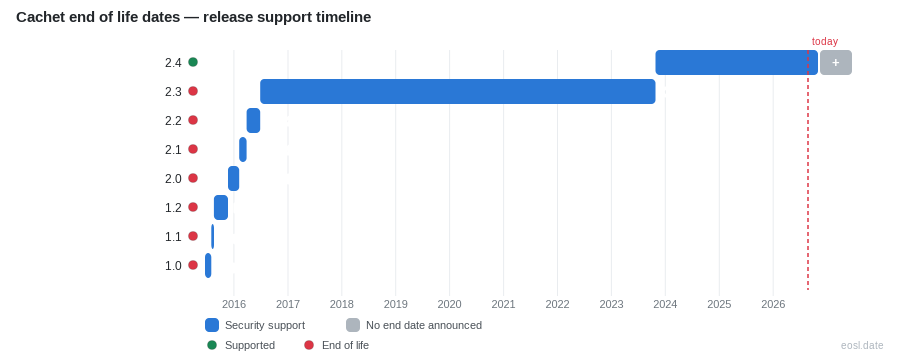
Currently Supported Cachet Releases - Active EOS/EOSL Support (1)
| Release | Released | Security Support | Latest |
|---|---|---|---|
| 2.4 | (3 years ago) | Active | 2.4.1 (3 years ago) |
Cachet End of Life (EOL) Releases - No Longer Supported (7)
| Release | Released | Security Support | Latest |
|---|---|---|---|
| 2.3 | (10 years and 4 months ago) | (3 years ago) | 2.3.18 (7 years and 5 months ago) |
| 2.2 | (10 years and 7 months ago) | (10 years and 4 months ago) | 2.2.4 (10 years and 5 months ago) |
| 2.1 | (10 years and 9 months ago) | (10 years and 7 months ago) | 2.1.2 (10 years and 8 months ago) |
| 2.0 | (10 years and 11 months ago) | (10 years and 9 months ago) | 2.0.4 (10 years and 10 months ago) |
| 1.2 | (11 years and 2 months ago) | (10 years and 11 months ago) | 1.2.1 (11 years and 2 months ago) |
| 1.1 | (11 years and 3 months ago) | (11 years and 2 months ago) | 1.1.1 (11 years and 3 months ago) |
| 1.0 | (11 years and 4 months ago) | (11 years and 3 months ago) | 1.0.0 (11 years and 4 months ago) |
If you run the open source status page and wonder how long it stays safe, Cachet end of life is the question to settle. The short answer: Cachet 2.4 is the last 2.x release and has had no update since 2023, while the team works on a 3.x rebuild. Below is what that means for your support, security and migration plans.
Cachet End of Life: Where Each Release Stands
There is no formal Cachet end of life announcement. Instead, the lifecycle shows up in the release history that endoflife.date tracks (last updated 30 August 2026). Only the newest line counts as a supported release, and 2.3 lost its security support when 2.4 was released on 27 October 2023.
| Release | Released | Security support | Latest patch |
|---|---|---|---|
| 2.4 | 27 Oct 2023 | Yes | 2.4.1 |
| 2.3 | 27 Jun 2016 | Ended 27 Oct 2023 | 2.3.18 |
| 2.2 | 27 Mar 2016 | Ended 27 Jun 2016 | 2.2.4 |
| 2.1 | 6 Feb 2016 | Ended 27 Mar 2016 | 2.1.2 |
| 2.0 | 22 Nov 2015 | Ended 6 Feb 2016 | 2.0.4 |
Is Cachet 2.4 still getting security updates?
On paper, yes. The tracker marks 2.4 as supported, and the GitHub security page says only the latest release receives security patches. In practice, 2.4.1 shipped in November 2023 and no fixes have followed. Treat 2.4 as supported in name only: if a flaw surfaces tomorrow, nothing promises a timeline for a patch, so your support really depends on 3.x arriving.
What EOL and EOS Mean for Open Source Software
EOL (end-of-life) and EOS (end of support) are often used interchangeably, yet vendors treat them differently. For a commercial product, EOL usually means the vendor stops selling it while limited support continues, and EOS means all support stops. A vendor may even label that same product milestone differently from its rivals. A project like this rarely draws that line. When nobody ships updates, EOL and EOS arrive together, so for Cachet both are a judgement from release activity, not a dated notice, and the end of support is something you infer. Every lifecycle ends the same way: no bug fixes and no new security updates.
How maintainers shape the lifecycle
An open-source project lives or dies by its maintainers. Cachet's team has said it is focused on v3, so nobody owns the next 2.x fix. The community can still read, fork and run the code, but the 2.x branch is effectively frozen.
Cachet 3.x: The Rebuild Behind the Quiet 2.x Branch
The team says it is entirely focused on v3, rebuilt with Laravel, Tailwind and Filament. The project site cites 15k+ GitHub stars, 2k+ forks and 1M+ downloads, plus sponsors who keep it free. A public demo resets every 30 minutes, so you can try it safely.
Cachet v3 requirements for PHP and databases
Cachet v3 needs PHP 8.3 or later, Composer and one supported database: MariaDB, MySQL, PostgreSQL or SQLite. Read the installation and upgrades pages in the documentation first; a server on an older PHP release needs a platform upgrade before any move.
Self-hosted status page features worth keeping
Whatever you run next, keep what works: a JSON API to automate incidents, custom metrics, planned maintenance, two-factor authentication and a branded status page system your customers and stakeholders trust.
Security Risk of an Unsupported Status Page
Unsupported software is a security risk because known flaws stay open. When a vendor ships fixes for a current release, attackers can compare it with older versions sharing the same code and hunt for the same hole. Your status page is also a public-facing app in production, often holding admin credentials, so an exploit there costs more than it looks.
CVEs and security vulnerabilities after support ends
New CVEs keep appearing after maintainers step back. Cachet asks you to email security vulnerabilities to the team, which reviews each case by case, with no promised 2.x backport. Infrastructure that reports your outages should not become one.
EOL Compliance and Audit Impact
Many organizations must show auditors that production systems are supported. EOL software can trigger audit findings, even when the product still runs fine and procurement delays. For an enterprise, an unsupported status page is a small system with a big compliance story, and the operational cost of explaining that product to auditors adds up. A 2.4 install with no patch since 2023 is exactly the exception an auditor will ask about, so IT leads and operations teams should log it.
How to Check Cachet EOS Dates Yourself
endoflife.date publishes a JSON API, an RSS feed and an iCalendar feed for Cachet, so your monitoring can alert you when its EOS status changes. Add the Composer package cachethq/cachet to your dependency inventory and let your team watch GitHub releases and the security policy.
Planning a Cachet EOL Migration Before Support Ends
A rushed migration adds operational risk of its own, so schedule it deliberately. For a Cachet install, the order that works is:
- Inventory every monitoring tool or script that posts incidents to the Cachet API.
- Back up the database and settings.
- Confirm PHP 8.3 and a supported database, deploy v3 in staging and run regression testing on those integrations.
- Run both pages side by side to avoid downtime, then announce planned maintenance.
Treat the move to v3 as modernization paced by business readiness, not by a deadline.
Keeping the latest release in view during the switch
Pin your current version and watch Cachet's releases page for the first stable 3.x tag; it tells you when a v3 upgrade path becomes safe.
Extended Support and End-of-Life Alternatives
Third-party extended support, like the never-ending support HeroDevs sells for Spring, exists for popular frameworks, but we found no such program for Cachet. Your realistic options are moving to v3, paying the team for professional installation, or switching to a hosted status page service.
Cachet Lifecycle Checklist for Your Team
- Record the software version you run and whether it is 2.4.
- Set an alert on endoflife.date.
- Test the v3 demo against your workflow.
- Decide who owns the migration and by when.