OpenWrt End of Life (EOL) Dates and End of Support (EOS) Dates
OpenWrt end of life (EOL) and end of support (EOS) dates: 7 OpenWrt versions have reached EOL, including OpenWrt 24.10 (EOL date: Sep 30, 2026) — no longer receiving security updates or patches. OpenWrt 25.12.6 is the current supported release. Also see AlmaLinux OS end of support life for related end-of-life information.
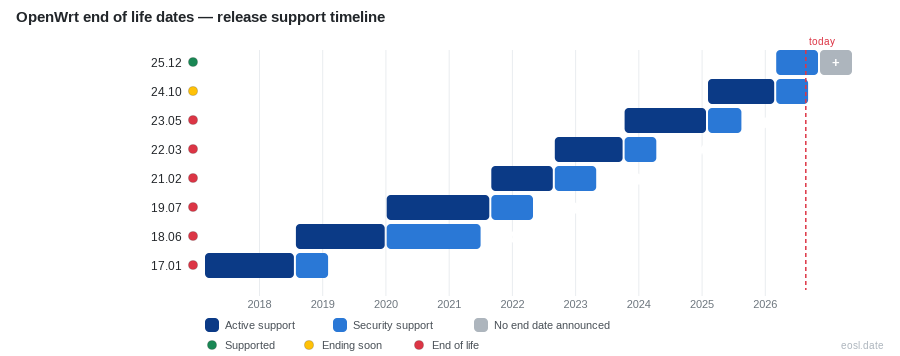
Currently Supported OpenWrt Releases - Active EOS/EOSL Support (1)
| Release | Released | Security Support | Active Support | Latest |
|---|---|---|---|---|
| 25.12 | (8 months ago) | Active | Active | 25.12.6 (1 month and 5 days ago) |
OpenWrt End of Life (EOL) Releases - No Longer Supported (7)
| Release | Released | Security Support | Active Support | Latest |
|---|---|---|---|---|
| 24.10 | (1 year and 9 months ago) | (1 month and 3 weeks ago) | (8 months ago) | 24.10.8 (3 months ago) |
| 23.05 | (3 years and 1 month ago) | (1 year and 2 months ago) | (1 year and 9 months ago) | 23.05.6 (1 year and 3 months ago) |
| 22.03 | (4 years and 2 months ago) | (2 years and 3 months ago) | (3 years and 1 month ago) | 22.03.7 (2 years and 4 months ago) |
| 21.02 | (5 years and 2 months ago) | (3 years and 5 months ago) | (4 years and 2 months ago) | 21.02.7 (3 years and 6 months ago) |
| 19.07 | (6 years and 10 months ago) | (4 years and 6 months ago) | (5 years and 2 months ago) | 19.07.10 (4 years and 7 months ago) |
| 18.06 | (8 years and 3 months ago) | (5 years and 10 months ago) | (6 years and 10 months ago) | 18.06.9 (6 years ago) |
| 17.01 | (9 years and 9 months ago) | (7 years and 4 months ago) | (8 years and 3 months ago) | 17.01.7 (7 years and 5 months ago) |
Running an old build on your home gateway is risky, so knowing the OpenWrt end of life status of your release matters before the next advisory lands. OpenWrt is a Linux distribution built for embedded devices such as wireless routers, and once your release stops receiving fixes, every new flaw stays open on your device.
What OpenWrt End of Life Means
OpenWrt is a free, GPL-licensed project, and its community maintains one stable series at a time with full care while the previous one only gets quiet clean-up. When a series drops out of that rotation, the project stops building it, stops issuing a patch, and stops publishing security advisories for it. Your router keeps working, but nothing protects the wireless and network services running on it.
The distribution ships a writable filesystem and the opkg package manager, and you create custom images with a heavily modified Buildroot. Its background is summarized on Wikipedia, but the live schedule below comes from release tracking data, not encyclopedia text.
Security Support Dates for Every Release
Every major release passes through two phases, and the table shows when each series launched next to the day each phase ended. The version history page on the project wiki records the same sequence. Trackers disagree by a few days on some dates, so treat the month as reliable and confirm exact days on the official release page.
| Release | Release date | Full updates ended | Fixes ended | Final version |
|---|---|---|---|---|
| 25.12 | 6 Mar 2026 | Still active | Still active | 25.12.6 (18 Oct 2026) |
| 24.10 | 6 Feb 2025 | 5 Mar 2026 | 30 Sep 2026 | 24.10.8 (25 Jul 2026) |
| 23.05 | 13 Oct 2023 | 4 Feb 2025 | 31 Aug 2025 | 23.05.6 (16 Aug 2025) |
| 22.03 | 6 Sep 2022 | 11 Oct 2023 | 31 Jul 2024 | 22.03.7 (23 Jul 2024) |
| 21.02 | 4 Sep 2021 | 3 Sep 2022 | 31 May 2023 | 21.02.7 (27 Apr 2023) |
| 19.07 | 6 Jan 2020 | 1 Sep 2021 | 30 Apr 2022 | 19.07.10 (17 Apr 2022) |
| 18.06 | 31 Jul 2018 | 6 Jan 2020 | 31 Dec 2020 | 18.06.9 (17 Nov 2020) |
| 17.01 | 22 Feb 2017 | 30 Jul 2018 | 30 Jun 2019 | 17.01.7 (21 Jun 2019) |
Only 25.12 is still covered. The 24.10 branch left security maintenance on 30 September 2026, about four weeks ago, so a device on any 24.10.x build is now unsupported.
Reading the Release Table
The two phases mean different things. Once active support ends, a branch only receives fixes for flaws. After security support ends too, it receives nothing. Compare your own version with the final column: if it is below the last entry for your series, install the final point release first.
Latest Version and Stable Release Status
The latest version is 25.12.6, published on 18 October 2026 as the 25.12 stable release line's sixth update. You can follow new builds through the project's RSS feed or a machine-readable API on the tracker sites, which is handy if you manage several devices.
Active Support and the Release Policy
The rule is simple. The newest series gets full updates, the one before it only gets security fixes, and each series reaches end of life six months after its successor appears, with at least one year from its own launch. Documentation phrases the same thing as a major release moving to EOL one year after its first release date, or six months after the next one, whichever is later.
That rule is why the lifecycle of 24.10 closed in 2026 even though its last build shipped in July. Before a cut-off, read the release notes and the changelog on GitHub, and grab firmware from the official downloads server.
Long-Term Support: What OpenWrt Offers
OpenWrt has no long-term support track. Tracking sites list every release as not LTS, so every supported release follows the same maintenance period and none gets extended coverage. Plan to move to a new series roughly every two years.
Service Release Security Fixes
Each service release bundles security fixes, and 25.12.6 shows why staying current matters. Its notes describe remote flaws in services that run by default. The uhttpd web server that fronts LuCI received five advisories reachable without authentication, including a denial of service from unlimited request headers and an out-of-bounds write through the ubus call endpoint.
- Cryptography: Mbed TLS moved to 3.6.7 for a remote buffer overflow tracked as CVE-2026-25832, OpenSSL moved to 3.5.9, and wolfSSL to 5.9.4.
- Wi-Fi stack: hostapd and wpa_supplicant now validate multi-link frames, because malformed ones could crash a WiFi access point.
- Kernel: the kernel advanced to 6.12.112 with upstream stable fixes.
- Privilege escalation: two rpcd issues rated high let limited LuCI users reach root, and one ser2net app flaw was critical.
Those security vulnerabilities do not touch every setup, yet together these vulnerabilities show how many default components a router exposes. Optional software such as curl, OpenSSH and unbound was also fixed, but only after you update the installed packages, because they are not in default firmware images.
Upgrading Before End-of-Life
Start by reading your version from the shell: cat /etc/openwrt_release. If the output shows a release older than 25.12, upgrading is the safe move. Download the matching image, keep a backup of your configuration, and flash it with the sysupgrade tool or the web interface. A cautious upgrade beats a rushed one after the next advisory.
Before you flash, check that your device is still built for 25.12, since hardware that fell off the supported list stays on its last compatible build. After the move, update packages and confirm the version again, so your device sits inside the end-of-life window for a full year at minimum.