Slackware Linux End of Life (EOL) Dates and End of Support (EOS) Dates
Slackware Linux end of life (EOL) and end of support (EOS) dates: 17 Slackware Linux versions have reached EOL, including Slackware Linux 14.2 (EOL date: Jan 01, 2024) — no longer receiving security updates or patches. Slackware Linux 15.0 is the current supported release. Also see AlmaLinux OS lifecycle dates for related end-of-life information.
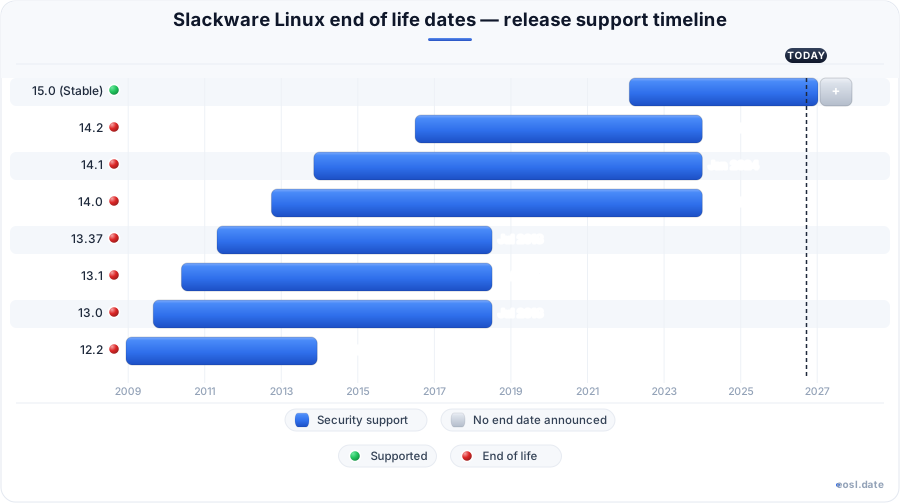
Currently Supported Slackware Linux Releases - Active EOS/EOSL Support (1)
| Release | Released | Security Support |
|---|---|---|
| 15.0 | (4 years and 9 months ago) | Active |
Slackware Linux End of Life (EOL) Releases - No Longer Supported (17)
| Release | Released | Security Support |
|---|---|---|
| 14.2 | (10 years and 4 months ago) | (2 years and 10 months ago) |
| 14.1 | (12 years and 11 months ago) | (2 years and 10 months ago) |
| 14.0 | (14 years and 1 month ago) | (2 years and 10 months ago) |
| 13.37 | (15 years and 6 months ago) | (8 years and 3 months ago) |
| 13.1 | (16 years and 5 months ago) | (8 years and 3 months ago) |
| 13.0 | (17 years and 2 months ago) | (8 years and 3 months ago) |
| 12.2 | (17 years and 10 months ago) | (12 years and 10 months ago) |
| 12.1 | (18 years and 6 months ago) | (12 years and 10 months ago) |
| 12.0 | (19 years and 4 months ago) | (14 years and 3 months ago) |
| 11.0 | (20 years and 1 month ago) | (14 years and 3 months ago) |
| 10.2 | (21 years and 1 month ago) | (14 years and 3 months ago) |
| 10.1 | (21 years and 8 months ago) | (14 years and 3 months ago) |
| 10.0 | (22 years and 4 months ago) | (14 years and 3 months ago) |
| 9.1 | (23 years and 1 month ago) | (14 years and 3 months ago) |
| 9.0 | (23 years and 7 months ago) | (14 years and 3 months ago) |
| 8.1 | (24 years and 4 months ago) | (14 years and 3 months ago) |
| 8.0 | (25 years and 4 months ago) | (23 years and 7 months ago) |
Slackware Linux end of life dates decide whether your install still receives fixes. Slackware is a GNU/Linux system created by Patrick Volkerding in 1993, a Unix-like design and the oldest distribution that is still maintained, so its support rules are unusual. Below you will find every unsupported release, the EOL dates, and what to do about them.
Slackware Linux End of Life Status at a Glance
Only Slackware 15.0 is fully supported today. It arrived on 2 February 2022, and every earlier version is now unsupported. The endoflife.date tracker, last updated on 21 September 2026, still lists 15.0 as the only release with security coverage. That matches how Slackware Linux has always worked: this Linux distribution aims for stability and simplicity, so it changes upstream software as little as it can and stays a predictable open source operating system for users who value that. Because Slackware Linux follows no vendor calendar, a Linux administrator cannot look up one end date and must read the notices instead.
There is no fixed end date for 15.0 itself. The project has no officially stated support term, and a version is declared EOL only when a notice is posted. The notice sets the effective date, usually a few months out, which makes watching the changelog the one habit worth building.
Slackware EOL Dates and Release History
Every Linux vendor handles this differently, and Slackware Linux leaves the call to Patrick Volkerding, unlike a Linux vendor with a published Linux policy. Slackware ships when it is ready, not on a timetable, so gaps between versions and EOL dates vary widely. The table shows each family of versions, when it first appeared, and when security fixes stopped. This release history shows that each now unsupported version usually lived between five and ten years, and the ARM builds are tracked separately below. Versions before 8.1 never got a formal notice but are no longer maintained.
| Version | First published | Fixes ended |
|---|---|---|
| 15.0 | 2 Feb 2022 | Still supported |
| 14.2 | 1 Jul 2016 | 1 Jan 2024 |
| 14.1 | 7 Nov 2013 | 1 Jan 2024 |
| 14.0 | 28 Sep 2012 | 1 Jan 2024 |
| 13.37 | 28 Apr 2011 | 5 Jul 2018 |
| 13.1 | 24 May 2010 | 5 Jul 2018 |
| 13.0 | 28 Aug 2009 | 5 Jul 2018 |
| 12.2 | 11 Dec 2008 | 9 Dec 2013 |
| 12.1 | 2 May 2008 | 9 Dec 2013 |
| 8.1 to 12.0 | 2002 to 2007 | 1 Aug 2012 |
Slackware 14.2, Slackware 14.1 and Slackware 14.0 Retire in 2024
On 9 October 2023, the changelog for 14.2 carried an announcement that 14.0, 14.1 and 14.2 would reach EOL, effective 1 January 2024. The announcement gave users about three months of notice, as most Slackware Linux notices do. 14.2 had been the newest version since July 2016, so it enjoyed roughly seven and a half years of coverage, and in practice long-term support, because 15.0 took more than five years to arrive. If you still run one of these, treat the package set as frozen and plan an upgrade.
How Slackware Security Support Works
Slackware has no formal support term policy, yet the pattern is clear. The newest branch gets bug fixes and security fixes, while older versions that have not reached EOL receive only the latter. When a notice is posted, that version is retired and security support ends on the date given. Decisions rest with Patrick Volkerding, the lead developer, and the distribution has no public bug tracker or code repository, so the changelog is the authoritative record. Unlike a typical Linux vendor, the Slackware Linux project promises no Linux support window of a set number of years.
Release Policy and Release Cycle
The release policy is feature and stability based, unlike the time-based schedule of Ubuntu or Gentoo, a rolling release distribution. Patrick Volkerding publishes a new version only when enough changes have landed and the result is stable, and he has said the project does not speculate on dates. The release cycle has slowed: 14.1 to 14.2 took over two years, and 14.2 to 15.0 more than five. Volkerding hopes 15.1 will have a far shorter development cycle, but no date exists. Linux users who expect a fixed cadence from Linux vendors should adjust their expectations.
Stable Release Versus the -current Development Tree
Alongside the stable branch, Patrick Volkerding keeps a testing tree called -current, the development tree that eventually becomes the next stable release. The -current tree closely follows upstream and can break, so it is not recommended for production. When a new stable version ships, the old -current is retired and a fresh one begins. Because -current is not a release, it has no EOL date of its own, and its desktop packages change continuously. Software built against -current may not run on a stable Linux system, and a package update can arrive without warning, so Linux users should avoid mixing the two.
Slackware 15.0 Support Outlook
Version 15.0 has no announced end date. Patrick Volkerding released Slackware 15.0 with the Linux kernel 5.15.19, a Linux long-term support series for the kernel developers, which is the main reason this branch can stay useful for years. The 32-bit non-PAE, 32-bit PAE and 64-bit x86 builds are officially supported, and the x86_64 port is developed alongside the 32-bit one. It is the only Linux distribution in the family still receiving security patches, and third-party scripts from SlackBuilds.org let you add software without waiting for the project to package it.
Latest Release Details and Release Notes
The latest release ships with the KDE Plasma 25th Anniversary Edition and supports Wayland sessions, and the release notes list every included package. The package list on the project site shows each package in detail. To try it without touching a disk, use Slackware Live Edition, a complete Slackware Linux installation that runs from a DVD or USB stick. Extra software outside the main tree usually comes from SlackBuilds. As the newest version, 15.0 is the one that will get the next EOL notice.
Slackware ARM End-of-Life Announcements
The ARM port keeps its own schedule, and its notices show how EOL works for a smaller team. The developer of Slackware ARM announced on 7 May 2016 that 14.1 would reach EOL on 1 September 2016, and a notice for Slackware ARM 14.2 followed on 21 December 2022, setting 1 March 2023 as its last day. The 32-bit ARM builds and the 64-bit AArch64 architecture, started in December 2020, both depend on a small ARM community, and Linux on boards such as the Pinebook Pro relies on it. The IBM S/390 port is different: it stays at version 10.0 with no updates since 2009, so it is unsupported in every practical sense, as are other unofficial ports, whatever their architecture.
Changelog Notices and Security Advisories
Every official EOL notice appears in the changelog of the affected version, so read the changelog before assuming any Linux install is safe. Security advisories go to the slackware-security mailing list and are archived at slackware.com/security. Beware of search results here: the SSA:2006-114-01 advisory from April 2006 marks the end of the Mozilla Suite, not a Slackware version, and its EOL has nothing to do with your install.
What an Unsupported Slackware Release Means for You
Running an unsupported release does not stop it booting. It means newly found vulnerabilities in the browser and system libraries are no longer fixed for that version, so every month adds risk. After 1 January 2024, 14.2 and earlier get no fixes. Linux servers face the worst of it because the network can reach them, and a Linux desktop user is exposed through the browser. Software compiled from source stays as exposed as the system. For most users on 14.2 or older, the practical choice is to move to 15.0. Slackware has no graphical installer and no automatic dependency resolution, so plan an unhurried change.
Migrating to a Supported Release
To leave a retired release such as 14.2, move to 15.0. Before migrating, back up your configuration and home directory. Slackware's pkgtools handle package work: upgradepkg installs a new package over the old one, and slackpkg is the official tool for fetching updates over a network. Because upgradepkg only checks that version numbers differ, it can also downgrade, so confirm the target before you run it. Then rebuild anything installed from SlackBuilds against the new libraries.
Staying Safe With Security Patches
No fixes ship for a retired release such as 14.2, so if you cannot move yet, keep exposure small and set a date to reach 15.0:
- Remove services you do not need and keep the machine behind a Linux firewall.
- Rebuild software from SlackBuilds.org only when its upstream project still publishes fixes.
- Subscribe to notices so the next EOL does not surprise you, and rehearse the move on a spare machine first.