Debian End of Life (EOL) Dates and End of Support (EOS) Dates
Debian end of life (EOL) and end of support (EOS) dates: 16 Debian versions have reached EOL, including Debian 11 (Bullseye) (EOL date: Aug 31, 2026) — no longer receiving security updates or patches. Debian 13.7 is the current supported release, with support through Jun 30, 2030 — 2 versions in active support. Also see AlmaLinux OS end of support life for related end-of-life information.
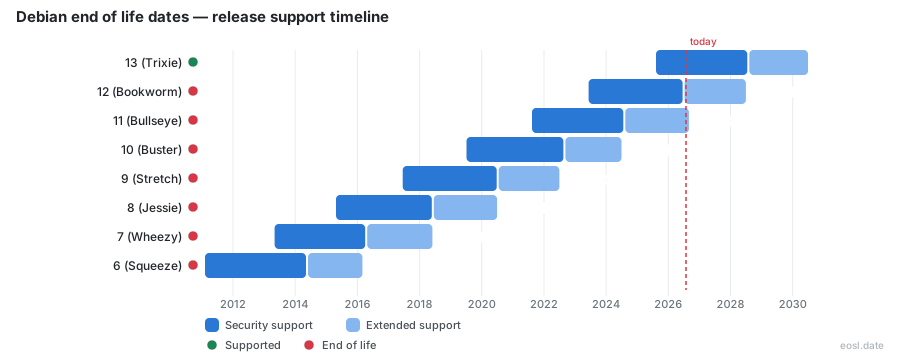
Currently Supported Debian Releases - Active EOS/EOSL Support (2)
| Release | Released | Debian LTS | Debian Security Support | ELTS | Latest |
|---|---|---|---|---|---|
| 13 (Trixie) | (1 year and 2 months ago) | (in 3 years and 7 months) | (in 1 year and 9 months) | (in 8 years and 7 months) | 13.7 (1 month and 3 weeks ago) |
| 12 (Bookworm) | (3 years and 4 months ago) | (in 1 year and 7 months) | (3 months ago) | (in 6 years and 7 months) | 12.15 (3 months ago) |
Debian End of Life (EOL) Releases - No Longer Supported (16)
| Release | Released | Debian LTS | Debian Security Support | ELTS | Latest |
|---|---|---|---|---|---|
| 11 (Bullseye) | (5 years and 2 months ago) | (2 months ago) | (2 years and 2 months ago) | (in 4 years and 7 months) | 11.11 (2 years and 2 months ago) |
| 10 (Buster) | (7 years and 3 months ago) | (2 years and 4 months ago) | (4 years and 1 month ago) | (in 2 years and 7 months) | 10.13 (4 years and 1 month ago) |
| 9 (Stretch) | (9 years and 4 months ago) | (4 years and 4 months ago) | (6 years and 3 months ago) | (in 7 months) | 9.13 (6 years and 3 months ago) |
| 8 (Jessie) | (11 years and 6 months ago) | (6 years and 4 months ago) | (8 years and 4 months ago) | (1 year and 4 months ago) | 8.11 (8 years and 4 months ago) |
| 7 (Wheezy) | (13 years and 6 months ago) | (8 years and 5 months ago) | (10 years and 6 months ago) | (6 years and 4 months ago) | 7.11 (10 years and 5 months ago) |
| 6 (Squeeze) | (15 years and 8 months ago) | (10 years and 8 months ago) | (12 years and 5 months ago) | Active | 6.0.10 (12 years and 3 months ago) |
| 5 (Lenny) | (17 years and 8 months ago) | (14 years and 8 months ago) | (14 years and 8 months ago) | Active | 5.0.10 (14 years and 7 months ago) |
| 4 (Etch) | (19 years and 6 months ago) | (16 years and 8 months ago) | (16 years and 8 months ago) | Active | 4.0r9 (16 years and 5 months ago) |
| 3.1 (Sarge) | (21 years and 4 months ago) | (18 years and 7 months ago) | (18 years and 7 months ago) | Active | 3.1r8 (18 years and 6 months ago) |
| 3.0 (Woody) | (24 years and 3 months ago) | (20 years and 4 months ago) | (20 years and 4 months ago) | Active | 3.0r6 (21 years and 5 months ago) |
| 2.2 (Potato) | (26 years and 2 months ago) | (23 years and 4 months ago) | (23 years and 4 months ago) | Active | 2.2r7 (24 years and 3 months ago) |
| 2.1 (Slink) | (27 years and 7 months ago) | (26 years ago) | (26 years and 1 month ago) | Active | 2.1r5 (26 years and 8 months ago) |
| 2.0 (Hamm) | (28 years and 3 months ago) | (27 years and 8 months ago) | (27 years and 8 months ago) | Active | 2.0r5 (27 years and 8 months ago) |
| 1.3 (Bo) | (29 years and 4 months ago) | (27 years and 10 months ago) | (27 years and 10 months ago) | Active | 1.3.1 r.6 (28 years and 9 months ago) |
| 1.2 (Rex) | (29 years and 10 months ago) | (29 years ago) | (29 years ago) | Active | 1.2 (29 years and 10 months ago) |
| 1.1 (Buzz) | (30 years and 4 months ago) | (29 years and 10 months ago) | (29 years and 10 months ago) | Active | 1.1 (30 years and 4 months ago) |
Your Debian end of life date is the day a release stops receiving fixes, and Debian support ends in stages. This guide lists every date so your Linux operating system keeps getting timely fixes.
Debian End of Life Dates and Release Date Table
Each debian release keeps a launch day, a full-support deadline and an LTS deadline. The newest codenames are Trixie, then Forky and Duke, which have no dates yet. Older Jessie and Wheezy now sit in the archive.
| Version | Codename | Release date | Full support ends | LTS ends |
|---|---|---|---|---|
| Debian 13 | Trixie | 2025-08-09 | 2028-08-09 | 2030-06-30 |
| Debian 12 | Bookworm | 2023-06-10 | 2026-07-11 | 2028-06-30 |
| Debian 11 | Bullseye | 2021-08-14 | 2024-08-14 | 2026-08-31 |
| Debian 10 | Buster | 2019-07-06 | 2022-09-10 | 2024-06-30 |
| Debian 9 | Stretch | 2017-06-17 | 2020-07-18 | 2022-07-01 |
Check the debian version row that matches your server, because only the first two rows still get official fixes.
Debian 11 Bullseye End of Life
Bullseye reaches end-of-life on 31 August 2026, so that release stopped receiving official patches. Anything still going end of life now depends on paid ELTS from a third-party vendor. Move those hosts to the newest release.
Debian Life Cycle: Five Years of Security Support
A release life cycle (some write lifecycle) spans five years, with volunteers handling maintenance after launch.
Security Updates From the Security Team
For the first three years, the Debian Security Team ships security updates; when year three closes, the release moves to LTS. The Release Team protects stability for developers until then.
Long Term Support and Extended LTS
Debian LTS covers the final two years, and the LTS Team delivers long-term support for a limited set of packages. Extended long term support, or Extended LTS, comes from Freexian, which is not an official Debian project, and suits any open source enterprise stack that cannot move yet.
Debian Releases: Stable Release, Oldstable and Testing
Debian keeps three debian releases alive. The stable release is for production, oldstable is the previous one, and oldoldstable trails it. Testing feeds the next distribution, while unstable, always called Sid, is for active development.
Current Stable and Codename Naming
The current stable is Debian 13, fully supported until 2028-08-09, and each codename marks one release. The release notes explain upgrade changes; Trixie launched with these architectures, and the set shrinks during LTS:
- amd64, arm64 and armhf
- ppc64el and riscv64
- i386 and armel only for running older hardware as co-architectures
Debian Support Explained: What Unsupported Debian Means
Once a release is unsupported, no patches reach it through APT. Debian is a free, open-source Linux kernel based distribution that underpins Ubuntu and many cloud images, so an unpatched host carries real risk.
Check Your Debian Version and Upgrade Outdated Systems
Run cat /etc/os-release to read your version, then upgrade any outdated release. The debian-security-support package flags packages without coverage. In a large network, audit every installation against the table's dates and watch the calendar, API or RSS feed.
- Compare your version with the LTS end date in the table, then read the Debian wiki and known problems.
- Plan the move to the current release with the installation guide, including new installations, before your LTS end date.
Pick a dated plan from the table above, because enterprise security depends on staying patched.