Micronaut Framework End of Life (EOL) Dates and End of Support (EOS) Dates
Micronaut Framework end of life (EOL) and end of support (EOS) dates: 2 Micronaut Framework versions have reached EOL, including Micronaut Framework 2 (EOL date: Mar 01, 2023) — no longer receiving security updates or patches. Micronaut Framework 5.2.25 is the current supported release — 3 versions in active support. Also see Apache Grails Framework EOSL information for related end-of-life information.
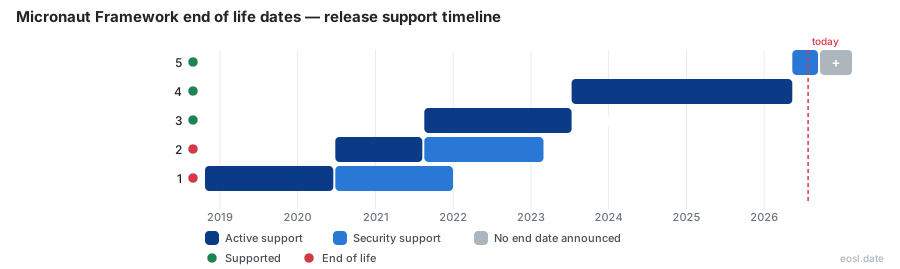
Currently Supported Micronaut Framework Releases - Active EOS/EOSL Support (3)
Micronaut Framework End of Life (EOL) Releases - No Longer Supported (2)
If you run services on the JVM, you probably want a straight answer on Micronaut Framework end of life: which versions still get fixes, and which ones you should leave behind. The Micronaut Framework is a modern, JVM-based, full-stack framework for microservices and serverless apps, built on compile-time dependency injection, fast startup, low memory use and GraalVM native image support. Right now the latest Micronaut Framework major release is 5, and older lines are shifting into maintenance, so this guide shows where each one stands.
Micronaut Framework End of Life: Where Each Version Stands
The Micronaut Framework follows semantic versioning, and every major version moves through the same stages: active development, active maintenance, then end of life. The Micronaut Framework project no longer publishes a formal policy page, so the practical signal is the lifecycle table that tracks each release line. Here is how it reads today.
| Release line | First released | Active development | Maintenance |
|---|---|---|---|
| Micronaut Framework 5 | May 2026 | Yes | Yes |
| Micronaut Framework 4 | 11 Jul 2023 | Ended 13 May 2026 | Yes |
| Micronaut Framework 3 | 18 Aug 2021 | Ended 11 Jul 2023 | Yes |
| Micronaut Framework 2 | 26 Jun 2020 | Ended 18 Aug 2021 | Ended 1 Mar 2023 |
| Micronaut Framework 1 | 23 Oct 2018 | Ended 26 Jun 2020 | Ended 31 Dec 2021 |
In short, the Micronaut Framework has no single end-of-life date. Each major version simply ages out, and you should treat any line whose maintenance column says "Ended" as unsupported.
Micronaut 5 Active Maintenance and Latest Release
Micronaut 5 is the line that gets new features, bug fixes and security updates. The Micronaut Framework announced Micronaut 5.0.0 as generally available in May 2026, after a milestone and a release candidate. Since then the Micronaut Framework team has released a steady run of patches and minor versions: 5.1.0 added Open DI support, and 5.2.0 added experimental Micronaut for Python support and a new Jakarta EL module. The most recent release announcement lists Micronaut Framework 5.2.3, a security release. That is the latest version at the time of writing, so check the announcements page for anything newer.
The recent timeline of the Micronaut Framework shows how quickly the team ships, and every entry below was released within the past five months:
- Micronaut Framework 5.0.1 released on 1 June 2026 with Micronaut Core, Micronaut Data, GraphQL and JSON Schema updates plus two security advisory fixes.
- Micronaut Framework 5.0.4 released on 7 July 2026 with Micronaut Core and Netty 4.2.16, which fixes multiple CVEs.
- Micronaut Framework 5.1.0 released on 27 July 2026, adding Open DI support and updates to Micronaut Core, Micronaut Data and the cloud modules.
- Micronaut Framework 5.1.4 released on 9 September 2026, with Micronaut Core and Micronaut Data fixes for several security advisories.
- Micronaut Framework 5.2.0 released on 27 September 2026, introducing experimental Python support and a Jakarta EL module.
- Micronaut Framework 5.2.2 released on 7 October 2026 as a security release, followed by 5.2.3 released on 20 October 2026 with fixes in Micronaut Core and Micronaut Security.
Each of these was released as a drop-in update inside the same major line, so you can adopt them without touching your code.
Major Release Cadence and Semantic Versioning
A major release of the Micronaut Framework arrives roughly every few years: Micronaut 4 appeared almost three years before Micronaut 5. Within a major line, minor versions add features and patches add fixes, which is what semantic versioning promises. Because the Micronaut Platform BOM manages the framework and its modules together, you move the whole set of dependencies at once. A legacy reflection-based framework resolves its application model at startup, whereas the Micronaut Framework does that work at build time, and that design is also why every new feature of the Micronaut Framework has to be tested against the compiler, not just the runtime.
Java 25, Kotlin and Groovy Baselines
Micronaut 5 raises the baseline of the Micronaut Framework to Java 25, supports Kotlin 2.3 and Apache Groovy 5, and moves Jackson databind to Jackson 3. It also drops RxJava 2, so you choose Project Reactor or RxJava 3 for reactive code. Virtual threads on Java 25 are another reason to move, since the Micronaut Framework supports them in its HTTP server. The Micronaut Framework also keeps GraalVM native image support current, and its GraalVM native tests reuse the same suite as your JVM tests, so testing stays simple. GraalVM executables start in milliseconds, compared with a JVM start of a few hundred milliseconds, and Kotlin users get Kotlin 2.3 support. These changes are the real cost of an upgrade, and they are why many teams stay on Micronaut 4 for now.
Micronaut 4 Maintenance Window and EOL Date
Micronaut 4 left active development on 13 May 2026, but it is still in maintenance, and the Micronaut Framework keeps shipping patched versions of it. The 4.10 line is where those fixes land. Micronaut 4 has no announced EOL date, so plan around the fact that the Micronaut Framework team concentrates on the newest line and that backports could stop without much warning.
When the Micronaut Framework publishes a Micronaut 4 patch, it usually bundles Micronaut Core updates plus modules such as Micronaut Data. A patched version released in October 2026 carried Micronaut Core 4.10.31, with Jackson 2.21.7 and Netty 4.2.19.Final.
Bug Fixes in the 4.10 Patch Line
Patch versions of the Micronaut Framework mostly contain bug fixes and dependency bumps, with Micronaut Support from the maintainers focused on CVEs. Earlier in the year, Micronaut Framework 4.10.14 shipped with Netty 4.2.13, and the team strongly recommended updating because that Netty release fixed multiple CVEs. Reading the release notes and changelog for each patch tells you whether the fix touches your code path.
Micronaut 3 End-of-Life and Security Updates
The Micronaut Framework 3 line began in August 2021 and left active development in July 2023. It remains listed as maintained, and in October 2026 the Micronaut Framework team released Micronaut Framework 3.10.15, a security release that updates managed Netty to 4.1.139.Final and fixes several vulnerabilities. That is a good sign for open source users, but it is not a promise. A line in maintenance can reach end-of-life whenever the project decides, so treat Micronaut 3 as borrowed time.
Why Dependency Updates Matter After EOL
Once a Micronaut Framework line stops receiving patches, your risk comes from its dependencies rather than from your own code. Netty, Jackson and similar libraries publish fixes constantly, and an unpatched Micronaut Framework version keeps the old, vulnerable ones. Teams on Micronaut 3 should compare their dependencies against each new release announcement.
Micronaut 2 and 1 EOL: Unsupported Versions
Micronaut Framework 2 stopped receiving maintenance on 1 March 2023, and Micronaut Framework 1 stopped on 31 December 2021. Their final releases were 2.5.13 and 1.3.7. If your services still run on either line, we recommend you treat them as unsupported: they receive no fixes, and any new CVE in Netty or Jackson stays open. Moving them forward is the single most valuable step in this guide.
Micronaut Support Policy and Commercial Support
The Micronaut Framework previously documented its release, support and end-of-life policies, but that documentation is no longer publicly available. What you can observe is that the newest major line gets new features, bug fixes and security updates, while older lines get security-driven patches for as long as the maintainers choose. The Micronaut Framework is also now a project of the Commonhaus Foundation, announced on 1 September 2026, which gives the community a neutral and durable home. That helps the long-term outlook of the Micronaut Framework, but it does not publish an EOL schedule.
If you need guarantees, commercial support is the answer. Several companies sell support for the Micronaut Framework, and the official support page lists them. Ask each vendor which Micronaut Framework lines it covers and for how long, since that contract, not the open source project, decides how long a line stays usable for you.
Third-Party Support Providers
Vendors vary: some cover only the current major line of the Micronaut Framework, while others will maintain older Micronaut Core and Micronaut Data versions. Oracle is among the organizations involved in the project's history, and the Micronaut Framework also ships an Oracle Cloud module, but cloud modules are not a support contract. Get the coverage in writing.
Micronaut Security Releases: Netty and Jackson CVEs After Maintenance Ends
Security fixes are the main reason a Micronaut Framework version stays usable. Recent patches show the pattern: Micronaut Framework 5.2.2 updated Netty to 4.2.19.Final in Micronaut Core 5.2.15, and Micronaut Framework 5.1.4 addressed several security advisories in Micronaut Core and Micronaut Data. In October 2026 the Micronaut Security module published 5.4.1, 3.11.2 and 4.18.1 to fix two GitHub advisories across several of its lines. This shows maintainers still patch older Micronaut Security versions, which is exactly what you should check before you stay put.
Netty and Jackson Advisories
Netty and Jackson sit under almost every Micronaut Framework HTTP service. A new Netty advisory can land on a Micronaut Framework version within days, so subscribe to the release announcements. The Micronaut Framework release page marks each security release plainly, which makes it easy to scan for gaps in your own cloud services.
Maintenance Check: Is Your Version a Supported Release?
To check where you stand, find your Micronaut Framework version, then compare it with the lifecycle table above. In a Gradle or Maven build, look for the Micronaut Platform BOM or the Micronaut Core version, or run the CLI.
mn --versionA supported release is a line in the table with a "Yes" in the maintenance column. Anything else is a candidate for migration. Keep your modules aligned with the BOM, because mixing a Micronaut Framework 4 core with Micronaut Framework 5 modules is not supported.
Reading the Lifecycle Table
Two columns matter. Active development means new functionality, while maintenance means the Micronaut Framework only accepts fixes. When both say "Ended", the line has hit EOL. Use the documentation and the GitHub release pages to confirm, because the table is community-maintained.
EOL Upgrade Planning with the Migration Guide
The Micronaut Framework publishes a migration guide for each major step, and the Micronaut 5 guide covers Java 25, Jackson 3, JSpecify nullability annotations and the removal of RxJava 2. Start by upgrading to the latest patch version of your current Micronaut Framework line, run your tests, and then move to the next major version. Because the Micronaut Framework resolves injection at compile time, wiring mistakes surface as build errors rather than production surprises.
A sensible order is: update the Micronaut Platform BOM, fix compilation errors in your controllers and clients, replace removed APIs, then rerun your GraalVM native tests if you use native image. Move to the latest version of your target line first, since the Micronaut Framework patches it most often. Plan a window of a few sprints for a service with many modules, and treat the upgrade as routine work rather than an emergency.
Rolling Out the Upgrade Safely
Roll the new Micronaut Framework version out one service at a time, starting with the least critical. Watch startup time, memory and error rates, then continue. Services that use serverless functions or Kubernetes can use canary deployments, so a regression in the new Micronaut Framework version affects only a small share of traffic.