Apache Grails Framework End of Life (EOL) Dates and End of Support (EOS) Dates
Apache Grails Framework end of life (EOL) and end of support (EOS) dates: 6 Apache Grails Framework versions have reached EOL, including Apache Grails Framework 6 (EOL date: Oct 19, 2025) — no longer receiving security updates or patches. Apache Grails Framework 8.0.0 is the current supported release — 2 versions in active support. Also see Spring Boot end of support life for related end-of-life information.
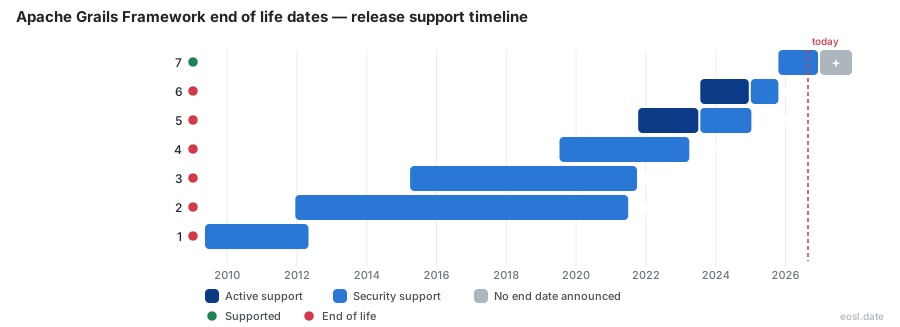
Currently Supported Apache Grails Framework Releases - Active EOS/EOSL Support (2)
Apache Grails Framework End of Life (EOL) Releases - No Longer Supported (6)
| Release | Released | Active Maintenance | Active Development | Latest |
|---|---|---|---|---|
| 6 | (3 years and 3 months ago) | (1 year and 1 month ago) | (1 year and 10 months ago) | 6.2.3 (1 year and 10 months ago) |
| 5 | (5 years and 1 month ago) | (1 year and 10 months ago) | (3 years and 3 months ago) | 5.3.6 (2 years and 10 months ago) |
| 4 | (7 years and 4 months ago) | (3 years and 7 months ago) | — | 4.1.4 (2 years and 8 months ago) |
| 3 | (11 years and 7 months ago) | (5 years and 1 month ago) | — | 3.3.18 (2 years and 10 months ago) |
| 2 | (14 years and 11 months ago) | (5 years and 4 months ago) | — | 2.6.1 (4 years and 5 months ago) |
| 1 | (17 years and 6 months ago) | (14 years and 6 months ago) | — | 1.3.9 (11 years and 10 months ago) |
Apache Grails framework end of life planning starts with one question: which release line is your team running, and how long will it keep getting fixes? This open source framework publishes exact dates, and they are closer than most EOL calendars suggest. Here is what your Java applications need to know before the next Spring Boot deadline.
Apache Grails Framework End of Life Dates by Version
Every release of this Groovy-based web application framework sits in one stage of the published lifecycle. The table below shows when each Grails version started, when it last shipped and how long fixes keep coming. Grails 8 sits in active development, while Grails 7 has already reached end of support.
| Version | Stage | Initial release | Last release | Support through | Extended support |
|---|---|---|---|---|---|
| Grails 8 (Spring Boot 4.1) | In development | Oct 2026 | Coming soon | Jul 2027 | Coming soon |
| Grails 7 (Spring Boot 3.5) | Ended | Oct 2025 | Sept 2026 (7.2.4) | Sept 2026 | Available |
| Grails 6 | Ended | Jul 2023 | Jan 2025 (6.2.3) | Jun 2025 | 6.2.x only |
| Grails 5 | Ended | Oct 2021 | Jan 2024 (5.3.6) | Jun 2024 | Not available |
| Grails 4 | Ended | Jul 2019 | Jan 2024 (4.1.4) | Mar 2024 | Not available |
| Grails 3 | Ended | Mar 2015 | Jan 2024 (3.3.18) | Sep 2021 | Not available |
Future dates are subject to change, so recheck the Grails support schedule before you commit to a timeline. Grails 5, Grails 4 and Grails 3 have no extended coverage at all, and Grails 6 gets it only for the 6.2 line.
Grails Lifecycle Stages Explained
The Apache Grails community describes three lifecycle stages, and the stage tells you how much attention your application's version gets.
Active Development
Releases in active development receive regular updates, including new features, performance work and bug fixes. Most of the team's time goes here, so new and existing applications should build on these releases.
Active Maintenance
Active maintenance releases get limited patches, mostly for critical security advisories. Features rarely land. These security updates keep a version stable but do not move it forward, so treat this stage as an early warning.
End of Support
Once a version reaches end of support, it is unlikely to see another release. Organizations running legacy versions should upgrade to a supported one as soon as possible. If that has to wait, a vendor can cover the gap.
Spring Boot 3.5 EOL and the Dependency Cliff
The Grails framework has always followed Spring Boot. Grails 7 builds on Spring Boot 3.5, whose open-source support ended in June 2026, which is why the Grails 7 lines left support this autumn. Teams on older releases face a slow-moving dependency cliff: each version that falls away makes the next upgrade harder, and the dependencies underneath keep aging.
How Spring Boot Support Dates Set the Pace
Spring Boot follows a six-month release cadence, with roughly 13 months of community support per release. Spring Boot 3.3 ended in June 2025, 3.4 ended in December and 3.5 ran until June 2026. Spring Boot 4.0, released in November 2025, is covered through December 2026, and Grails 8 is built on that generation. Under the Spring Framework sits the JVM baseline: Grails 7 requires Java 17 and Jakarta EE 10, so every javax package became jakarta. Plan around that cadence, because it moves on its own schedule.
Security Updates and the Real Risk
The risk of an out-of-support Grails stack is rarely that an application stops working. It is that a CVE lands for Grails or Spring Boot and no upstream patch exists for your line. Your exposure window grows quietly through the supply chain: unsupported components flagged in a compliance audit, or vulnerabilities nobody tracks. Mature applications stay stable for years, which hides the problem until an audit or an integration exposes it.
Grails 8 Release Timeline and Support Schedule
Grails 8 is the first major version planned entirely under the Apache Software Foundation. Apache Grails graduated to a top-level project there in September 2025, which moved governance to a vendor-neutral community and made the enterprise paper trail clearer for teams that run the framework in production applications. Grails 8 work began right after Spring Boot 4.0 reached general availability, and the production-ready 8.0.0 arrived in October 2026. Under the Grails support schedule, the 8 line gets maintenance support through July 2027. Maven coordinates are unified under org.apache.grails, and the Gradle build is reproducible, with Groovy as the core language.
Grails 8 Release Window
Development started in late November 2025, and the first milestone, 8.0.0-M1, shipped on May 6, 2026. Every later milestone was a preview, so the general availability build is the first one meant for production. Check the latest release on the project page rather than trusting older blog posts.
Overlapping Lifecycles for Grails 7 and Grails 8
The two lines overlapped on purpose: Grails 7 kept getting fixes while Grails 8 matured, so Java teams had time to plan a migration to the newer Java and JVM baseline for their applications. That overlap is over, since Grails 7 is now out of support.
Grails 8 Deprecated Features and Breaking Changes
This release removes long-deprecated APIs and changes some default behavior. Read the breaking changes before you upgrade, because legacy code that leaned on deprecated features will fail to compile.
Extended Support and Commercial Support Options
The Apache Software Foundation does not offer commercial support, so teams that cannot move yet look elsewhere. Commercial continuity support keeps an end-of-life component covered after the community stops patching it, which buys breathing room without a rushed upgrade. HeroDevs, for example, sells Never-Ending Support as a drop-in replacement for Grails 6.2 and 7, delivering security fixes without a rewrite. Treat it as a bridge, not a permanent fix: coverage helps most when you are about to retire an application or finish its upgrade, and an unsupported one keeps accumulating exposure, so legacy applications are the first candidates. The schedule lists availability per version, so confirm yours after end of support arrives.
Grails Upgrade Path and Migration Sequence Before End-of-Life
The reflex advice is "just upgrade," but an upgrade is an action, not a strategy. A Grails application is also a Spring Boot application on a specific Java version, so the upgrade path runs through all three. One application is manageable; a portfolio becomes a multi-quarter programme.
Know Which Versions You Run
Start with an inventory of every Grails application you run. Fat JARs, shaded dependencies and containers hide what is inside a system, so generate an SBOM and map every Grails, Spring Boot, Java and JVM version against the schedules. That reveals your exposure window, and it takes a day with a spreadsheet, not a commercial tool.
Sequence the Upgrade as a Programme
Prioritise by exposure, not convenience. Follow this migration sequence for each of your applications, oldest first:
- Move to a current Java version and the matching Spring Boot release.
- Switch to the new Maven coordinates and update the Gradle plugin.
- Fix breaking changes, then re-run the tests and deployment pipelines.
Write the plan down, because the Spring Boot dates will not wait for it.