oVirt End of Life (EOL) Dates and End of Support (EOS) Dates
oVirt end of life (EOL) and end of support (EOS) dates: 6 oVirt versions have reached EOL, including oVirt 4.4 (EOL date: May 20, 2022) — no longer receiving security updates or patches. oVirt 4.5.7 is the current supported release. Also see Apache Grails Framework lifecycle dates for related end-of-life information.
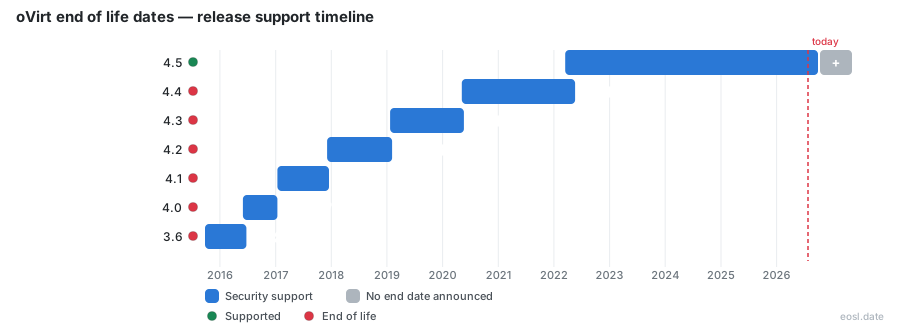
Currently Supported oVirt Releases - Active EOS/EOSL Support (1)
| Release | Released | Security Support | Latest |
|---|---|---|---|
| 4.5 | (4 years and 8 months ago) | Active | 4.5.7 (11 months ago) |
oVirt End of Life (EOL) Releases - No Longer Supported (6)
| Release | Released | Security Support | Latest |
|---|---|---|---|
| 4.4 | (6 years and 6 months ago) | (4 years and 6 months ago) | 4.4.10.7 (4 years and 8 months ago) |
| 4.3 | (7 years and 9 months ago) | (6 years and 6 months ago) | 4.3.11.4 (6 years and 3 months ago) |
| 4.2 | (8 years and 11 months ago) | (7 years and 9 months ago) | 4.2.8.9 (7 years and 1 month ago) |
| 4.1 | (9 years and 10 months ago) | (8 years and 11 months ago) | 4.1.11.2 (8 years and 7 months ago) |
| 4.0 | (10 years and 5 months ago) | (9 years and 10 months ago) | 4.0.7.5 (9 years and 5 months ago) |
| 3.6 | (11 years and 1 month ago) | (10 years and 4 months ago) | 3.6.13.5 (8 years and 5 months ago) |
If you run workloads on oVirt, the question behind oVirt End of Life is simple: when does coverage stop for this open-source virtualization platform? The community project has no announced end date, but the commercial Red Hat Virtualization product built on it reached the end of its Red Hat support policy in August 2026. Here is how both timelines work, so you can plan your next move.
Is There an oVirt End of Life Date?
No. oVirt is the upstream community project behind Red Hat Virtualization, and in February 2022 the project stated that although there will be an end of life for RHV, there is no planned end of life for oVirt itself, which remains a community project. The software provides centralized virtualization management: a hosted hypervisor setup in which an Engine controls hosts that run Linux and Windows virtual machines.
That does not mean every build is safe to keep. Community fixes land only in the newest series, so the practical risk is falling behind on your release rather than the whole project disappearing.
oVirt Versions and Security Support Dates
The table below shows when security support ended for each earlier series, according to the endoflife.date tracker (last updated May 2026). Only 4.5 remains a supported release.
| oVirt versions | Released | Fixes ended | Latest build |
|---|---|---|---|
| 4.5 | 16 Mar 2022 | Still active | 4.5.7 |
| 4.4 | 6 May 2020 | 20 May 2022 | 4.4.10.7 |
| 4.3 | 22 Jan 2019 | 20 May 2020 | 4.3.11.4 |
| 4.2 | 4 Dec 2017 | 4 Feb 2019 | 4.2.8.9 |
The tracker also publishes a JSON endpoint through its API, an RSS feed and an iCalendar feed, so you can be alerted before your series falls out of support.
Latest Release: oVirt 4.5.7
The latest release, 4.5.7, became generally available in January 2026. Its engine and hosts run on Red Hat Enterprise Linux 9 or 10 and CentOS Stream 9 or 10. New features include a fix for CVE-2024-7259, newer hardware and CPU definitions, Windows 2025 in the operating system list and a cluster level 4.8 default. All Java code is now built on Java 21, and the project dropped Ceph and some packages on CentOS 10. These enhancements arrive through GitHub-hosted development, and the Manager is updated like any other package.
Red Hat Virtualization Life Cycle Dates
Red Hat Virtualization pairs the Manager with a KVM-based hypervisor, and Red Hat sells it to customers under a subscription. Red Hat offers five years of production support per major release, then two years of an extended phase; 4.4 was the final series of Red Hat Virtualization. For the 4.4 series, the Red Hat policy lists Sep 1, 2024 to Aug 31, 2026 as that final phase, so the life cycle dates for RHV have now passed.
Full Support and Maintenance Phases
During full support, you receive security advisories, urgent bug fix releases and hardware enablement. Under maintenance support, critical security advisories continue and a hotfix may be issued for serious problems, but no new features arrive. Technical support remains unlimited in both phases, depending on your subscription level.
The Extended Life Phase and Extended Updates
Extended Update Support adds one year for eligible Red Hat Virtualization 4.2 and later hypervisors. In the extended life phase, Red Hat provides no bug fixes or security errata advisories, only limited technical help on existing installs, plus access to documentation and the Red Hat Knowledgebase.
RHV Upgrade Policy and Migration Path
Red Hat supports an upgrade policy that moves from the latest minor release of one series to the next major release, for example 3.6.11 to 4.0. It does not support skipping steps or upgrading from upstream builds. Each Manager release also supports a range of cluster level and compatibility level values, so an old cluster must be raised before its hosts are replaced, because a Red Hat Virtualization Manager cannot manage a cluster whose level exceeds its oldest host. Red Hat recommends tested configurations from its package manifest for live environments, and a supported upgrade path covers hypervisors only within the same major release. Moving between majors is a migration path at Red Hat's discretion.
Moving to Red Hat OpenShift Virtualization
Red Hat names OpenShift Virtualization as the successor for KVM-based workloads managed by RHV, converging virtual machines and containers on one platform. If you are migrating from Red Hat Virtualization, plan inventory, storage and network mapping before your Red Hat contract lapses.
Install and Upgrade Notes for RHV and oVirt Hosts
Because CentOS Stream 8 reached end of life on May 31, 2024, oVirt no longer supports it or its derivatives. In practice, the end-of-life date of your host operating system sets how long an install stays usable. For installs on RHEL or similar systems, read the project's RHEL guidance first and use release 10.0-4 or newer of centos-release45. The project also urges oVirt Node users to move to another deployment method, and it advises against running master snapshots in production. Check the release notes before every upgrade.