Kyverno End of Life (EOL) Dates and End of Support (EOS) Dates
Kyverno end of life (EOL) and end of support (EOS) dates: 12 Kyverno versions have reached EOL, including Kyverno 1.19 (EOL date: Nov 11, 2026) — no longer receiving security updates or patches. Kyverno 1.20.0 is the current supported release. Also see Argo Workflows EOSL dates for related end-of-life information.
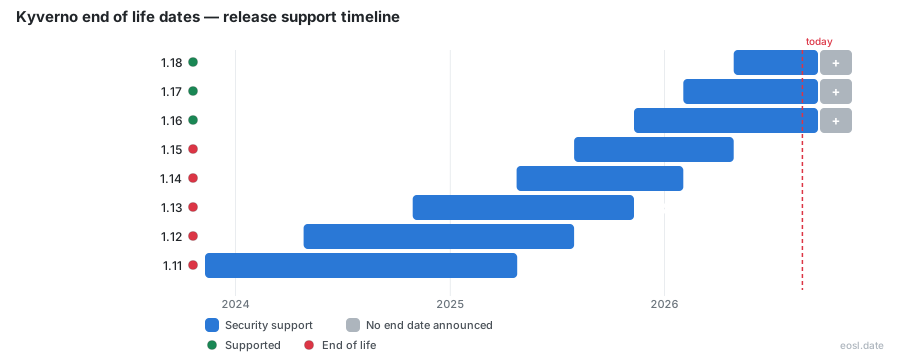
Currently Supported Kyverno Releases - Active EOS/EOSL Support (1)
| Release | Supported K8S Versions | Released | Support | Latest |
|---|---|---|---|---|
| 1.20 | 1.34 - 1.37 | (1 week and 3 days ago) | Active | 1.20.0 (1 week and 3 days ago) |
Kyverno End of Life (EOL) Releases - No Longer Supported (12)
| Release | Supported K8S Versions | Released | Support | Latest |
|---|---|---|---|---|
| 1.19 | 1.33 - 1.35 | (3 months ago) | (1 week and 3 days ago) | 1.19.2 (1 month ago) |
| 1.18 | 1.33 - 1.35 | (6 months ago) | (3 months ago) | 1.18.2 (4 months ago) |
| 1.17 | 1.32 - 1.35 | (9 months ago) | (6 months ago) | 1.17.2 (6 months ago) |
| 1.16 | 1.31 - 1.34 | (1 year ago) | (6 months ago) | 1.16.4 (6 months ago) |
| 1.15 | 1.30 - 1.33 | (1 year and 3 months ago) | (6 months ago) | 1.15.20 (1 year ago) |
| 1.14 | 1.29 - 1.32 | (1 year and 6 months ago) | (9 months ago) | 1.14.5 (1 year ago) |
| 1.13 | 1.28 - 1.31 | (2 years ago) | (1 year ago) | 1.13.6 (1 year and 6 months ago) |
| 1.12 | 1.26 - 1.29 | (2 years and 6 months ago) | (1 year and 3 months ago) | 1.12.7 (1 year and 10 months ago) |
| 1.11 | 1.25 - 1.28 | (3 years ago) | (1 year and 6 months ago) | 1.11.5 (2 years and 6 months ago) |
| 1.10 | 1.24 - 1.26 | (3 years and 5 months ago) | (2 years ago) | 1.10.7 (2 years and 11 months ago) |
| 1.9 | 1.24 - 1.26 | (3 years and 9 months ago) | (2 years and 6 months ago) | 1.9.5 (3 years and 5 months ago) |
| 1.8 | 1.23.3 - 1.25 | (4 years and 1 month ago) | (3 years ago) | 1.8.5 (3 years and 11 months ago) |
Running an old build of a policy engine in production is a risk, so check Kyverno end of life before your next audit. Kyverno guards your Kubernetes cluster, and each minor release gets only a short window of fixes before a newer version replaces it. A major release is rare, so the quarterly cadence is what drives your planning.
Kyverno End of Life Status and the Latest Version
As of 27 October 2026, the latest version is 1.19, first released on 20 August 2026, with patch 1.19.2 shipped on 21 October 2026. It is the only supported release listed by the project as current, and the docs give an estimated end of life of the v1.20 release, expected around November 2026.
Unlike many commercial products, Kyverno publishes no fixed EOL calendar and has no LTS track. There is no long-term support line to fall back on, so a version is retired once newer minors arrive. Third-party trackers describe this as a "latest version" model, and the end-of-life date for any line is only known in hindsight. Treat the retirement date as a moving target on GitHub, not a contract with a vendor.
Kyverno Community Patch Support Explained
The project offers roughly three months of community patch support per release. That support policy is deliberately narrow: only fixes for critical bugs and critical-to-high CVE entries qualify, so a medium or low severity issue waits for the next minor line.
- Each patch lands on
mainfirst, then is cherry-picked to the release branch such asrelease-1.19. - Routine bug fixes and small enhancements stay in the next minor version.
- Open vulnerabilities in a retired line stay unfixed, which matters for your security posture.
Supported Kyverno Versions, Kubernetes Versions and the Release Cycle
Kyverno releases follow a fixed rhythm, and the table below follows the release cycle as published by endoflife.date. A line is retired when the third newer minor ships, so the support schedule is predictable even without announced dates. Use it as a quick version history check against what your cluster runs.
| Release | Release date | Kubernetes versions | Support status | Latest patch |
|---|---|---|---|---|
| 1.19 | 20 Aug 2026 | 1.33 - 1.35 | Supported | 1.19.2 |
| 1.18 | 29 Apr 2026 | 1.33 - 1.35 | Supported | 1.18.2 |
| 1.17 | 2 Feb 2026 | 1.32 - 1.35 | Supported | 1.17.2 |
| 1.16 | 10 Nov 2025 | 1.31 - 1.34 | Ended 20 Aug 2026 | 1.16.4 |
| 1.15 | 31 Jul 2025 | 1.30 - 1.33 | Ended 29 Apr 2026 | 1.15.20 |
This life cycle view also shows which Kubernetes range each line was tested against. The code carries an Apache License, and the project is a graduated CNCF project.
Kyverno Release Management and Semantic Versioning
Kyverno follows semantic versioning, written MAJOR.MINOR.PATCH. The team handles release management with GitHub tags of the form v<major>.<minor>.<patch>, and each candidate goes through release candidates before the final tag. Ongoing maintenance follows the same flow.
Major Release, Minor Release and Patch Release Rules
A major version changes architecture and may break APIs, so it appears about once a year at most. Minor releases arrive roughly every three months with backward-compatible features. Each patch release carries only critical fixes, and patch releases come about monthly when needed.
Release Planning on the Release Branch
Non-critical issues go to the next minor milestone by default, while critical issues with no workaround go into the next patch. This release planning keeps every old line stable but frozen.
Upgrade Planning Across the Kyverno Life Cycle
Plan your upgrade before your line drops out of the table, not after. Move one minor version at a time, confirm compatibility with your Kubernetes control plane, and test in staging before touching production. A policy set that works today may need edits, because each new line reshapes the lifecycle of older policy types.
Breaking Changes and Deprecation Schedule
Read the breaking changes list on every minor release. The 1.17 post sets a deprecation timeline that retires legacy APIs in favor of newer policy types, and the 1.10 release notes show how a single minor can alter generate behavior.
Migration Tips and Backward Compatibility
For a safe migration, convert one ClusterPolicy at a time from JMESPath to CEL and keep both running side by side. This preserves backward compatibility while you validate results. These migration tips reduce the chance of a blocked deploy.
Lifecycle Highlights from Recent Release Notes
The release notes show where support effort is going. Version 1.17 promoted CEL policy types to GA, which marks the API as stable after a beta in 1.16. It also added namespaced MutatingPolicy and GeneratingPolicy types, giving tenants their own rules.
- ValidatingPolicy, MutatingPolicy and GeneratingPolicy now cover most policy as code needs.
- The admission controller handles each webhook request and admission decision.
- Cosign support and supply chain security features extend image checks.
The roadmap favors CEL, which suggests older engine paths will be the first to lose attention. Platform teams that rely on governance reviews should read the release dates beside each minor, and platform engineers should track the CNCF project page as well.