VMware Harbor Registry End of Life (EOL) Dates and End of Support (EOS) Dates
VMware Harbor Registry end of life (EOL) and end of support (EOS) dates: 13 VMware Harbor Registry versions have reached EOL, including VMware Harbor Registry 2.10 (EOL date: Jan 31, 2025) — no longer receiving security updates or patches. Also see Envoy end of life dates for related end-of-life information.
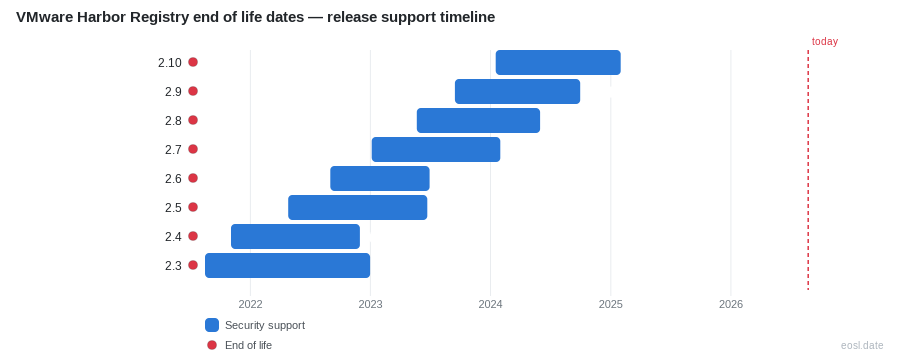
VMware Harbor Registry End of Life (EOL) Releases - No Longer Supported (13)
| Release | Released | End of general support | Latest |
|---|---|---|---|
| 2.10 | (2 years and 10 months ago) | (1 year and 9 months ago) | 2.10.2 (2 years and 7 months ago) |
| 2.9 | (3 years and 2 months ago) | (2 years and 1 month ago) | 2.9.1 (2 years and 11 months ago) |
| 2.8 | (3 years and 6 months ago) | (2 years and 5 months ago) | 2.8.4 (3 years and 2 months ago) |
| 2.7 | (3 years and 10 months ago) | (2 years and 9 months ago) | 2.7.4 (2 years and 11 months ago) |
| 2.6 | (4 years and 2 months ago) | (3 years and 4 months ago) | 2.6.4 (3 years and 8 months ago) |
| 2.5 | (4 years and 6 months ago) | (3 years and 4 months ago) | 2.5.5 (3 years and 9 months ago) |
| 2.4 | (5 years ago) | (3 years and 11 months ago) | 2.4.3 (4 years and 3 months ago) |
| 2.3 | (5 years and 3 months ago) | (3 years and 10 months ago) | 2.3.5 (4 years and 11 months ago) |
| 2.2 | (5 years and 7 months ago) | (4 years and 6 months ago) | 2.2.3 (5 years and 4 months ago) |
| 2.1 | (6 years ago) | (4 years and 4 months ago) | 2.1.6 (5 years and 4 months ago) |
| 2.0 | (6 years and 4 months ago) | (4 years and 8 months ago) | 2.0.6 (5 years and 8 months ago) |
| 1.10 | (6 years and 11 months ago) | (5 years and 5 months ago) | 1.10.3 (6 years and 5 months ago) |
| 1.9 | (7 years ago) | (5 years and 10 months ago) | 1.9.4 (6 years and 10 months ago) |
Planning around VMware Harbor Registry end of life starts with knowing which release you run and who still supports it. The VMware Harbor Registry tile packages Harbor, a container registry for storing images, for Tanzu Kubernetes Grid Integrated Edition, and each version stops receiving fixes on a schedule. Here are the Harbor dates, notes and next steps you need.
VMware Harbor Registry End of Life and End of General Support Dates
The enterprise Harbor Registry is a Broadcom product, and the endoflife.date tracker gives every major version its own end of general support date. Each major line is maintained for roughly one year, and the VMware Harbor Registry tile follows the same pattern for every version. The newest Harbor row the tracker lists is 2.10. Use the release date and patch columns to see how long each Harbor line lasted; after its last day a line gets no routine security fixes.
| Release | Released | Support ended | Latest patch |
|---|---|---|---|
| 2.10 | 17 Jan 2024 | 31 Jan 2025 | 2.10.2 |
| 2.9 | 15 Sep 2023 | 30 Sep 2024 | 2.9.1 |
| 2.8 | 22 May 2023 | 31 May 2024 | 2.8.4 |
| 2.7 | 5 Jan 2023 | 31 Jan 2024 | 2.7.4 |
That data stops at 2.10, yet the VMware Harbor Registry tile release notes show v2.15.x builds shipping through October 2026. Both are true: the tracker was last updated on 27 July 2026, while the tile release notes follow current builds. Check your exact version with Broadcom before relying on either source.
Enterprise Edition Versus the Open-Source Registry
Keep the two tracks apart. Open source Harbor, which installs on Kubernetes or any system with Docker support, stores images and OCI artifacts. It is a CNCF graduated project with community backing, and its latest three minor releases receive critical fixes, each lasting about nine months. The VMware Harbor Registry tile follows the vendor's schedule instead. The open-source registry publishes no fixed end-of-life dates, so teams on it watch each release for the supported window.
Harbor Upgrade Policy and Minor Release Support
The Harbor upgrade policy allows moves only from the previous two minor releases. Because every VMware Harbor Registry tile builds on this Harbor policy, a skipped minor release can block the whole path. The tile also needs matching Docker and BOSH components, so read each release before you plan the change.
How the n-2 Rule Limits Upgrades
Under the n-2 rule, moving from 2.12 to 2.14 is supported, while moving from 2.11 to 2.14 is not. Stage an intermediate Harbor release first, then move the stored artifacts and Harbor settings forward. The latest release number shows what to target.
Release Notes for Every Supported Release of the Tile
Each VMware Harbor Registry tile for TKGI has its own Harbor release notes with a snapshot, new features and enhancements. A few older ones also list deprecations. TKGI owners should read the VMware Harbor Registry tile notes for the release they run, then compare the next one.
Release Snapshot for v2.15.6
The release snapshot for the VMware Harbor Registry tile v2.15.6 carries a release date of October 20, 2026. It lists compatible Tanzu Operations Manager versions v3.1.x to v3.3.x and v11.0.x, TKGI v1.25.x to v1.27.x, BOSH stemcell 1.1364, and upgrade paths from v2.15.x, v2.14.x and v2.13.x.
New Features and Enhancements in v2.15.x
Recent VMware Harbor Registry tile releases in the 2.15 line list no new features. Their enhancements are component updates that address each CVE, and security fixes listed on a separate page. That is typical of a mature Harbor line: it is patched for security and compliance, not extended.
Release Snapshot for v2.14.3
The release snapshot for the VMware Harbor Registry tile v2.14.3 lists upgrade paths from v2.14.x and v2.13.x, Tanzu Operations Manager v3.1.x and v3.2.x, TKGI v1.23.x and v1.24.x, and a BOSH stemcell range of 1.954 to 1.1065. Older Harbor snapshots show a narrower compatibility.
New Features and Enhancements in v2.14.x
The v2.14 line added new features and enhancements such as a setting to restrict TLS to strong ciphers. It also fixed Trivy database options in air-gapped use. Open-source Harbor covers cosign signature handling, replication and role-based access control, while the tile adds the Harbor platform packaging.
Resolved Issues and Known Issues Across the Harbor Lifecycle
The VMware Harbor Registry tile notes keep known issues and resolved issues in one table. Open defects stay open once a line is retired, so these entries feed your end-of-life decision. Resolved issues in v2.15.4 and v2.15.6 include a job service that failed to start, which blocked garbage collection, and credentials that fell out of sync between Harbor core and the registry. A security scanner finding about weak ciphers was resolved in v2.14.2. Each release lists the fix.
TLS and LDAP Problems That Remain Unresolved
Three items were still unresolved in the VMware Harbor Registry tile notes: SBOM generation fails behind an external proxy, LDAP handshakes fail against servers using legacy TLS_RSA ciphers, and legacy cosign replication keeps one signature per artifact. A workaround exists for the handshake failure: set GODEBUG="tlsrsakex=1" in the core env file and restart Harbor. Expect no fix once the line retires; each vulnerability or defect that stays open adds to your case for moving.
Air-Gapped Harbor Deployment with Supervisor Service
In a private cloud on VMware Cloud Foundation, Harbor can run as a Supervisor Service, and this Harbor deployment path suits regulated sites. Air-gapped environments face a bootstrap problem: the registry needs container images, but no registry exists to supply them. The VMware Harbor Registry tile does not solve this; the bootstrap approach below does.
Bootstrap Registry Appliance for VCF 9.0
For VCF 9.0 air-gapped environments, deploy the VMware Bootstrap Registry Appliance OVA from the support portal. It hosts only the OCI images needed for the Contour and Harbor deployment, and it is not a permanent registry. From VCF 9.1, the Fleet Depot Service replaces that bootstrap registry for day-two work.
Harbor Supervisor Service as the Production Registry
Once the bootstrap registry holds the container images, install the Harbor Supervisor Service. It then becomes the production registry for the infrastructure, with enterprise backing and vSphere namespaces. A VMware Harbor Registry tile estate on TKGI cannot take over this role, so plan a separate migration.
Harbor Upgrade Paths and Security Fixes for Planning
Work backward from the upgrade paths. A VMware Harbor Registry tile release accepts moves only from specific earlier lines, so a tile that has aged out can need two hops. Apply the security fixes from each hop, because an unsupported build collects vulnerabilities with no patch.
What to Do Before a Release Stops Receiving Fixes
- Record your tile version, TKGI version and stemcell.
- Find the next release that lists your version as an upgrade source.
- Read its notes, then schedule the change window.