Argo Workflows End of Life (EOL) Dates and End of Support (EOS) Dates
Argo Workflows end of life (EOL) and end of support (EOS) dates: 5 Argo Workflows versions have reached EOL, including Argo Workflows 3.7 (EOL date: Aug 14, 2026) — no longer receiving security updates or patches. Argo Workflows 4.1.6 is the current supported release — 2 versions in active support. Also see Argo CD end of support life for related end-of-life information.
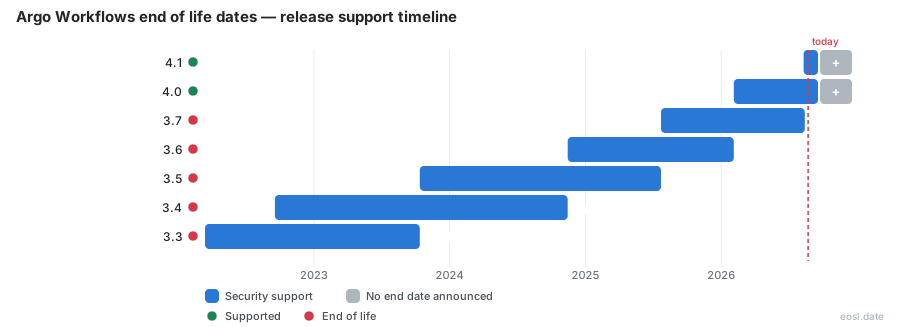
Currently Supported Argo Workflows Releases - Active EOS/EOSL Support (2)
Argo Workflows End of Life (EOL) Releases - No Longer Supported (5)
| Release | Released | Supported | Latest |
|---|---|---|---|
| 3.7 | (1 year and 3 months ago) | (3 months ago) | 3.7.18 (3 months ago) |
| 3.6 | (2 years ago) | (9 months ago) | 3.6.19 (9 months ago) |
| 3.5 | (3 years and 1 month ago) | (1 year and 3 months ago) | 3.5.15 (1 year and 5 months ago) |
| 3.4 | (4 years and 2 months ago) | (2 years ago) | 3.4.18 (2 years and 1 month ago) |
| 3.3 | (4 years and 8 months ago) | (3 years and 1 month ago) | 3.3.10 (3 years and 11 months ago) |
If you run Argo Workflows in production, the Argo Workflows end of life schedule tells you how long each release keeps receiving fixes. This open-source, container-native workflow engine for orchestrating parallel jobs on Kubernetes maintains only its two newest minor lines, so 3.7 and everything older no longer get patches. Every workflow and container you run should now sit on 4.0 or 4.1.
Argo Workflows End of Life Status Today
As of 23 October 2026, two lines are supported on Kubernetes: 4.1 (newest build 4.1.6) and 4.0 (newest build 4.0.15). Release 3.7 ended on 14 August 2026, once 4.1 shipped.
The Argo Workflows end of life picture is therefore simple: if argo version prints anything below 4.0, you are running unsupported software. Argo Workflows versions are easy to track through the GitHub releases page, the endoflife.date JSON API, its RSS feed or its iCalendar feed, so a reminder can land before your line drops out. The project is part of the CNCF ecosystem.
Supported Versions and Their End Dates
The table shows each minor line, its first release and when support stopped. The supported versions are always the two newest.
| Version | Released | Status | Latest patch |
|---|---|---|---|
| 4.1 | 11 Aug 2026 | Supported | 4.1.6 |
| 4.0 | 4 Feb 2026 | Supported | 4.0.15 |
| 3.7 | 23 Jul 2025 | Ended 14 Aug 2026 | 3.7.18 |
| 3.6 | 14 Nov 2024 | Ended 4 Feb 2026 | 3.6.19 |
| 3.5 | 13 Oct 2023 | Ended 23 Jul 2025 | 3.5.15 |
| 3.4 | 18 Sep 2022 | Ended 14 Nov 2024 | 3.4.18 |
| 3.3 | 14 Mar 2022 | Ended 13 Oct 2023 | 3.3.10 |
Only two release branches are maintained, and the stable choice is the newest patch of a supported line.
How the Release Cycle Works
The release cycle is predictable: a new minor line roughly every six months, with patches about every two weeks.
Minor Version and Patch Version Rules
A minor version such as 4.1 can change behavior, while a patch version such as 4.1.6 carries only bug fixes and minor features. Always install the latest patch of your line.
Release Candidates and General Availability
Release candidates appear four to six weeks before general availability. A feature added in a later candidate gets at least one week of testing, and if bugs remain it is rolled back and a new candidate ships.
Semantic Versioning and Breaking Changes
The project borrows semantic versioning terms but does not follow them strictly, so a minor line may break existing behavior. Breaking changes are listed in the upgrading guide, which you should read before every move.
Choosing a Supported Release for Your Cluster
Pick a supported release and plan the move early. Fixes are backported to release branches only when severity, risk and feasibility allow, so a bug fixed today may never reach an older line.
Version Skew Between Controller and CLI
The argo-server and argocli must run the same version as the controller. Upgrade all three together, or commands may call an API the older component does not understand.
Kubernetes Versions and Compatibility
Each release is tested against only two Kubernetes minor versions, yet Kubernetes stays backward compatible with clients, so newer ones usually work. Argo relies on stable APIs such as pods and ConfigMaps, so recheck RBAC rules and each namespace after an upgrade, and read the tested versions in the docs for your release.
Upgrading Your Workflow Engine Before Support Ends
An ended release gets no fixes for security flaws or vulnerabilities in the Docker images your steps pull. Teams running CI/CD pipelines, machine learning jobs and data processing on Kubernetes feel this first, because a CronWorkflow keeps firing every week with nobody watching.
- Export each workflow template and CronWorkflow as a custom resource and apply it to a test environment with the new CRD.
- Confirm every DAG still resolves its dependencies, then rebuild each Docker image and push it to your Docker registry.
- Deploy the upgraded components together, then deploy one sample workflow end to end and watch its Docker steps finish.
- Wire the release feed into your DevOps or GitOps alerts so the next cloud migration is planned, not rushed,.