KEDA End of Life (EOL) Dates and End of Support (EOS) Dates
KEDA end of life (EOL) and end of support (EOS) dates: 21 KEDA versions have reached EOL, including KEDA 2.19 (EOL date: Sep 23, 2026) — no longer receiving security updates or patches. KEDA 2.21.1 is the current supported release — 2 versions in active support. Also see Contour EOSL dates for related end-of-life information.
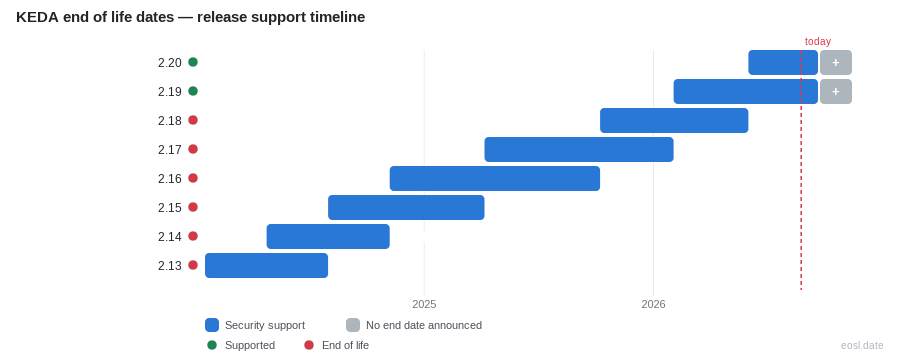
Currently Supported KEDA Releases - Active EOS/EOSL Support (2)
KEDA End of Life (EOL) Releases - No Longer Supported (21)
| Release | Supported Kubernetes Versions | Released | Support | Latest |
|---|---|---|---|---|
| 2.19 | 1.32 - 1.34 | (9 months ago) | (2 months ago) | 2.19.0 (9 months ago) |
| 2.18 | 1.31 - 1.33 | (1 year and 1 month ago) | (5 months ago) | 2.18.3 (11 months ago) |
| 2.17 | 1.30 - 1.32 | (1 year and 7 months ago) | (9 months ago) | 2.17.3 (11 months ago) |
| 2.16 | 1.29 - 1.31 | (2 years ago) | (1 year and 1 month ago) | 2.16.1 (1 year and 11 months ago) |
| 2.15 | 1.28 - 1.30 | (2 years and 3 months ago) | (1 year and 7 months ago) | 2.15.1 (2 years and 3 months ago) |
| 2.14 | 1.27 - 1.29 | (2 years and 6 months ago) | (2 years ago) | 2.14.1 (2 years and 3 months ago) |
| 2.13 | 1.27 - 1.29 | (2 years and 10 months ago) | (2 years and 3 months ago) | 2.13.1 (2 years and 8 months ago) |
| 2.12 | 1.26 - 1.28 | (3 years and 1 month ago) | (2 years and 6 months ago) | 2.12.1 (2 years and 11 months ago) |
| 2.11 | 1.25 - 1.27 | (3 years and 5 months ago) | (2 years and 10 months ago) | 2.11.2 (3 years and 3 months ago) |
| 2.10 | 1.24 - 1.26 | (3 years and 8 months ago) | (3 years and 1 month ago) | 2.10.1 (3 years and 7 months ago) |
| 2.9 | 1.23 - 1.25 | (3 years and 11 months ago) | (3 years and 5 months ago) | 2.9.3 (3 years and 9 months ago) |
| 2.8 | 1.17 - 1.25 | (4 years and 3 months ago) | (3 years and 8 months ago) | 2.8.2 (3 years and 10 months ago) |
| 2.7 | 1.17 - 1.25 | (4 years and 6 months ago) | (3 years and 11 months ago) | 2.7.1 (4 years and 6 months ago) |
| 2.6 | 1.17 - 1.25 | (4 years and 9 months ago) | (4 years and 3 months ago) | 2.6.1 (4 years and 9 months ago) |
| 2.5 | 1.17+ | (4 years and 11 months ago) | (4 years and 6 months ago) | 2.5.0 (4 years and 11 months ago) |
| 2.4 | 1.16+ | (5 years and 3 months ago) | (4 years and 9 months ago) | 2.4.0 (5 years and 3 months ago) |
| 2.3 | 1.16+ | (5 years and 5 months ago) | (4 years and 11 months ago) | 2.3.0 (5 years and 5 months ago) |
| 2.2 | 1.16+ | (5 years and 8 months ago) | (5 years and 3 months ago) | 2.2.0 (5 years and 8 months ago) |
| 2.1 | 1.16+ | (5 years and 9 months ago) | (5 years and 5 months ago) | 2.1.0 (5 years and 9 months ago) |
| 2.0 | 1.16+ | (6 years ago) | (5 years and 8 months ago) | 2.0.0 (6 years ago) |
| 1.5 | 1.13+ | (6 years and 4 months ago) | — | 1.5.0 (6 years and 4 months ago) |
KEDA end of life arrives one release at a time: the community supports only the newest minor versions of this event driven autoscaler for Kubernetes, and older ones are quietly marked deprecated. As of 27 October 2026, KEDA 2.21 and 2.20 are supported, while 2.19 and everything older are not. Here is how long each version lasts, which Kubernetes releases it pairs with, and how to move before support lapses for your events.
What KEDA End of Life Means for Your Cluster
KEDA scales any container in your Kubernetes cluster according to the number of events waiting to be processed, so autoscaling for your production workloads hangs on it. When a version reaches its end date, maintainers stop shipping fixes for it. The software keeps running, but you carry every new bug and risk yourself.
KEDA Lifecycle and Support Policy
A new minor release lands roughly every four months, and each one is usually supported for two release cycles before it ends.
Semantic Versioning and the Minor Version Cadence
KEDA follows semantic versioning: 2.21 is a minor version, while 2.21.1 would be a patch. Minor versions may carry breaking changes; patches carry fixes. The gaps between the last five minors ran from 114 to 184 days and averaged about 137, so "every four months" is a loose habit, not a calendar.
Community-Supported, Best-Effort Help
KEDA is an open-source project started by Microsoft and Red Hat. Because the community supports it on a best-effort basis, an ended version gets no paid backport or service level: you file bugs and feature requests on GitHub and the maintainers answer when they can.
Current KEDA Releases and Their Support Status
KEDA 2.21.0, published on 23 September 2026, is the newest release, and 2.20 still receives patches (2.20.2 arrived on 31 July 2026). Version 2.19 lost support on 23 September 2026, the day 2.21 shipped.
The Latest Release: KEDA 2.21
Moving to the newest supported release brings a ClickHouse scaler, a GCP Cloud Spanner scaler and an Azure Cosmos DB Change Feed scaler, plus OAuth2 client-credentials login for the Prometheus scaler and Kerberos credential-cache support for the Kafka scaler. Scalers for AWS services such as SQS carry on as before.
CNCF Graduation and the KEDA Lifecycle
As an open source, cloud native project with its own autoscaling roadmap, KEDA gets no support contract from graduation, so the end dates in the table below still govern.
How the CNCF Graduated KEDA
Graduated status does not extend any version's support window. KEDA was accepted into the CNCF on 12 March 2020, moved to incubating on 18 August 2021 and graduated on 22 August 2023.
Supported Kubernetes Versions for Each KEDA Release
Every minor version is tested against a window of three Kubernetes versions that slides forward with each release, so match your cluster before you pick a target.
| KEDA release | Released | Support ended | Days supported | Kubernetes versions |
|---|---|---|---|---|
| 2.21 | 23 Sep 2026 | Supported | 34 so far | 1.34 - 1.36 |
| 2.20 | 1 Jun 2026 | Supported | 148 so far | 1.33 - 1.35 |
| 2.19 | 2 Feb 2026 | 23 Sep 2026 | 233 | 1.32 - 1.34 |
| 2.18 | 8 Oct 2025 | 1 Jun 2026 | 236 | 1.31 - 1.33 |
| 2.17 | 7 Apr 2025 | 2 Feb 2026 | 301 | 1.30 - 1.32 |
| 2.16 | 7 Nov 2024 | 8 Oct 2025 | 335 | 1.29 - 1.31 |
The pattern is clear: support windows are shrinking, from 335 days for 2.16 to 233 for 2.19. Each version ends when the one two steps ahead ships, so with 2.22 estimated for the second week of January 2027, I expect 2.20 to end after about 224 days. That is my estimate, not an announced date.
Unsupported KEDA Versions and the Risks of Staying Put
A version is unsupported once it drops out of the table above. You get no new patches, no fixes when Kubernetes moves on, and no help beyond a GitHub thread. KEDA acts as a metrics server for the HPA, so a compatibility gap can quietly break event-driven autoscaling. Aim for a supported release at all times.
End-of-Life Risks for Scalers and Security Fixes
The sharpest risk is security: fixes ship only in supported lines, and every scaler you run widens the surface a flaw can reach.
CVE Exposure and Missing Security Fixes
KEDA 2.21 fixed CVE-2026-77524, a critical flaw in service account token audience enforcement. You are affected if you use Vault Kubernetes authentication or any TriggerAuthentication with boundServiceAccountToken. Teams parked on 2.19 cannot receive that fix without upgrading, which is the clearest case for leaving an unsupported line.
Deprecation Notice and Breaking Changes in KEDA 2.21
Three breaking changes ship in 2.21, and one scaler is on its way out. Read the upgrade guide before moving from 2.20.
Temporal and Azure Pipelines Scaler Changes
The Temporal scaler no longer accepts buildId, selectAllActive or selectUnversioned, so any ScaledObject or ScaledJob still carrying them fails metadata parsing. The Azure Pipelines scaler adds scaleOnInFlight, defaulting to true, so queue length now counts unfinished jobs already assigned to an agent. Set it to false to keep the 2.20 behavior.
The Deprecated Liiklus Scaler
The Liiklus scaler is deprecated because its upstream project is unmaintained, and its code is slated for removal in a later minor release, so an unsupported line will get no migration help. If a ScaledObject depends on that scaler, plan a switch to the Kafka scaler or your own external scaler now.
Upgrading KEDA Across Its Lifecycle: In-Place or Blue-Green
Upgrading is cheapest when it is routine, because production autoscaling should never depend on a version nobody tested. Choose the strategy by how much downtime your production cluster tolerates, and move one minor version at a time.
In-Place Upgrade With the Helm Chart
To move off an unsupported version, update the Helm chart or the KEDA operator inside the existing cluster. Since chart version 2.2.1 the CRDs are managed automatically, which can clash with older installs that handled them differently, so inspect your CRDs and any CRD edits first. Afterward, confirm the HPA objects KEDA creates (the Horizontal Pod Autoscaler) still scale pods up, and down to zero when idle: that is scale to zero working.
Blue-Green Upgrade for Production
Stand up a parallel KEDA instance on the new version in a staging namespace or separate cluster, validate it with real events, then switch over. An upgrade template that writes down each step and the rollback path cuts human error. Keep the old instance until the new one has survived a patch release.
Preflight and Postflight Checks
Before upgrading, look for outdated CRDs, missing prerequisites and trigger configurations the new version rejects. Afterward, confirm the operator and metrics server pods are healthy, the new CRDs are recognised and your workloads scale as expected.
Release Notes and Deprecation Signals Worth Watching
Most end-of-support surprises are announced well ahead, so read the notes for every minor version between yours and your target.
Release Notes and Changelog Review
Open the GitHub releases page and read three headings: breaking changes, deprecated features and new scalers. Then check the roadmap for the next date, estimated for the second week of January 2027. Look hardest at the scalers you depend on, whether that is RabbitMQ, an AWS queue, an Azure Monitor metric or a Prometheus query.
Next Steps When a Version Becomes Unsupported
- Find the version you run and compare it with the table above.
- Read the upgrade guide for each minor version you will cross.
- Upgrade a staging cluster first, then production.
Choosing a Supported Release Target on Kubernetes
Pick the newest version whose Kubernetes range includes your cluster: today that is 2.21 for 1.34 - 1.36 and 2.20 for 1.33 - 1.35. If you run Kubernetes 1.32, the matching 2.19 is already unsupported, so upgrade the cluster too. Rehearse the move where your KEDA end of life date is least painful, and let the operator image tag tell you where you stand.