Contour End of Life (EOL) Dates and End of Support (EOS) Dates
Contour end of life (EOL) and end of support (EOS) dates: 7 Contour versions have reached EOL, including Contour 1.30 (EOL date: Sep 08, 2025) — no longer receiving security updates or patches. Contour 1.33.8 is the current supported release — 3 versions in active support. Also see Argo CD EOSL information for related end-of-life information.
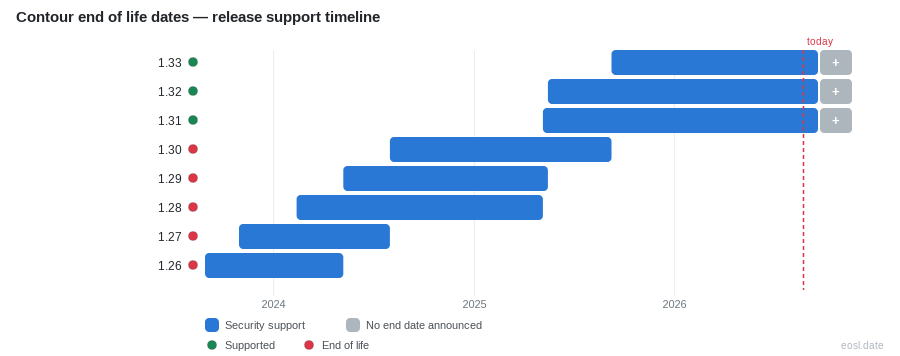
Currently Supported Contour Releases - Active EOS/EOSL Support (3)
Contour End of Life (EOL) Releases - No Longer Supported (7)
| Release | Released | Bug and Security Fixes | Latest |
|---|---|---|---|
| 1.30 | (2 years and 3 months ago) | (1 year and 2 months ago) | 1.30.5 (1 year and 3 months ago) |
| 1.29 | (2 years and 6 months ago) | (1 year and 6 months ago) | 1.29.5 (1 year and 7 months ago) |
| 1.28 | (2 years and 9 months ago) | (1 year and 6 months ago) | 1.28.8 (1 year and 10 months ago) |
| 1.27 | (3 years ago) | (2 years and 3 months ago) | 1.27.4 (2 years and 5 months ago) |
| 1.26 | (3 years and 2 months ago) | (2 years and 6 months ago) | 1.26.3 (2 years and 7 months ago) |
| 1.25 | (3 years and 6 months ago) | (2 years and 9 months ago) | 1.25.3 (3 years and 1 month ago) |
| 1.24 | (3 years and 9 months ago) | (3 years ago) | 1.24.6 (3 years and 1 month ago) |
If you searched Contour end of life, you probably mean one of two things: the Kubernetes ingress controller whose release stream keeps moving, or the trade finance network behind the headline Contour to shut down. This guide covers both, so you can see which software versions stay safe to run and what the platform's closure means for its former customers.
Contour End of Life and the Kubernetes Ingress Controller
Contour is an open source project in the CNCF family that deploys Envoy as a reverse proxy and load balancer. Its control plane pushes dynamic configuration updates to Envoy without restarts. For Contour, the end-of-life position is simple: only the newest minor line is patched, and no calendar says when that stops.
Contour Support Policy: Supported Releases and Security Fixes
The policy is blunt: the project keeps a single release track, and each new release arrives on-demand rather than on a fixed schedule. Once a new minor line ships, the previous one is no longer supported, so 1.34 would retire 1.33. Supported means the team patches critical bugs, and you must run the most recent patch release of the line to qualify. If 1.20.0 is current and 1.20.1 appears, only 1.20.1 is supported, so upgrade promptly.
Latest Version and the Latest Tag
The newest stable release carries the latest tag, so the docker tag :latest always points at the highest patch of the current line, 1.33 today. There is no long-term support track, which means there is no extended-maintenance flag to fall back on.
Contour Releases: EOL Dates and Compatibility Matrix
Trackers record every build. Contour EOL pages such as endoflife.date list the latest three minor lines as receiving fixes, while the project's own wording names only the current one; treat the stricter reading as your cutoff in production. They also publish a compatibility matrix for the proxy and cluster releases each line works with, a release date for each build, and feeds in JSON, RSS feed and iCalendar form, plus CPE and purl identifiers for scanners. One tracker counts 171 tagged builds, 23 of them unstable versions, all under the Apache License 2.0. Its FAQ confirms Contour publishes no end-of-life calendar, only the latest-line rule above. Following Contour releases through such feeds is the easiest way to track a lifecycle.
Semantic Versioning and Minor Version Cadence
Contour follows semantic versioning, and a new minor version lands about once a quarter. A cluster pinned to a line from two years ago therefore sits far outside any window, and your own plan needs a calendar slot every few months.
Contour Collapses: Digital Trade Network Closes
The other Contour collapses story concerns a platform owned by banks for documentary trade. Built on R3's Corda blockchain stack, it reached live production in October 2020. In a memo the group warned that operations will cease on November 30, 2023, so users had to migrate or finish outstanding transactions and download their data first. Before discontinuing operations it had signed partners such as Finastra, linked the legal entity identifier into its flows and planned tokenising trade assets. The consortium of banks wanted to join industry partners through shared technology, a clear step for digital documentary trade.
Bank Shareholders Pull Funding
Contour could not close a fresh funding round, because not every one of its bank shareholders would top up the pot and none would lead it. Its CEO said a crowd of investors without a lead made the round hard to run, and venture capital never followed. It counted nine bank investors, 22 bank members and corporates like Posco International, yet the banks behind it, among the biggest banks in the world, could not agree on paying for another two years.
Letters of Credit and Trade Finance Fallout
The service digitised the letter of credit, cutting processing from roughly ten days to under 24 hours in testing, so its end sends users back to paper-heavy workflows. Most banks have moved on, and the lesson for trade finance is that demand was never the problem; scale and interoperability across a fragmented industry were.
Marco Polo, TradeLens and we.trade
Contour joined a growing casualty list, and it had even bought the we.trade rulebook after that rival folded.
Upgrade or Migrate: Planning Around the Closure
| Which Contour | Status | Your move |
|---|---|---|
| Ingress software | Only the current line is maintained | Move to the newest patch |
| Trade network | Operations ended | Archive your records |
For the Contour software, check your running line against the policy and move to the newest patch before the current line is replaced. For the Contour network, which stopped operating after November 30, 2023, export every document you still need, because nothing stays online after a platform closes.