Podman End of Life (EOL) Dates and End of Support (EOS) Dates
Podman end of life (EOL) and end of support (EOS) dates: 26 Podman versions have reached EOL, including Podman 6.1 (EOL date: Nov 10, 2026) — no longer receiving security updates or patches. Podman 6.2.0 is the current supported release. Also see Contour end of support dates for related end-of-life information.
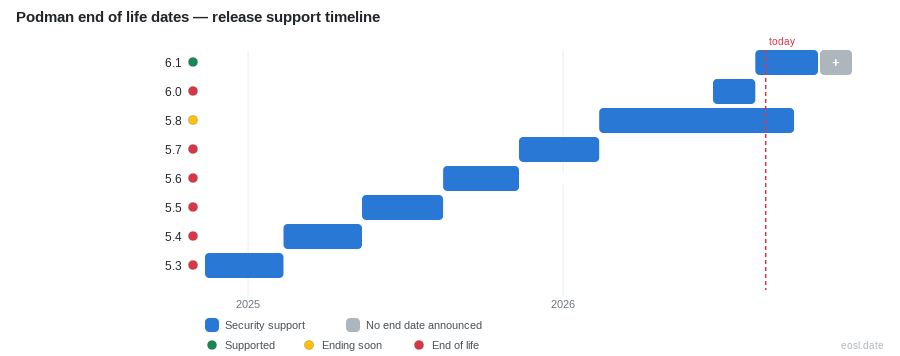
Currently Supported Podman Releases - Active EOS/EOSL Support (1)
| Release | Released | Security Support | Latest |
|---|---|---|---|
| 6.2 | (1 week and 6 days ago) | Active | 6.2.0 (1 week and 6 days ago) |
Podman End of Life (EOL) Releases - No Longer Supported (26)
| Release | Released | Security Support | Latest |
|---|---|---|---|
| 6.1 | (3 months ago) | (1 week and 6 days ago) | 6.1.4 (1 month and 1 week ago) |
| 6.0 | (4 months ago) | (3 months ago) | 6.0.2 (4 months ago) |
| 5.8 | (9 months ago) | (1 month and 4 weeks ago) | 5.8.10 (1 week and 6 days ago) |
| 5.7 | (1 year ago) | (9 months ago) | 5.7.1 (11 months ago) |
| 5.6 | (1 year and 3 months ago) | (1 year ago) | 5.6.2 (1 year and 1 month ago) |
| 5.5 | (1 year and 6 months ago) | (1 year and 3 months ago) | 5.5.2 (1 year and 4 months ago) |
| 5.4 | (1 year and 9 months ago) | (1 year and 6 months ago) | 5.4.2 (1 year and 7 months ago) |
| 5.3 | (2 years ago) | (1 year and 9 months ago) | 5.3.2 (1 year and 10 months ago) |
| 5.2 | (2 years and 3 months ago) | (2 years ago) | 5.2.5 (2 years and 1 month ago) |
| 5.1 | (2 years and 5 months ago) | (2 years and 3 months ago) | 5.1.2 (2 years and 4 months ago) |
| 5.0 | (2 years and 8 months ago) | (2 years and 5 months ago) | 5.0.3 (2 years and 6 months ago) |
| 4.9 | (2 years and 10 months ago) | (2 years and 5 months ago) | 4.9.5 (2 years and 5 months ago) |
| 4.8 | (2 years and 11 months ago) | (2 years and 10 months ago) | 4.8.3 (2 years and 10 months ago) |
| 4.7 | (3 years and 1 month ago) | (3 years ago) | 4.7.2 (3 years ago) |
| 4.6 | (3 years and 4 months ago) | (3 years and 2 months ago) | 4.6.2 (3 years and 2 months ago) |
| 4.5 | (3 years and 7 months ago) | (3 years and 5 months ago) | 4.5.1 (3 years and 5 months ago) |
| 4.4 | (3 years and 9 months ago) | (3 years and 7 months ago) | 4.4.4 (3 years and 7 months ago) |
| 4.3 | (4 years and 1 month ago) | (4 years ago) | 4.3.1 (4 years ago) |
| 4.2 | (4 years and 3 months ago) | (4 years and 2 months ago) | 4.2.1 (4 years and 2 months ago) |
| 4.1 | (4 years and 6 months ago) | (4 years and 5 months ago) | 4.1.1 (4 years and 5 months ago) |
| 4.0 | (4 years and 9 months ago) | (4 years and 7 months ago) | 4.0.3 (4 years and 7 months ago) |
| 3.4 | (5 years and 1 month ago) | (4 years and 7 months ago) | 3.4.7 (4 years and 7 months ago) |
| 3.3 | (5 years and 3 months ago) | (5 years and 2 months ago) | 3.3.1 (5 years and 2 months ago) |
| 3.2 | (5 years and 5 months ago) | (5 years and 4 months ago) | 3.2.3 (5 years and 4 months ago) |
| 3.1 | (5 years and 7 months ago) | (5 years and 7 months ago) | 3.1.2 (5 years and 7 months ago) |
| 3.0 | (5 years and 9 months ago) | (4 years and 6 months ago) | 3.0.2 (4 years and 6 months ago) |
Wondering about Podman end of life? This container software has no fixed EOL calendar, so the latest version is the only supported release you can count on for fixes.
Podman End of Life: Is There a Fixed Schedule?
Podman is an open source project run by its community, and it follows a latest-line model instead of a published calendar. When a newer line ships, the previous one is superseded and stops being the recommended choice, so you should upgrade promptly. That is a different rhythm from Docker, which sets its own engine schedule.
Podman Releases Without Fixed End-of-Life Dates
The community tracker notes that Podman Engine is maintained by the containers community, so there is no official list of maintained lines. Run one of the newest patch numbers shown for each line. The project joined the CNCF sandbox under the Linux Foundation in 2025, yet that move added no formal retirement date for the software.
Podman Releases: Version History and Latest Version
Podman 6 arrived on 24 June 2026, and its newest patch is 6.1.4 from 12 October 2026. Line 5 began on 19 March 2024 and sits at 5.8.9, while line 4 ended at 4.9.5 in May 2024. None of them carry LTS (long-term support) status, and the code is licensed under the Apache License 2.0. More than 200 published builds have been tied to a CVE, so staying current matters.
| Line | Release date | Security support | Newest patch |
|---|---|---|---|
| 6.1 | 12 Aug 2026 | Yes | 6.1.4 (12 Oct 2026) |
| 6.0 | 24 Jun 2026 | Ended 12 Aug 2026 | 6.0.2 (21 Jul 2026) |
| 5.8 | 12 Feb 2026 | Ended 26 Sep 2026 | 5.8.9 (12 Oct 2026) |
Patch Version and Minor Release Cadence
New minor lines land every few months: 5.8 shipped in February 2026 and 6.0 followed in June. Each patch carries a bug fix batch, and security coverage on a line ends when the next one supersedes it, as 5.8 shows. Always move to the newest patch of your line before hopping to the next.
Podman Desktop Life Cycle: Full Support and Maintenance Support
Red Hat publishes a formal life cycle for its Red Hat build of Podman Desktop. The Full Support phase runs about three months, until the following minor update ships. The Maintenance Support phase then lasts until the third superseding update, roughly three more months. Both phases deliver critical security advisories, and customers need an active subscription to receive them.
Security Support for Bundled Extensions
Extensions bundled with Red Hat's Podman Desktop receive security support only until the maintenance phase of the matching desktop build closes. Custom or third-party extensions fall outside that promise. Red Hat validates each platform and operating system on x86_64 and ARM64, so developers should read the release notes first.
Planning Around Podman EOL Dates for Older Releases
A line that is left behind keeps running but stops receiving fixes, so move to the newest one before your platform changes. On Linux, a package manager handles the upgrade; on Windows and macOS, containers run inside a virtual machine, so refresh that machine too. Red Hat's Podman Desktop covers both architectures, which helps mixed teams.
Checking Your Supported Release From the Command Line
Run podman --remote version --format '{{.Server.Version}}' and compare the answer with the table above. Because Podman offers a Docker-compatible interface, many teams set an alias such as docker=podman, so confirm the real binary rather than assume.
Podman Lifecycle Background: Daemonless OCI Container Engine
Podman is a daemonless container engine for OCI containers and container images, built on the libpod library. Unlike Docker, it leans on systemd instead of a background service, and it offers a REST API for remote tools. Red Hat created it, and the Apache License keeps it free to use.
Rootless Containers, Pods and Kubernetes
Rootless mode lets ordinary users run containers without administrator rights, using Linux namespaces. Podman groups containers into pods and manages volumes, which maps neatly onto Kubernetes. On macOS and Windows, a virtual machine does the heavy lifting.