Apache HBase End of Life (EOL) Dates and End of Support (EOS) Dates
Apache HBase end of life (EOL) and end of support (EOS) dates: 4 Apache HBase versions have reached EOL, including Apache HBase 1.7 (EOL date: Aug 09, 2022) — no longer receiving security updates or patches. Apache HBase 3.0.0 is the current supported release — 3 versions in active support. Also see Apache ActiveMQ Artemis end of support life for related end-of-life information.
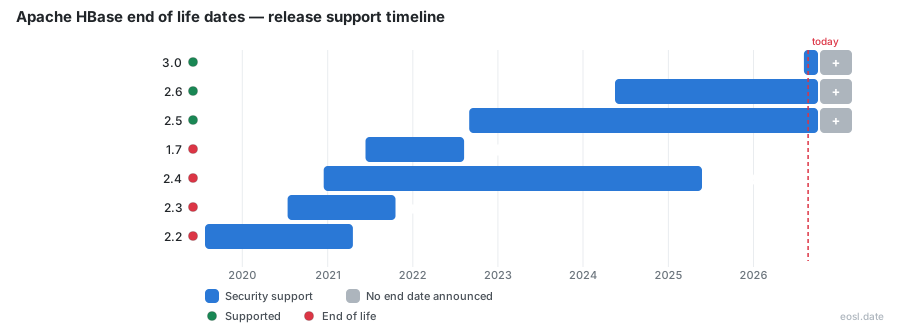
Currently Supported Apache HBase Releases - Active EOS/EOSL Support (3)
Apache HBase End of Life (EOL) Releases - No Longer Supported (4)
| Release | Released | Service Status | Latest |
|---|---|---|---|
| 1.7 | (5 years and 5 months ago) | (4 years and 3 months ago) | 1.7.2 (4 years and 3 months ago) |
| 2.4 | (5 years and 11 months ago) | (1 year and 5 months ago) | 2.4.18 (2 years and 5 months ago) |
| 2.3 | (6 years and 4 months ago) | (5 years and 1 month ago) | 2.3.7 (5 years and 1 month ago) |
| 2.2 | (7 years and 3 months ago) | (5 years and 7 months ago) | 2.2.7 (5 years and 7 months ago) |
Your Apache HBase end of life date depends on the release line you run, and only three lines of this open-source, Java-based database still receive upstream fixes: 3.0, 2.6 and 2.5. Below you will find every retirement date, what a retired line means for your production cluster, and how to plan an upgrade before the next release line ages out.
Apache HBase End of Life Dates for Every Release Line
Each release line moves from supported to retired on its own schedule, so check your exact version against the table first. The project publishes no retirement calendar in advance, and no releases are scheduled ahead of time.
| Release line | Released | Service status | Latest release |
|---|---|---|---|
| 3.0 | 5 Aug 2026 | Supported | 3.0.0 |
| 2.6 | 17 May 2024 | Supported | 2.6.7 |
| 2.5 | 31 Aug 2022 | Supported | 2.5.16 |
| 2.4 | 15 Dec 2020 | Ended 25 May 2025 | 2.4.18 |
| 2.3 | 13 Jul 2020 | Ended 19 Oct 2021 | 2.3.7 |
| 1.7 | 12 Jun 2021 | Ended 9 Aug 2022 | 1.7.2 |
| 2.2 | 25 Jul 2019 | Ended 19 Apr 2021 | 2.2.7 |
Latest Release and Service Status for HBase 3.0
The latest release is 3.0.0, published on 5 August 2026, and its service status is active, just like 2.6 and 2.5. As the newest stable release, 3.0 raises the runtime baseline, so reserve testing time before moving your database onto it.
HBase 2.4 and Older Versions Once Support Ends
When support ends for a line, maintainers stop shipping fixes, and the final patch becomes permanent. HBase 2.4 is the most recent line to retire, in May 2025, while 2.3, 1.7 and 2.2 retired earlier and are now frozen at 2.3.7, 1.7.2 and 2.2.7.
HBase Lifecycle and Release Timeline at a Glance
HBase began at Powerset, became a top-level project of the Apache Software Foundation in 2010, and is a non-relational distributed database modeled after Google's Bigtable. Every entry on the release timeline is a maintained line until its retirement, after which newer lines take over.
What Each Release Line Means for Your Data
As a wide-column store built for real-time reads and writes over big data, HBase holds tables with billions of rows and millions of columns on commodity hardware, stored in Hadoop's HDFS. That data survives a retirement untouched; what freezes is the code serving it, so a retired line keeps your stored data readable but stops improving how Hadoop-based workloads behave.
Community Release Managers and Upstream Support Policy
The project community assigns a volunteer release manager to every maintained line, and each one is a committer. If you need a fix in a specific line, raise it on the developer mailing list, because upstream support depends on those volunteers.
Release Manager Duties per Release Branch
A release manager owns one release branch. When a fix lands on master, committers mark every applicable fix version in JIRA and the manager backported the change to the lines it fits, while backward-incompatible features go only to master, which is why they first appear in 3.0. For example, Andrew Purtell managed 2.4 and 2.5, and Bryan Beaudreault manages 2.6.
Production Cluster Risks Without Extended Support
A retired line keeps running, but nothing new protects it. An enterprise cluster in production loses security fixes, bug fixes and compatibility work, so the exposure for your data grows every month, and a single RegionServer failure causes longer downtime when no maintainer remains to diagnose it.
Security Patches and CVE Fixes
After retirement, no new security patches or CVE fixes ship upstream. Any newly disclosed vulnerability stays open on your cluster, and a compliance review or an auditor will treat unsupported software as a gap, and compliance frameworks expect a documented answer about your data and its protection.
ZooKeeper, RegionServer and HMaster Dependencies
A distributed install depends on a ZooKeeper ensemble that every HMaster, RegionServer and client can reach. ZooKeeper should hold only transient state, so you can wipe it and let the cluster rebuild it. Use monitoring on ZooKeeper sessions, RegionServer heap and HMaster failover, plus monitoring alerts on stored data growth, since ZooKeeper timeouts quietly hurt performance. Teams using Phoenix for SQL also need a Phoenix build that matches the line.
JDK 17 and Java Runtime Changes
Starting with 3.0.0, HBase requires JDK 17, and support for JDK 8 and JDK 11 is dropped. Older lines still run on those runtimes, so moving to 3.0 also means upgrading your runtime. Pick a Hadoop release listed in the compatibility matrix before you switch.
Vendor Support for End-of-Life Apache HBase
If you cannot leave a retired line yet, vendor support can cover the gap with backported fixes, a documented audit trail and 24/7 operations, so you choose the upgrade date instead of the project.
Patched Builds and Signed Builds from Vendors
Some vendors publish patched builds of retired lines such as 2.4, 2.3, 1.7 and 2.2, plus signed builds that you can verify. This is a bridge, not a destination: the open source project itself still treats those lines as finished, and each patched line only has as much life as the vendor commits to.
Planning an Upgrade Before Support Ends
Treat an upgrade as a scheduled project with a deadline tied to your line's retirement, not as an emergency after a security notice.
Migration Lessons from Facebook's Messaging Platform
Facebook chose HBase for its messaging platform in November 2010 and moved off it in 2018, which shows that a migration can be planned on your own timeline when the data model and workload are understood.
Upgrade Checklist for Your Database Team
- Confirm your release line against the table and note its retirement date.
- Test the target line in staging, including your ZooKeeper settings and every RegionServer.
- Check the runtime and Hadoop compatibility before you plan the data move.
- Run the upgrade one cluster at a time and keep a rollback path.