Apache Flink End of Life (EOL) Dates and End of Support (EOS) Dates
Apache Flink end of life (EOL) and end of support (EOS) dates: 4 Apache Flink versions have reached EOL, including Apache Flink 2.0 (EOL date: Jun 25, 2026) — no longer receiving security updates or patches. Apache Flink 2.3.0 is the current supported release — 4 versions in active support. Also see Apache ActiveMQ Artemis end of support dates for related end-of-life information.
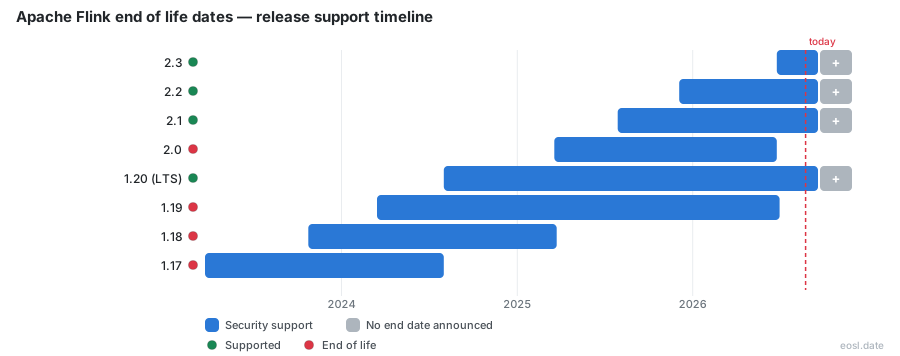
Currently Supported Apache Flink Releases - Active EOS/EOSL Support (4)
| Release | Recommended Java Version | Released | Security Support | Latest | LTS |
|---|---|---|---|---|---|
| 2.3 | 17 | (4 months ago) | Active | 2.3.0 (4 months ago) | - |
| 2.2 | 17 | (11 months ago) | Active | 2.2.1 (6 months ago) | - |
| 2.1 | 17 | (1 year and 3 months ago) | Active | 2.1.3 (5 months ago) | - |
| 1.20 (LTS) | 11 | (2 years and 3 months ago) | Active | 1.20.5 (5 months ago) | LTS |
Apache Flink End of Life (EOL) Releases - No Longer Supported (4)
| Release | Recommended Java Version | Released | Security Support | Latest | LTS |
|---|---|---|---|---|---|
| 2.0 | 17 | (1 year and 8 months ago) | (4 months ago) | 2.0.2 (6 months ago) | - |
| 1.19 | 11 | (2 years and 8 months ago) | (4 months ago) | 1.19.3 (1 year and 4 months ago) | - |
| 1.18 | 11 | (3 years ago) | (1 year and 7 months ago) | 1.18.1 (2 years and 10 months ago) | - |
| 1.17 | 11 | (3 years and 7 months ago) | (2 years and 3 months ago) | 1.17.2 (2 years and 11 months ago) | - |
Knowing Apache Flink end of life dates keeps your streaming jobs on patched code, yet the project does not publish a formal calendar. Apache Flink is a stream processing framework for real-time data, built for high throughput and low latency, and the community decides which lines still get fixes. This guide shows which lines are covered today, which are not, and how to plan your move.
Apache Flink End of Life: Which Release Is Supported
The table reflects the mid-July 2026 snapshot published by endoflife.date, which tracks each Apache Flink line against the project's download listing. The 2.x lines need a newer runtime than the 1.x lines, so check your Java version before you plan a change.
| Release | Java | Released | Security support |
|---|---|---|---|
| 2.3 | 17 | 25 Jun 2026 | Yes |
| 2.2 | 17 | 4 Dec 2025 | Yes |
| 2.1 | 17 | 29 Jul 2025 | Yes |
| 2.0 | 17 | 19 Mar 2025 | No (25 Jun 2026) |
| 1.20 LTS | 11 | 1 Aug 2024 | Yes |
| 1.19 | 11 | 15 Mar 2024 | No (1 Jul 2026) |
| 1.18 | 11 | 24 Oct 2023 | No (24 Mar 2025) |
| 1.17 | 11 | 23 Mar 2023 | No (1 Aug 2024) |
Two things stand out. The 2.0 line lost patches on 25 June 2026, the same day the newest line arrived, so teams that adopted 2.0 early already sit on an unmaintained branch. And 1.20 is the only 1.x line still covered, which makes it the natural resting place for jobs that cannot yet leave the older runtime.
LTS and Security Support in Flink 1.20
Flink 1.20 was the last minor release before 2.0, and its latest patch is 1.20.5, published in June 2026. Because the project treats it as the long-term branch, it is the safest landing spot while you prepare larger changes.
Flink EOL Dates and the Support Policy
The Apache Flink support policy is not formally defined. The working rule is simple: a line that no longer appears on the download page counts as no longer maintained, so you should run one of the lines shown above. As an open source project, Flink makes no contractual promises, and maintenance windows are inferred from publishing activity.
The community, meaning the PMC and its contributors, patches only the lines it still maintains, which today include 1.20 and the newer 2.x lines. Reported issues against an ended line usually receive the same answer: move to a current line.
Why Flink 1.19 and 1.18 Already Ended
Flink 1.19 shipped in March 2024 and lost patch coverage on 1 July 2026, while Flink 1.18 stopped receiving fixes in March 2025. A team still on either line is running code nobody maintains, even though the final patches, 1.19.3 and 1.18.1, remain downloadable from archives. Read the documentation for your own line before assuming any fix will be backported.
Deprecated Features Approaching End-of-Life
Maintainers deprecate individual features long before whole release lines do. The Flink roadmap includes a feature radar that tells you how mature each capability is, so you can judge whether to build on it.
- MVP: worth a look, but not yet something to depend on.
- Beta: useful, though you should evaluate it carefully.
- Ready and evolving: ready for production, with adjustments possible at later upgrades.
- Stable: unrestricted use in production.
- Approaching end-of-life: still usable, but a poor match for new long-lived projects.
- Deprecated: start looking for alternatives now.
Read the stages as a feature maturity ladder, not a calendar. The old SinkFunction interface is a concrete case: it is deprecated in 1.20, so pipelines on retired lines inherit the removal risk that Flink 2.0 brings to Flink users. A capability may sit on the deprecated rung for several minor lines before removal, and each change is tracked in a FLIP, the Flink Improvement Proposal that records the design and the decision.
Deprecated APIs Before the Flink 2.0 Release
Flink 1.19 began formally deprecating several APIs, and 1.20 sorted through everything else that had to be replaced before Flink 2.0 could arrive. Existing jobs feel two changes most: the retirement of the old SinkFunction interface and a long list of changed configuration options.
Several SQL items matter when you leave a retired line. That line introduced the materialized table in Flink SQL as an MVP feature, added catalog syntax for inspecting metadata, and extended the state TTL hints that arrived in 1.19, which let a query set its own state lifetime per join. Developers on the Table API, the DataStream API or a custom UDF should read each announcement for removals, and anyone using a Kafka connector should confirm it targets the current interfaces. Line 1.19 also added beta support for Java 21 and parallelism settings for a source, both worth testing early.
When you leave a retired line, Flink SQL carries the most visible changes. The SQL Gateway gained configurable runtime options, a SQL hint now sets state lifetime per query, and session window table-valued functions work in streaming mode, including over changelog data from CDC sources. Teams with long SQL scripts should migrate older window aggregations to the newer syntax, and anyone using a JDBC or Hive catalog should recheck its metadata calls. Release notes tie each of these to a FLIP: FLIP-435 defines the materialized table, FLIP-306 merges small checkpoint files into larger ones, FLIP-27 unified the source interface, FLIP-147 lets bounded programs finish with a final checkpoint, and FLIP-367 covers parallelism for table sources.
Legacy SinkFunction and the Unified Sink API
Since 1.12 the Unified Sink API has matured under the stability criteria of FLIP-197, so 1.20 promoted the v2 interface to public and deprecated the legacy SinkFunction. FLIP-191 describes the design. New work should target the v2 interface only.
Configuration Options and Standard YAML
1.19 made standard YAML the format for its configuration file, and 1.20 deprecated multiple configuration options while correcting their types. Review every configuration key for the JobManager and the TaskManager, plus the metrics and web UI settings, because an option marked for removal can disappear in the next major line. A configuration audit takes an afternoon; a failed restore takes far longer.
Migrate Off Deprecated Releases: Upgrade Steps
The safest migration path moves one line at a time and keeps your state intact. Start with your largest streaming pipeline, since it carries the most state and the tightest latency targets, then treat batch jobs and small ETL tasks as follow-ups. If you migrate in that order, the hardest lessons arrive first.
- Inventory your jobs. List every application and connector that touches a retiring API. The 1.20 deprecation notes work as the checklist.
- Take savepoints. A savepoint captures operator state in a form meant for restoring on another release, whereas checkpoints exist mainly for failure recovery. Take one from every running job before you touch anything.
- Test on 1.20 first. Fixing deprecation warnings there is cheaper than discovering removals on 2.x, where those APIs are gone.
- Restore and compare. Start the job from its savepoint, then compare outputs against the old run for the same input data.
Compatibility deserves its own pass. Checkpoint formats and operator state can change between lines, so a restore that works in a small test cluster may still fail against your real data. Rehearse it with a copy of that data, ideally in a Kubernetes test environment that mirrors your deployment, and keep checkpoints enabled throughout so you have a fallback.
The jump from 1.20 to a supported 2.x line such as one of the newer lines deserves a dedicated rehearsal, because Flink 2.0 removed interfaces that 1.20 only flags, and 2.0 itself is no longer a safe target. Run your streaming SQL queries and batch SQL queries side by side on a staging cluster, size each TaskManager for your largest state, and restart the TaskManager processes once so you see the real startup path.
Parallelism needs the same attention when you leave an unsupported line. A job restored with a different parallelism redistributes its state across subtasks, so check TaskManager slots and memory first. Because Flink runs batch as a special case of streaming, test both modes of every batch pipeline and every streaming pipeline: a bounded run over historical data and an unbounded run over live input. Dynamic parallelism inference helps batch jobs after a move, and a batch job can now recover from JobMaster failures, but neither replaces a rehearsal. For analytics workloads, compare sample outputs; for any engine-level change, read the documentation for that platform before the cutover.
EOL on Amazon Managed Service for Apache Flink
Amazon Managed Service for Apache Flink runs its own lifecycle on top of the community's. According to its documentation, its list of supported versions still includes the 1.18 and 1.15 lines even though the community no longer maintains them, so managed users get extra time that self-hosted teams do not.
Older lines were retired on a schedule. Applications on Apache Flink 1.6, 1.8 and 1.11 moved to a READY state from 14 July 2025 and could not be started from 28 July 2025, and AWS set 16 October 2025 as the end of support for 1.13. The service recommends moving to 1.20 through in-place version upgrades, which carry application state forward.
Roadmap and the Download Page: Tracking Deprecated Status
The official channels give the earliest warning. Flink release announcements list each deprecation, that listing shows which lines are still current, and mailing list threads tell you what the Flink community plans next. Set a quarterly review: compare your running batch and streaming lines against the table, read the newest announcement, and note any feature that slipped from stable to retiring.